

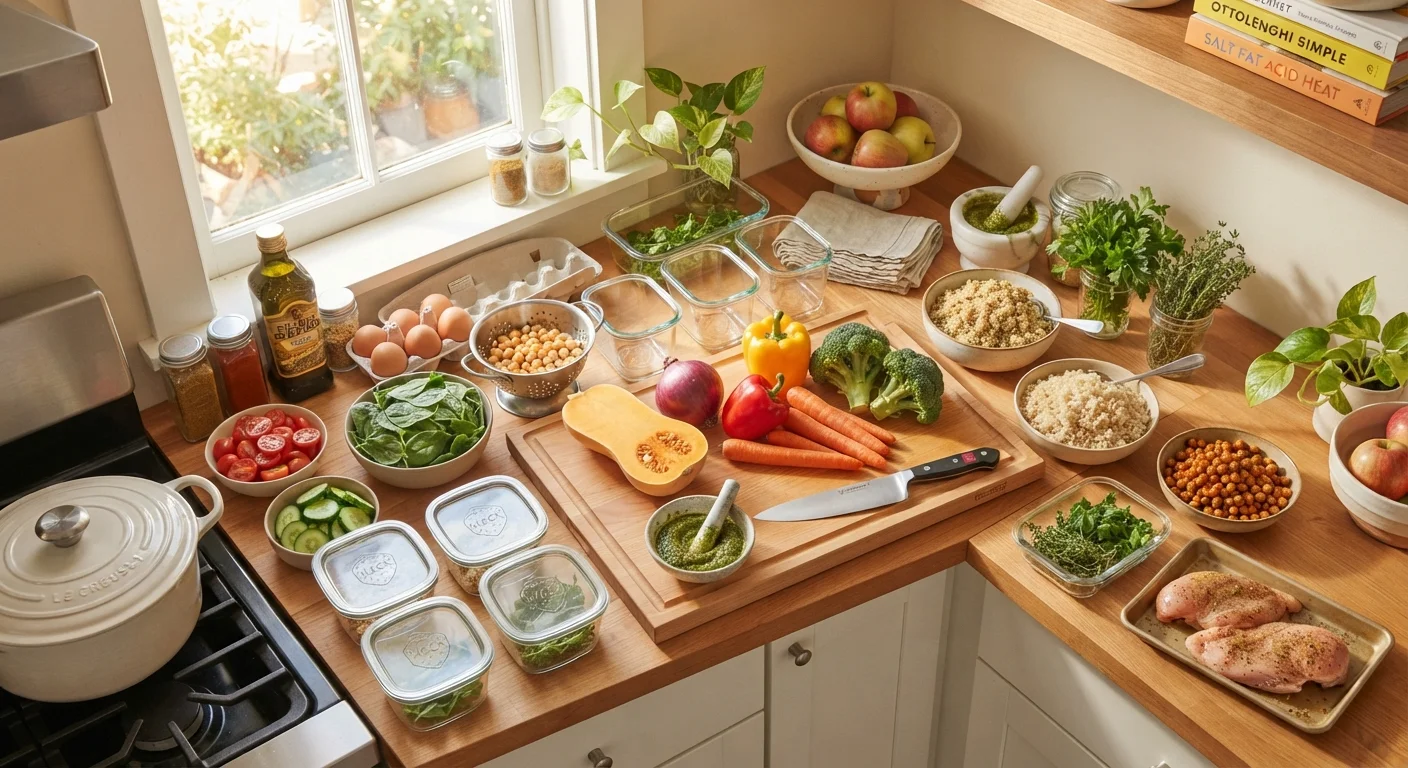
Why Saturday Morning Is the Right Window
Weeknight cooking pressure is real: research consistently links time scarcity to reliance on highly processed convenience foods, which tend to be higher in sodium and lower in fibre than home-cooked alternatives. A dedicated Saturday morning session — typically 90 to 150 minutes — breaks that cycle without demanding daily effort.
Morning works well for most families because the house is quieter before activities ramp up, groceries bought Saturday are fresher than any other time of the week, and the sense of accomplishment carries positive momentum into the rest of the weekend. The routine pairs naturally with other weekend planning habits; if you're also thinking about how to make the most of family weekend time, see our piece on active weekends versus scattered daily movement for complementary strategies.
Make Friday Night Your Planning Night
Spend 10–15 minutes on Friday reviewing your family's week ahead: school events, late work nights, sports practices. Matching your meal-prep choices to those specific pressure points means your prepped food actually gets used. Write a brief grocery list at the same time so Saturday morning shopping is fast and focused.
What You'll Need Before You Start
Effective meal prep doesn't require specialty equipment or advanced cooking skills — it requires the right basic tools and a clear plan. Review the prerequisites and tool list below before your first session to avoid mid-cook interruptions.
What you will need
Sheet pans (at least two)
Roast two trays of vegetables simultaneously at different oven racks to save time.
Large stockpot or saucepan
Cook a big batch of whole grains such as brown rice, farro, or quinoa.
Airtight glass or BPA-free plastic containers
Store individual staples safely in the refrigerator or freezer after cooking.
Instant-read food thermometer
Confirm cooked proteins reach safe internal temperatures recommended by the USDA.
Cutting board and sharp chef's knife
Efficiently chop vegetables and portion raw proteins before cooking.
Slow cooker or pressure cooker
Hands-off cooking of beans, legumes, or tougher protein cuts while you handle other tasks.
Food Safety Comes First
Cooked proteins and grains should be cooled to room temperature within two hours, then refrigerated promptly. The USDA advises storing cooked foods at or below 40°F and consuming refrigerated leftovers within three to four days. When in doubt about whether something is still safe to eat, discard it rather than risk foodborne illness.
If keeping grocery costs manageable is a priority, our guide to nutritious family eating on a tight budget offers a practical framework for choosing staples that deliver the most nutritional value per dollar spent.
Follow These Steps Each Saturday Morning
The seven steps below are designed to run in parallel — grain cooking while you prep vegetables, oven roasting while you cook the protein — so the total time stays under two and a half hours even for larger families. Work through them in order for your first few sessions until the rhythm becomes natural.
Plan Your Week's Meals the Night Before
Before Saturday arrives, spend 10–15 minutes identifying which dinners — and ideally lunches — your family needs that week. Look for overlapping ingredients across multiple meals: a batch of roasted chicken, for example, can serve as a dinner protein on Monday and fill tacos on Wednesday. This overlap is the core efficiency of batch cooking.
Write down three staples that will carry the most meals: typically one protein, one grain, and one or two vegetables. If you pack school lunches, check out our weekly school lunch readiness checklist to make sure your prepped ingredients cover midday needs too.
Set Up Your Workspace and Preheat the Oven
Clear counter space, set out your containers with lids nearby, and preheat your oven to 400°F — a reliable all-purpose roasting temperature for most vegetables and proteins. Lay out two sheet pans lined with parchment for easy cleanup.
Pull all ingredients from the refrigerator about 15 minutes before cooking proteins so they're not ice-cold going into the oven, which helps them cook more evenly. Review your plan one last time so you can work across multiple tasks simultaneously rather than sequentially.
Start Your Grain on the Stovetop
Whole grains take the longest, so start them first. Measure out enough brown rice, quinoa, or farro to cover several meals — a general guideline is about half a cup dry per person per meal, scaled to your family size. Follow package instructions for liquid ratios, bring to a boil, then reduce to a simmer and cover.
While the grain cooks, move immediately to vegetable prep so no time is lost waiting. Most whole grains take 25–45 minutes unattended, giving you a productive window.
Chop and Season Your Vegetables
Choose two or three vegetables that roast well and hold up over several days in the refrigerator: broccoli, cauliflower, sweet potatoes, bell peppers, zucchini, and carrots are all reliable. Cut them into similar-sized pieces so they cook evenly, spread them on sheet pans without overcrowding, and toss with a small amount of olive oil plus salt and pepper.
Roast at 400°F for 20–30 minutes depending on the vegetable's density, flipping once halfway through. Denser vegetables like sweet potato need the higher end of that range; softer ones like zucchini need less.
Cook Your Protein Batch
While vegetables roast, cook your chosen protein. Boneless chicken thighs or breasts, ground turkey, hard-boiled eggs, or a pot of dried beans are all highly versatile. Season simply — herbs, garlic, and a little salt — so the protein works across multiple different meal styles during the week.
Use an instant-read thermometer to verify safe internal temperatures: the USDA recommends 165°F for poultry and 160°F for ground meats. If using a slow cooker for beans or a tougher cut, this step can run entirely hands-off while you handle everything else.
Cool, Portion, and Store Everything Safely
Once cooked, allow each item to cool at room temperature for no longer than two hours before refrigerating — this is a firm food safety limit set by the USDA. Divide food into individual meal-sized containers rather than storing everything in one large batch. This makes weeknight assembly faster and reduces repeated opening of the same container, which can affect food quality.
Label each container with the contents and the date. Most cooked proteins and grains stay safe in the refrigerator for three to four days; roasted vegetables typically last four to five days. Anything you won't use by midweek can be frozen.
Do a Quick Fridge Audit and Plan Assembly
Before closing up the kitchen, take a two-minute look at what's now stored in your refrigerator. Mentally — or physically on a whiteboard — match each container to a specific meal: Monday's grain bowl uses the quinoa and roasted broccoli; Tuesday's wraps use the sliced chicken. This brief step ensures nothing gets forgotten at the back of the fridge.
Building this habit supports the kind of consistent nutrition practices described in our research-backed nutrition habits for busy households guide — small planning moments repeated weekly compound into lasting family health patterns.
Don't Over-Prep for Your Family's Habits
Prepping more food than your family will realistically eat leads to waste — financial and nutritional. Start with two or three staples your household already enjoys before expanding the routine. It's easier to scale up gradually than to feel defeated by a refrigerator full of uneaten food.
Once the routine feels comfortable, consider assigning age-appropriate tasks to children: rinsing vegetables, stirring grains, or labelling containers. Involving kids in food preparation is associated in research literature with greater willingness to eat a wider variety of foods — a meaningful long-term benefit worth building in from the start.
This article provides general nutrition and food-safety information for educational purposes only. It is not a substitute for advice from a registered dietitian, nutritionist, or other qualified health professional. Individual dietary needs vary; consult a qualified professional for guidance tailored to your family's specific health circumstances.
The content provided on our blog site traverses numerous categories, offering readers valuable and practical information. Readers can use the editorial team’s research and data to gain more insights into their topics of interest. However, they are requested not to treat the articles as conclusive. The website team cannot be held responsible for differences in data or inaccuracies found across other platforms. Please also note that the site might also miss out on various schemes and offers available that the readers may find more beneficial than the ones we cover.