

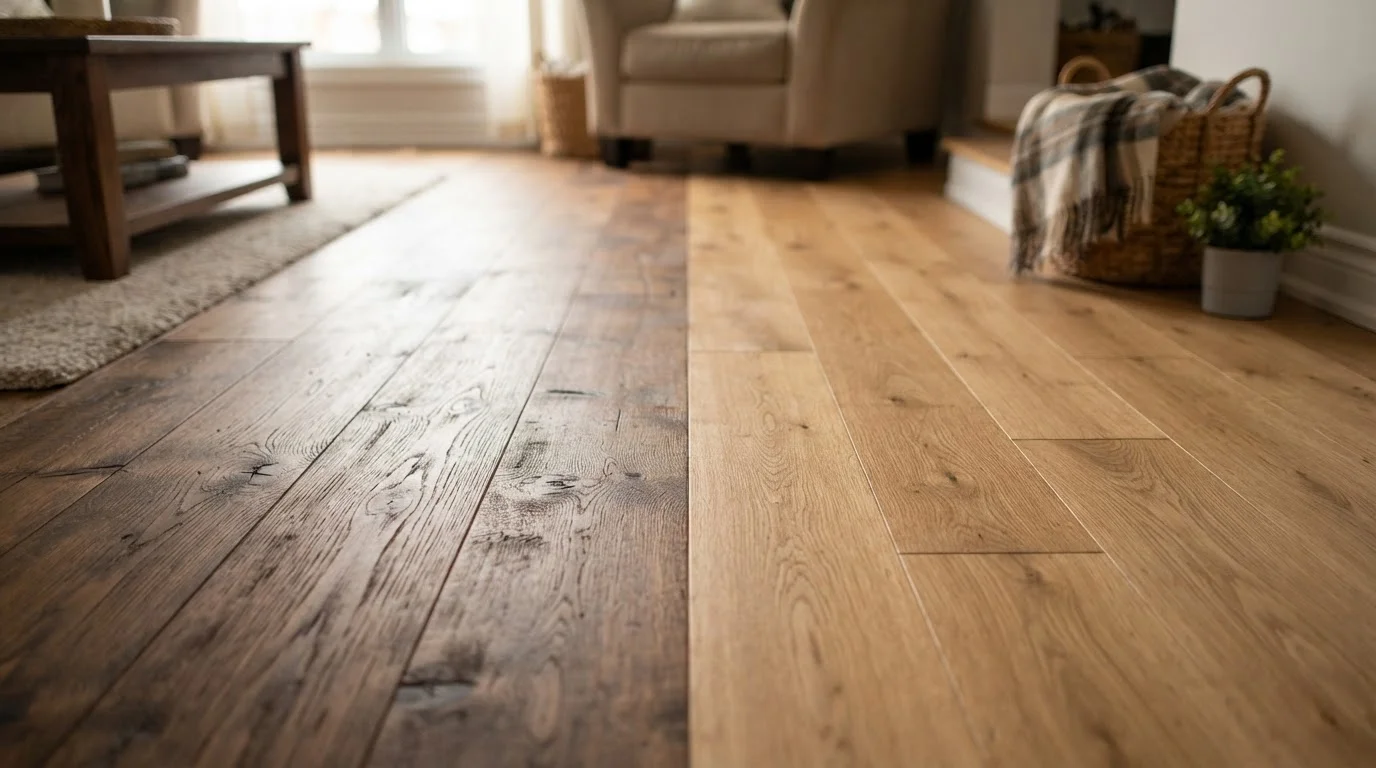
Option A
Engineered Hardwood
The moisture-tolerant, versatile modern option.
Best for: Families who want the look of real wood in basements, kitchens, or regions with humidity swings.
Option B
Solid Hardwood
The traditional, long-lasting investment floor.
Best for: Homeowners in stable climates who want a floor they can refinish multiple times over decades.
What Makes Them Different Under the Surface
Both engineered and solid hardwood feature a genuine wood surface — but their internal construction is where the real differences lie.
Solid hardwood is exactly what it sounds like: a single, thick piece of wood milled from one species, typically ¾ inch thick. That thickness is its greatest strength and its key limitation. It expands and contracts noticeably as humidity shifts, which is why installers recommend it only above grade (on wood subfloors in climate-controlled spaces).
Engineered hardwood is a layered product. A real hardwood veneer — anywhere from 1/12 to 1/6 inch thick — sits on top of multiple cross-directional plywood or hardwood core layers. Those alternating layers counter each other's natural movement, giving the product far more dimensional stability under moisture and temperature changes.
| Criterion | Engineered Hardwood | Solid Hardwood |
|---|---|---|
| Construction | Veneer over plywood core | Single solid wood plank |
| Moisture resistance | Good — dimensionally stable | Poor — expands and contracts |
| Suitable locations | Below, on, or above grade | Above grade only |
| Refinishing potential | 1–3 times (veneer-dependent) | 5–8 times over lifespan |
| Installation methods | Nail, glue, or float | Nail or staple down |
| Typical lifespan | 25–40 years | 50–100+ years |
| Appearance | Real wood surface layer | Real wood throughout |
Durability, Refinishing, and Lifespan
Surface hardness is determined by the wood species used for the top layer — and since both products can use the same species, their scratch and dent resistance is comparable for everyday family life. Oak, maple, and hickory are popular choices in both formats.
Where they diverge is refinishing potential. Solid hardwood's thick planks can typically withstand 5–8 rounds of sanding and refinishing over a century of use. Engineered hardwood's veneer layer limits refinishing to 1–3 times depending on thickness — thicker veneers allow more passes.
¾ inch
Standard solid hardwood plank thickness
This thickness is what allows solid hardwood to be sanded and refinished multiple times throughout its life.
1/12–1/6 in
Typical engineered veneer thickness range
Thicker veneers — closer to 1/6 inch — allow for more refinishing cycles before replacement is needed.
50–100+ yrs
Potential lifespan of solid hardwood
With proper installation in suitable conditions and periodic refinishing, solid hardwood can outlast several renovation cycles.
Neither type is indestructible. Standing water, pet accidents left unaddressed, and heavy furniture dragged without pads will damage both. The practical difference is how each responds to the environment it lives in, not just the abuse it takes.
Installation: What Your Subfloor and Room Dictate
Your existing subfloor and the room's location will often make the decision for you.
- Above concrete slabs: Engineered hardwood can be glued down or floated directly over concrete (with a moisture barrier). Solid hardwood should not be installed over concrete.
- Basements: Only engineered hardwood is recommended below grade. Even with precautions, solid hardwood faces too much ground moisture risk.
- Main and upper floors with wood subfloors: Both options work well. Solid hardwood is typically nailed or stapled down; engineered hardwood can be nailed, stapled, glued, or floated — giving it more flexibility.
Check Local Codes Before You Start
Some flooring installations — particularly those involving structural subfloor repairs or modifications — may require permits depending on your municipality. Floating floors generally don't, but if your project involves significant subfloor work, consult your local building department. A licensed flooring contractor can also advise on whether your subfloor meets the flatness and moisture requirements for either product type.
Regardless of which product you choose, always follow the manufacturer's acclimation instructions. Planks left in the room for the recommended period (often 3–5 days) adjust to local temperature and humidity before installation, reducing post-install movement.
Cost and Long-Term Considerations
Material costs vary widely within each category based on species, grade, and plank width — so broad generalizations can be misleading. As a general pattern, solid hardwood often carries a higher upfront material cost, while engineered hardwood may offer more accessible entry price points for similar aesthetics. Installation labor tends to be comparable, though floating engineered floors can sometimes be a DIY-friendly option for confident homeowners.
For long-term value, consider total lifespan vs. refinishing cycles. A thinner engineered veneer refinished once may need replacement in 20–25 years. A well-maintained solid floor can outlast the homeowner. However, in moisture-prone environments, a solid floor installed incorrectly can fail far sooner than engineered hardwood would.
Think about your household's realistic conditions — pets, kids, humidity levels, and which floor of the home you're updating — before letting cost alone guide the decision.
The content provided on our blog site traverses numerous categories, offering readers valuable and practical information. Readers can use the editorial team’s research and data to gain more insights into their topics of interest. However, they are requested not to treat the articles as conclusive. The website team cannot be held responsible for differences in data or inaccuracies found across other platforms. Please also note that the site might also miss out on various schemes and offers available that the readers may find more beneficial than the ones we cover.