

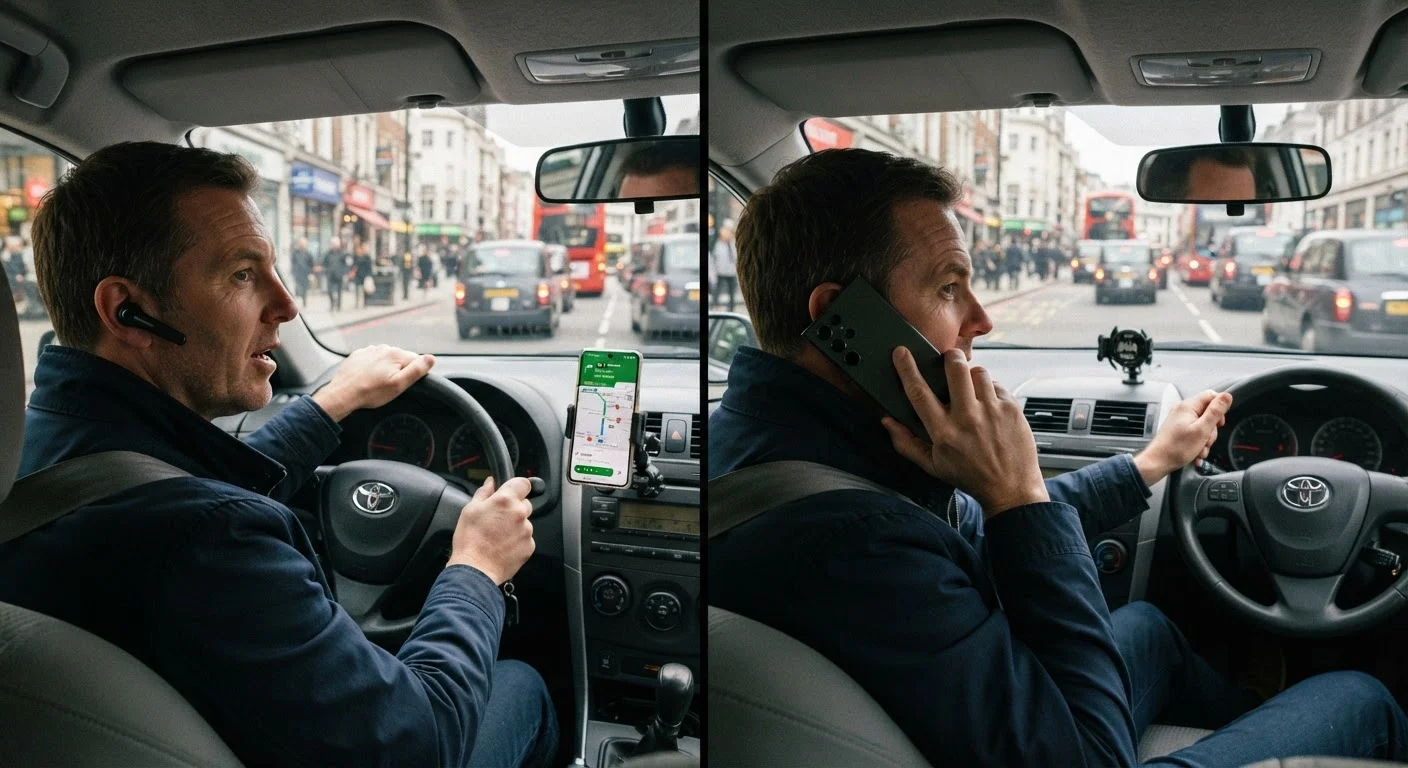
Option A
Handheld Phone Use
The visibly risky, widely banned driving behavior.
Best for: No legitimate driving scenario - handheld phone use while driving is illegal in most U.S. states and consistently linked to crash risk.
Option B
Hands-Free Phone Use
The legal alternative that still carries hidden cognitive risks.
Best for: Situations where a call is truly necessary and cannot wait - though delaying the call until parked remains the safest option.
Why Most Drivers Think Hands-Free Is Safe
The logic seems airtight: if your hands are on the wheel and your eyes are on the road, a phone call shouldn't be dangerous. Laws across most U.S. states reinforce this assumption by banning handheld use while allowing hands-free calls. But the science of distraction tells a more complicated story.
Researchers and traffic safety experts distinguish between three types of distraction: visual (eyes off the road), manual (hands off the wheel), and cognitive (mind off the task of driving). Handheld phone use triggers all three simultaneously. Hands-free calling eliminates the first two - but cognitive distraction remains fully active.
That mental load matters more than most people expect. Distraction while driving takes many forms, and cognitive distraction is often the most underestimated because nothing looks wrong from the outside.
| Criterion | Handheld Phone Use | Hands-Free Phone Use |
|---|---|---|
| Visual distraction | High - eyes move to screen | Low - eyes stay on road |
| Manual distraction | High - one hand off wheel | None - both hands free |
| Cognitive distraction | High - conversation diverts focus | Still significant - same mental load |
| Legal status (most U.S. states) | Banned while driving | Permitted while driving |
| Reaction time impact | Substantially slowed | Measurably slowed |
| Crash risk vs. no phone use | Markedly elevated | Elevated, though less so |
What the Research Actually Shows
Studies by the National Safety Council and academic traffic researchers have found that drivers engaged in hands-free conversations can miss seeing up to half of what's in their visual field - a phenomenon sometimes called inattention blindness. The eyes are open and pointed at the road, but the brain isn't fully processing what they see.
~50%
Visual field missed during phone calls
National Safety Council research suggests drivers on phone calls can fail to process roughly half of what they look at due to inattention blindness.
3-4x
Crash risk increase with handheld use
Multiple peer-reviewed studies estimate handheld phone use raises crash or near-crash risk three to four times compared to undistracted driving.
48 states
U.S. states banning handheld use
As of recent legislative tallies, the vast majority of U.S. states have enacted laws prohibiting handheld phone use while driving.
Reaction times during hands-free calls have been measured as comparable to those at the legal blood-alcohol limit in some studies, though findings vary across research designs and conditions. The consistent thread: any phone conversation diverts mental resources that driving genuinely needs.
Handheld use adds an additional layer. Physically holding a device requires manual dexterity and pulls visual attention toward the screen, especially for texting or navigating apps. That combination - cognitive plus visual plus manual - explains why handheld use is consistently associated with much higher crash odds in observational studies.
It's worth noting that these findings don't mean hands-free and handheld are equally dangerous. They're not. But hands-free is not the clean safety solution many drivers assume it to be. Several long-held driving beliefs turn out to be outdated or simply wrong - and the idea that hands-free is fully safe ranks among them.
Practical Habits That Actually Reduce Your Risk
Understanding the research is useful only if it changes behavior. Here are evidence-grounded habits families can adopt:
- Let calls go to voicemail when you're moving. Most calls can wait five or ten minutes.
- Pull into a parking lot or side street if a call is genuinely urgent. It takes less time than you think.
- Use do-not-disturb driving modes available on most smartphones. These auto-reply to texts and suppress incoming call notifications while you're in motion.
- Set expectations with frequent callers - family members, employers, and close contacts - so they understand you won't answer while driving.
- Avoid emotionally charged conversations behind the wheel even with hands-free. Stressful or intense discussions increase cognitive load significantly more than neutral ones.
None of this requires expensive equipment or major lifestyle changes. The most effective safety tool is simply deciding, before the trip starts, that the phone can wait.
This article provides general driver safety information for educational purposes. For guidance on your state's specific distracted driving laws, consult your state's department of motor vehicles or a qualified legal professional.
The content provided on our blog site traverses numerous categories, offering readers valuable and practical information. Readers can use the editorial team’s research and data to gain more insights into their topics of interest. However, they are requested not to treat the articles as conclusive. The website team cannot be held responsible for differences in data or inaccuracies found across other platforms. Please also note that the site might also miss out on various schemes and offers available that the readers may find more beneficial than the ones we cover.