

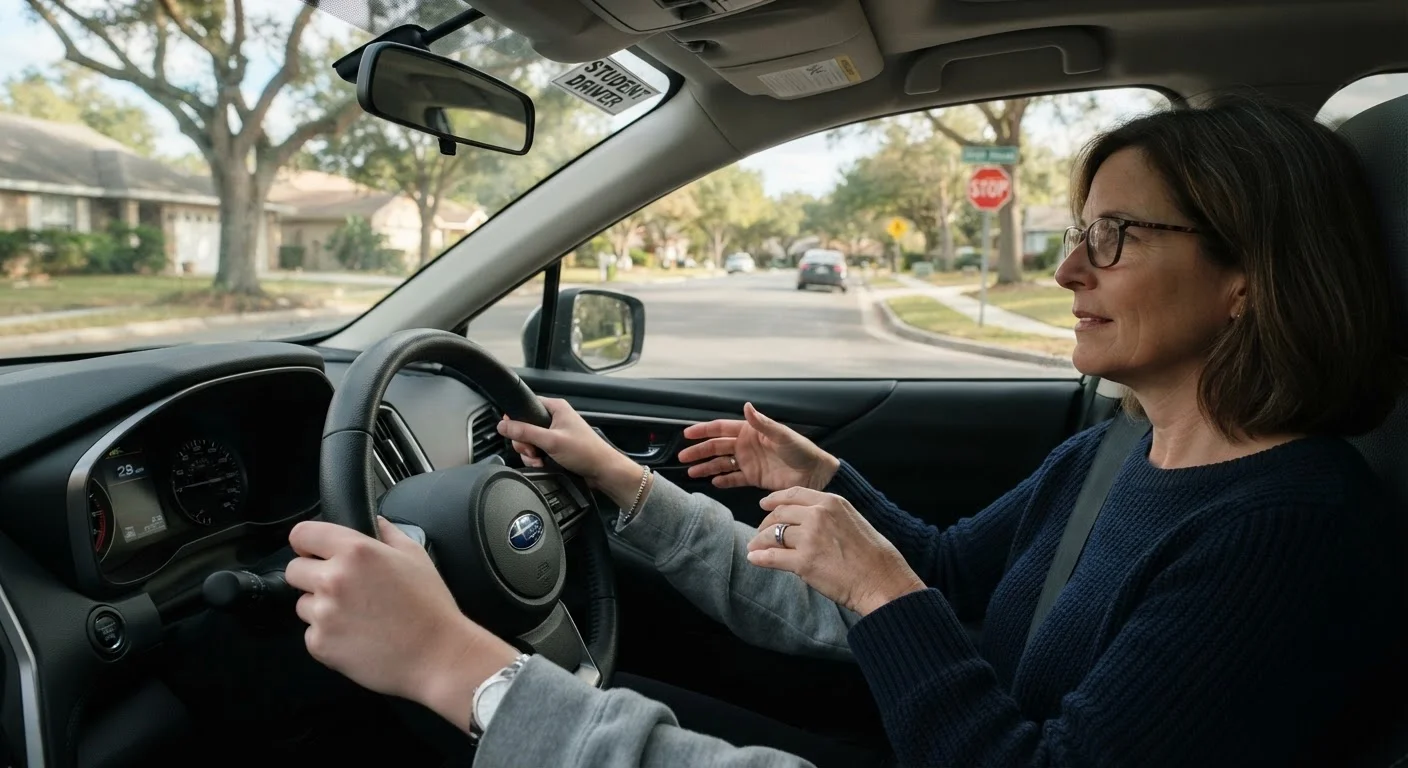
Why the First Year Is the Most Dangerous
Motor vehicle crashes are the leading cause of death among teenagers in the United States, according to the Centers for Disease Control and Prevention (CDC). What makes this window so dangerous isn't recklessness alone - it's inexperience. New drivers haven't yet built the automatic pattern recognition that lets experienced drivers anticipate hazards before they fully develop.
Research consistently shows crash risk drops sharply after the first 1,000 to 1,500 miles of independent driving, but that drop only happens when teens are accumulating quality experience - not just seat time. Understanding which specific conditions cause crashes lets families target their efforts where they matter most.
3x
Higher crash rate for 16-17-year-olds vs. adults
The CDC reports that per mile driven, teen drivers aged 16-17 are approximately three times more likely to be involved in a fatal crash than drivers 20 and older.
2x
Crash risk increase with one teen passenger
According to IIHS research, the presence of just one teen peer passenger roughly doubles crash risk for an unsupervised teen driver.
Evidence-Based Practices Every Family Should Follow
The following practices draw on data from the Insurance Institute for Highway Safety (IIHS), the CDC's teen driver research, and Graduated Driver Licensing (GDL) outcome studies. GDL programs are state licensing systems that phase in driving privileges - learner's permit, restricted license, then full license - to limit exposure to high-risk situations before skills are solid.
Extend the supervised driving period beyond your state's minimum requirement.
GDL minimums are a floor, not a target. Studies show teens who log more supervised hours - particularly in varied conditions like rain, highway driving, and night - enter independent driving with significantly more robust hazard-perception skills. Fifty hours of supervised practice is a common benchmark, but more is better.
Enforce a zero-passenger rule for at least the first three months of independent driving.
Peer passengers measurably increase crash risk for teen drivers. IIHS data shows crash risk roughly doubles with one teen passenger and continues to rise with each additional rider. The distraction isn't only about conversation - social dynamics shift attention from the road.
Ban nighttime driving until a clear milestone of daytime confidence is met.
Night driving demands higher visual processing skill and fatigue management. Fatal crash rates for teens spike sharply between 9 p.m. and midnight. Most state GDL laws restrict night driving, but those restrictions often lift before a teen has meaningful night-driving experience.
Treat phone use as a non-negotiable zero-tolerance issue, not a preference.
Handheld phone use while driving is illegal for teens in nearly every U.S. state, but hands-free interactions still cause significant cognitive distraction. Framing this as a firm family value - not just a legal requirement - increases compliance when parents aren't watching.
Choose a vehicle with robust passive and active safety features.
Electronic stability control (ESC), automatic emergency braking (AEB), and a strong crash-test rating all reduce injury severity when a crash does occur. New drivers have higher crash rates by definition - so the vehicle's safety margin is doing more work than it would for an experienced driver.
Create a written family driving agreement before the first solo trip.
Explicit, written agreements outperform verbal ones because they remove ambiguity about expectations and consequences. Research on teen driver programs shows that families with formal agreements report fewer violations of driving rules in the first year.
Quick Wins You Can Act on Today
Some of the most effective safety changes cost nothing and take minutes to set up. If you have a teen who recently got their license - or is about to - start here.
For a broader look at keeping your family vehicle in safe working order, see our plain-language car maintenance guide - it covers the foundational habits that apply to every driver in the household.
Having the Ongoing Conversation
Rules posted on a refrigerator rarely outlast the novelty of a new license. What does work, according to family communication research, is ongoing, low-pressure dialogue - check-ins that treat driving as a skill being developed together rather than a privilege being policed.
The 'No Questions Asked' Ride Rule
One of the most consistently recommended practices from teen-safety researchers is a standing family agreement: if a teen ever feels unsafe - whether because of their own driving, a peer's driving, or any other situation - they can call for a ride without fear of punishment or interrogation that night. This removes the incentive to make a dangerous choice to avoid getting in trouble. The conversation can happen the next day, calmly.
Ask your teen to narrate close calls or situations that felt uncertain, without judgment. That debrief habit builds metacognition - the ability to reflect on one's own decision-making - which is one of the strongest predictors of long-term safe driving. You might also review the family vehicle safety walkthrough together before any longer trip your teen takes independently.
“Young drivers don't crash because they take risks on purpose - they crash because they haven't yet learned to see the hazards that experienced drivers notice automatically. That perceptual skill only develops through structured, deliberate practice.”
— Dr. Allan Williams, Former Chief Scientist, Insurance Institute for Highway Safety
Finally, vehicle choice matters more than many families realize. Smaller, older vehicles with fewer active safety features give a new driver less margin for error. If cost is a factor - and it usually is - our guide on reducing car costs without sacrificing safety walks through where families can trim spending without removing safety net features.
The content provided on our blog site traverses numerous categories, offering readers valuable and practical information. Readers can use the editorial team’s research and data to gain more insights into their topics of interest. However, they are requested not to treat the articles as conclusive. The website team cannot be held responsible for differences in data or inaccuracies found across other platforms. Please also note that the site might also miss out on various schemes and offers available that the readers may find more beneficial than the ones we cover.