

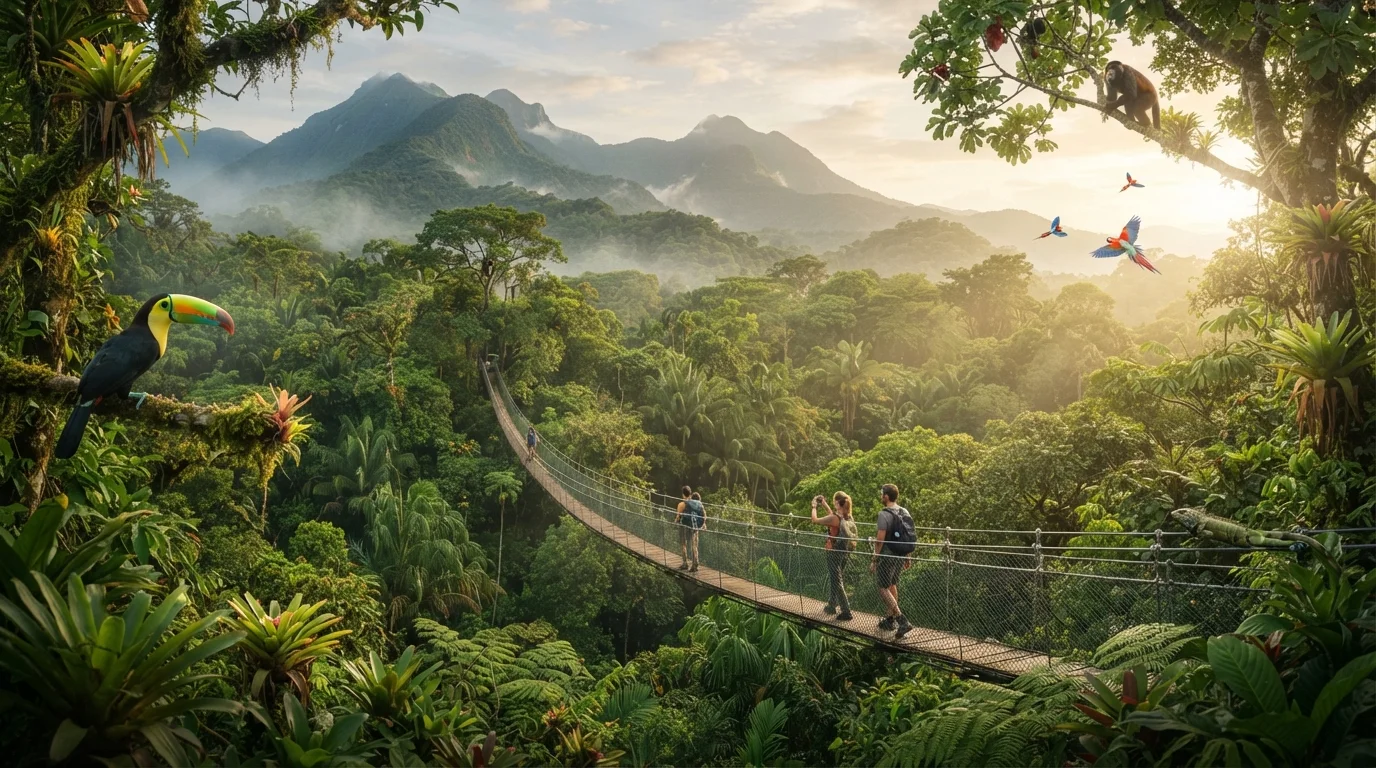
What Makes Costa Rica a Realistic Family Destination
Costa Rica is one of the most biologically diverse countries on Earth, and that's not marketing - roughly 5% of the world's species live within its borders, according to the Costa Rican Tourism Board. For families, that means a genuine shot at spotting sloths, toucans, howler monkeys, and sea turtles without the deep logistics of Africa or Southeast Asia.
That said, it's not a "plug and play" trip. Distances between regions are shorter on paper than on the road - mountain terrain, unpaved stretches, and river crossings can turn a 60-mile drive into a three-hour commitment. Planning around that reality is the difference between a smooth trip and an exhausted one. See our guide to itinerary pacing for specific strategies on building in buffer time.
| Country size | Approximately 19,730 square miles (smaller than West Virginia) (Costa Rican Tourism Board) |
| Percentage of land protected | ~26% in national parks or biological reserves (SINAC (National System of Conservation Areas), Costa Rica) |
| Primary language | Spanish (English widely spoken in tourist areas) |
| Currency | Costa Rican colón; USD widely accepted in tourist zones |
| Dry season (Pacific coast) | Generally December-April (Instituto Meteorológico Nacional, Costa Rica) |
| Number of species recorded | Over 500,000 species estimated, including ~900 bird species (Costa Rican Tourism Board / INBio estimates) |
Key Regions and What Families Find There
Costa Rica's regions each offer something different, and picking two or three focus areas is usually smarter than rushing across the country.
- Arenal Volcano area - Families often center on La Fortuna. The volcano provides a dramatic backdrop, hot springs are genuinely relaxing after hiking days, and the hanging bridges at Mistico Park let kids walk through cloud forest at canopy level.
- Monteverde Cloud Forest - Cooler, misty, and famous for resplendent quetzals and zip-lining. Note: the roads into Monteverde are rough; some families rent 4WD vehicles specifically for this leg.
- Manuel Antonio - A national park with white-sand beaches and accessible wildlife trails. Squirrel monkeys and white-faced capuchins frequently appear along well-maintained paths, making it one of the easiest wildlife encounters for younger children.
- Tortuguero - Accessible only by boat or small plane. Sea turtle nesting season (generally July-October for green turtles) draws families willing to take the extra step; guided night tours are a memorable experience but require advance booking and official permits.
- Guanacaste (Pacific North) - Drier climate, beach-resort infrastructure, and calmer surf in the dry season. Families who want wildlife plus beach relaxation often combine a short inland excursion with a Guanacaste base.
Cloud forest
A high-altitude tropical forest persistently shrouded in low cloud cover. Cloud forests are extraordinarily biodiverse and notably cooler and mistier than lowland rainforests - Monteverde is one of the most visited examples.
Canopy tour
A guided experience - typically zip-lining or suspension bridges - that takes visitors through the upper layers of a rainforest. Most commercial canopy tours in Costa Rica are designed with general-public participants in mind, though age and weight minimums vary by operator.
Pura vida
A Costa Rican phrase meaning literally "pure life." It functions as a greeting, a farewell, and a cultural attitude reflecting an easygoing, life-affirming outlook. Visitors encounter it constantly.
SINAC
Sistema Nacional de Áreas de Conservación - Costa Rica's national system of conservation areas. SINAC manages the country's national parks and biological reserves, including visitor access and wildlife protection rules.
Logistics, Safety, and What to Verify Before You Go
Costa Rica is generally considered one of the more stable and visitor-friendly countries in Central America, but families should verify current entry requirements, health advisories, and travel advisories through official government sources - the U.S. State Department and CDC both publish country-specific pages that are updated regularly. Do not rely on information from a single source or from this article for entry or health requirements, as conditions change.
Always Verify Entry and Health Requirements Officially
Entry requirements, vaccination recommendations, and travel advisories for Costa Rica can change. Before booking or departing, check the U.S. State Department's Costa Rica country page (travel.state.gov) and the CDC's traveler health notices. Your family physician or a travel medicine clinic can advise on vaccinations appropriate for the regions you plan to visit.
A few logistics worth knowing:
- Rental vehicles - A 4WD is recommended for many rural routes, not just Monteverde. Mandatory insurance requirements apply; verify what your personal auto policy and credit card actually cover before declining supplemental coverage.
- Water safety - Tap water is potable in most urban and tourist areas, but bottled water is advisable in remote rural zones. Confirm locally.
- Wildlife encounters - Animals in national parks are wild. Feeding wildlife is illegal and genuinely harmful to the animals. Maintain distances recommended by park rangers.
- Sun and heat - The Pacific lowlands can exceed 95°F. Kids dehydrate faster than adults; hats, sunscreen, and water are non-negotiable on outdoor days.
Costa Rica sits in an active volcanic and seismic zone. While most visits are uneventful, it's reasonable to familiarize yourself with basic earthquake protocols before arrival. For a broader look at how nature-focused family trips compare to city-based alternatives, see our city vs. nature trip comparison.
Budgeting Honestly for a Costa Rica Family Trip
Costa Rica is not an inexpensive destination by Central American standards. Families who arrive expecting budget pricing often find the costs for lodging, guided tours, and domestic transportation comparable to parts of Western Europe. That said, the trip can be calibrated. National park entrance fees are modest, and many wildlife sightings happen on self-guided walks rather than paid tours.
Guided tours are often worth the cost for families - a trained naturalist guide dramatically increases the likelihood of spotting camouflaged animals, and reputable guides provide important safety context on trails. Budgeting for at least two or three guided experiences while handling easier beach and park days independently is a reasonable middle approach.
Our complete family travel budget framework covers how to build a realistic spending plan across all trip components. For ideas on stretching value within destinations, the free and low-cost activities guide lists options at nature-based destinations specifically. Families considering how Costa Rica stacks up against closer alternatives may also find the Mexico coastal regions comparison a useful read.
~26%
Land area under formal conservation protection
Costa Rica protects roughly a quarter of its national territory through parks and reserves, one of the highest rates globally, according to SINAC.
~900
Bird species recorded in the country
Costa Rica's bird diversity exceeds that of the entire North American continent north of Mexico, making it a standout destination for families interested in wildlife observation.
2-3 hrs
Typical real driving time for a 60-mile mountain route
Mountain roads and unpaved stretches mean that map distances in Costa Rica are a poor proxy for travel time; logistics planning should account for this.
The content provided on our blog site traverses numerous categories, offering readers valuable and practical information. Readers can use the editorial team’s research and data to gain more insights into their topics of interest. However, they are requested not to treat the articles as conclusive. The website team cannot be held responsible for differences in data or inaccuracies found across other platforms. Please also note that the site might also miss out on various schemes and offers available that the readers may find more beneficial than the ones we cover.