

Why Packing Strategy Actually Matters
Most families treat car packing as an afterthought — you grab the bags, shove them in, and hope everything fits. But a chaotic trunk means digging for the sunscreen at the rest stop, realizing the snack bag is under three suitcases, and arriving at your destination already worn out. A little structure before you leave pays dividends the entire trip.
This is especially true for longer drives. As we cover in our complete family road trip planning guide, packing is one of the few parts of a road trip you have near-total control over — so it's worth doing deliberately.
Packing Light Pays Off at the Pump
Every extra 100 pounds of cargo can reduce fuel economy by roughly 1–2%, according to the U.S. Department of Energy. On a long road trip, that adds up. A tighter packing list isn't just less stressful — it can quietly trim your travel costs too. For more on keeping family travel affordable, explore our travel on a budget hub.
Before you focus purely on what to bring, make sure the car itself is ready. Our family vehicle safety walkthrough covers the mechanical checks — tires, fluids, lights — that should happen before packing day.
What You'll Need
What you will need
Cargo Net or Trunk Organizer
Prevents bags and loose items from shifting during turns and sudden stops.
Seatback Organizer
Keeps kids' snacks, tablets, activity books, and small items within easy reach without backseat chaos.
Soft-Sided Duffel Bags
Compress and conform to irregular trunk shapes far better than rigid hard-shell suitcases.
Roof Cargo Box or Hitch Carrier
Adds substantial storage capacity for bulkier items like strollers or camping gear when trunk space is tight.
Insulated Cooler
Keeps drinks and perishable snacks fresh without requiring stops for drinks or overpriced convenience store runs.
The Packing Steps
Don't Block Rear Visibility
Loading bags too high in the trunk or cargo area can obstruct the driver's rear sightlines, which is a genuine safety concern. Keep cargo below the top of the rear seat backs whenever possible, and rely on mirrors — not a craned neck — for reversing. For more on pre-trip safety prep, see our family vehicle safety walkthrough.
Build your packing list before you touch a single bag
Write down every category: clothing, toiletries, documents, medications, car entertainment, snacks, and gear specific to your destination (beach towels, hiking shoes, etc.). Then go through it ruthlessly. A good rule of thumb: if you can't picture a specific moment on this trip when you'll use it, leave it home.
Assigning each family member their own bag — and making them responsible for packing it — reduces both the load and the last-minute scrambles. Kids old enough to pack a backpack should pack their own carry-along bag for the cabin.
Stage everything outside the car before loading
Lay every bag, box, and item out in the driveway or garage before a single thing goes in the car. This lets you see the full picture, catch obvious duplicates, and think through the loading order strategically. It also surfaces the inevitable forgotten items — chargers, kids' medications, the cooler still in the basement — before you're already down the road.
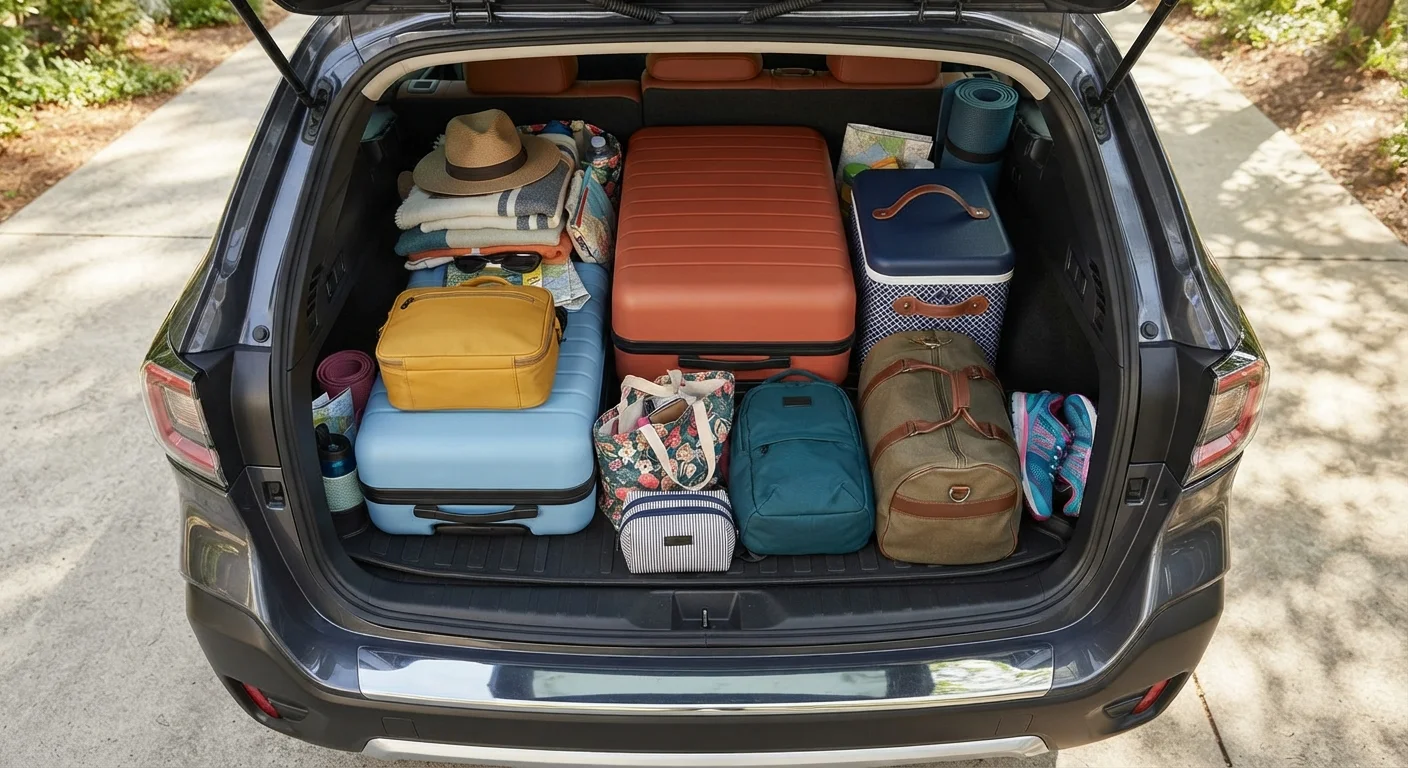
Load the trunk in order: heavy first, accessible last
Place the heaviest, most compact bags on the bottom and as far forward in the trunk as possible — this keeps the vehicle's center of gravity low and stable. Lighter bags, the cooler (if it's going in the trunk), and items you might need at a rest stop go on top. Anything you won't touch until you reach your destination can be buried deepest.
Use a cargo net or trunk organizer to keep bags from sliding into each other. Soft-sided duffel bags are much easier to Tetris into odd corners than rigid suitcases.
Set up the cabin for the long haul
Everything the kids will need during the drive — snacks, headphones, activity books, a tablet, a comfort item — should be in the cabin before you leave, not buried in the trunk. A seatback organizer on the back of each front seat is the simplest solution. Pack this bag last so it's the freshest in everyone's minds.
Keep a small trash bag clipped somewhere accessible. Without one, wrappers and juice boxes accumulate fast. For snack ideas that hold up well during long stretches, see our road trip snacking guide.
Do a final walk-around before backing out
Once everything is loaded, do a deliberate circuit of the vehicle. Check that the trunk is fully latched. Confirm nothing is resting on the roof. Verify that all passenger seatbelts — including child restraints — are properly buckled and adjusted. Glance at the tires for any obvious low pressure.
This is also the moment to run through the pre-departure readiness checklist if you use one. Two minutes here prevents the embarrassing (and sometimes costly) U-turn a mile from home.
Loose Items Become Projectiles in a Sudden Stop
Unsecured items in the cabin — water bottles, tablet cases, even a heavy tote bag — can become dangerous if you brake hard. Store anything heavy in the trunk, and use seatback organizers or the floor to keep smaller items contained. Never stack loose items on the rear dash or in the back window.
What to Leave Behind
Overpacking is almost universal among families hitting the road for the first time — or the tenth. Common offenders include full-size shampoo bottles (hotel sizes or refillable travel bottles work), multiple pairs of shoes beyond what will realistically be worn, bulky "just in case" gear that never gets used, and duplicate entertainment items.
A useful mental test: if the item isn't clothing, a document, a medication, or something specific to a planned activity, ask whether you could reasonably buy or borrow it at your destination if you truly needed it. If the answer is yes, it probably doesn't need to make the trip.
Families who struggle with overpacking often find that common road trip myths are partly to blame — the idea that you need to be prepared for every scenario tends to result in a trunk that won't close.
The content provided on our blog site traverses numerous categories, offering readers valuable and practical information. Readers can use the editorial team’s research and data to gain more insights into their topics of interest. However, they are requested not to treat the articles as conclusive. The website team cannot be held responsible for differences in data or inaccuracies found across other platforms. Please also note that the site might also miss out on various schemes and offers available that the readers may find more beneficial than the ones we cover.