

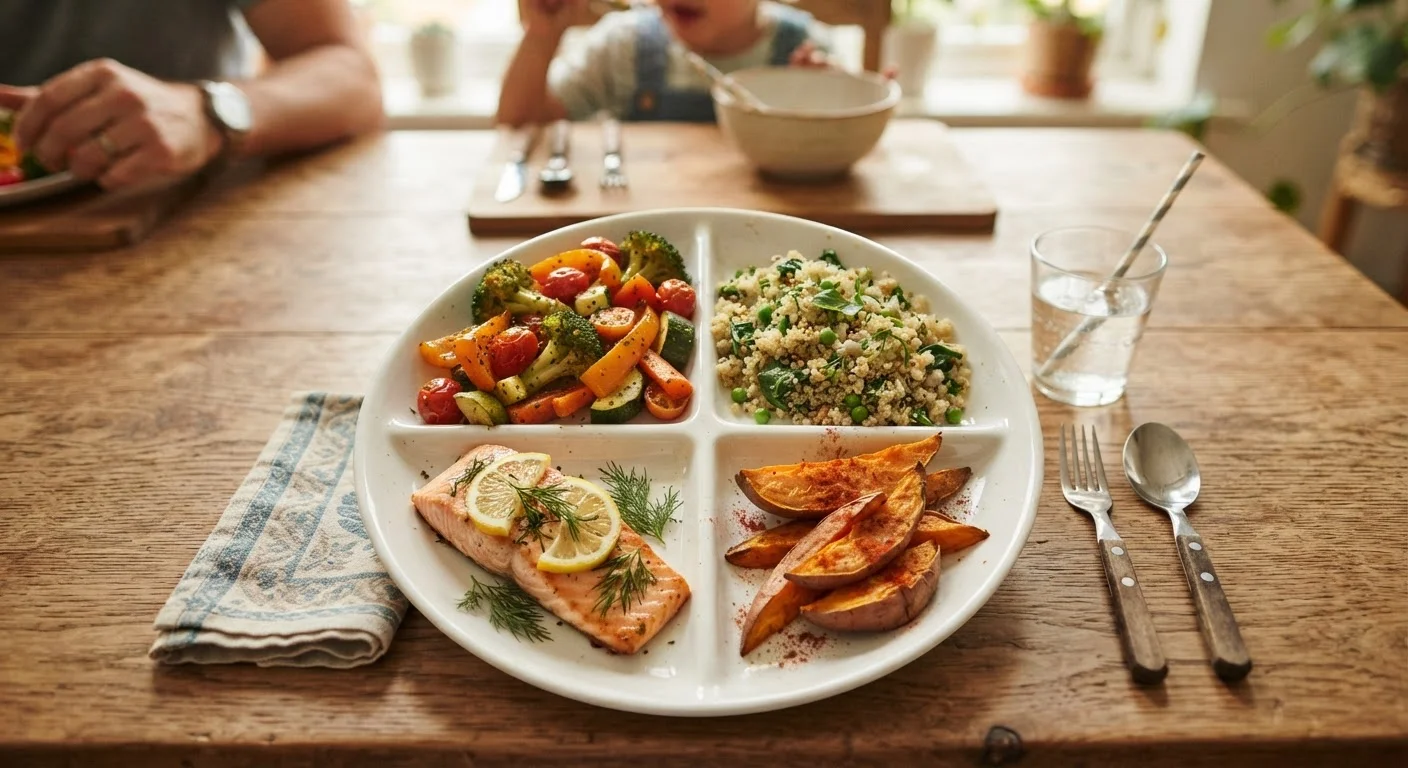
Why Visual Portioning Works for Families
Calorie counting can be useful in clinical settings, but for most families managing busy weeknight dinners, it introduces unnecessary complexity. Research published through institutions like the CDC and various dietetic associations supports the idea that consistent, moderate portion balance — rather than precise numeric targets — is a realistic and sustainable foundation for healthy eating.
The plate method is a visual framework that has been used by nutrition educators for decades. It requires no apps, no food scales, and no math. Instead, it uses the surface area of a standard dinner plate as a built-in measuring tool, making it accessible for the whole family, including children who are learning about food.
Pair this approach with nutrition habits that actually stick in busy households to build consistency around the table without adding to daily decision fatigue.
What you will need
Standard Dinner Plate
Acts as your visual portioning guide — the plate's surface area does the measuring for you.
Serving Spoons and Tongs
Help family members self-serve consistently without needing a kitchen scale.
Smaller Plates for Young Children
Age-appropriate plate sizes help right-size portions naturally for toddlers and young kids.
How to Build a Balanced Plate, Step by Step
Follow the steps below at your next family dinner. You'll only need a standard plate and the food you already planned to serve. The goal isn't perfection at every meal — it's building a reliable default that your family returns to most of the time.
Divide your plate into three visual zones
Picture your plate as a clock face. Draw an imaginary line down the middle, then divide the right half once more. You now have three sections: one large half and two smaller quarters. This is the foundation of the plate method, a visual tool widely used by nutrition educators to simplify meal balance.
- Left half: Reserved for non-starchy vegetables
- Upper right quarter: Reserved for a lean protein source
- Lower right quarter: Reserved for a whole grain or starchy vegetable
Fill the vegetable half first
Before anything else goes on the plate, fill the left half with non-starchy vegetables. Good examples include leafy greens, broccoli, carrots, cucumbers, peppers, zucchini, tomatoes, and green beans. Cooked or raw both count.
Filling this section first ensures vegetables don't get crowded out by more calorie-dense foods — a pattern that often leads to unbalanced plates without anyone noticing. For picky eaters, offering two vegetable options increases acceptance over time.
Add a protein source to one quarter
Fill one of the smaller quarters with a protein source. This can be animal-based (chicken, fish, eggs, lean beef) or plant-based (beans, lentils, tofu, edamame). Protein supports muscle maintenance, satiety, and steady energy throughout the evening.
A rough visual guide: a serving of cooked protein is roughly the size of the palm of your hand or a standard deck of cards. You don't need a scale — the quarter-plate visual keeps it proportional.
Use the remaining quarter for grains or starchy vegetables
The final quarter of the plate holds your grain or starchy vegetable. Options include brown rice, whole wheat pasta, quinoa, farro, sweet potato, corn, or whole grain bread. Whole grain versions offer more fiber and micronutrients than refined alternatives.
This portion naturally limits starch-heavy overfilling — a common pattern described in where families quietly lose the nutrition plot at mealtimes.
Add a small side of dairy or healthy fat
A glass of low-fat milk, a small portion of yogurt, a few slices of avocado, or a light drizzle of olive oil rounds out the meal with calcium, healthy fats, and additional micronutrients. These don't need to occupy plate space — they sit alongside the main plate.
For families watching grocery spending, feeding a family well on a tight budget offers practical approaches to keeping these wholesome additions affordable.
Scale portions appropriately by age and appetite
The plate method is a proportional guide, not a fixed serving size. A toddler's plate should be smaller than a teenager's; an active adolescent may need larger grain and protein portions than a less active adult. The ratios stay roughly the same — what changes is the overall volume.
For guidance on how nutritional needs shift across childhood, see family nutrition through every age. Letting children decide how much they eat from correctly portioned options supports healthy hunger recognition.
Make Portioning a Family Habit, Not a Rule
Instead of measuring food for each person, set out serving dishes and let family members plate their own food using the visual guide as a reference. This builds awareness gradually and keeps mealtimes relaxed. Children who learn to self-serve develop better hunger and fullness recognition over time.
Avoid Framing Food as 'Good' or 'Bad'
Language around food shapes how children think about eating. Labeling foods as forbidden or "bad" can contribute to stress around mealtimes and unhealthy relationships with food over time. Focus on abundance and variety rather than elimination, and model a calm, flexible attitude toward all foods.
This Is General Information, Not Medical Advice
The guidance in this article is intended as general nutrition education for healthy families. Individual dietary needs vary significantly based on age, health conditions, medications, and other factors. Always consult a registered dietitian or your family's healthcare provider before making significant changes to your diet, especially for children, pregnant individuals, or anyone managing a chronic condition.
Understanding how food labels support these choices is also useful. Our guide to reading packaged food labels explains how to quickly identify whole-grain products, sodium levels, and added sugars when grocery shopping.
This article provides general nutrition education for informational purposes only and is not a substitute for professional medical or dietary advice. Consult a qualified healthcare provider or registered dietitian for guidance specific to your family's health needs.
The content provided on our blog site traverses numerous categories, offering readers valuable and practical information. Readers can use the editorial team’s research and data to gain more insights into their topics of interest. However, they are requested not to treat the articles as conclusive. The website team cannot be held responsible for differences in data or inaccuracies found across other platforms. Please also note that the site might also miss out on various schemes and offers available that the readers may find more beneficial than the ones we cover.