

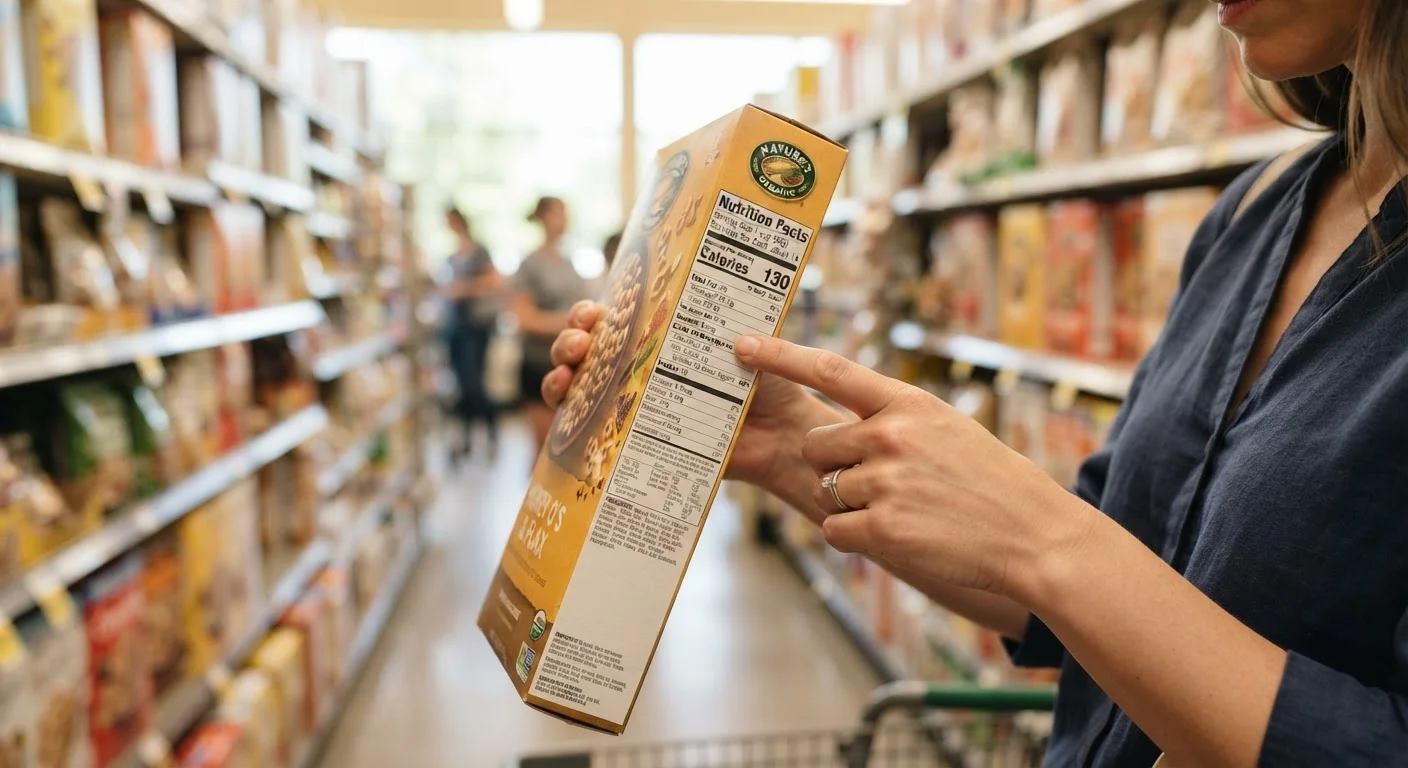
The Nutrition Facts Panel: What Each Line Actually Means
The Nutrition Facts panel is federally regulated and follows a standardized format set by the U.S. Food and Drug Administration (FDA). Here's how to read it from top to bottom without getting lost.
Serving size and servings per container appear first — and this is where many families get tripped up. All the numbers below apply to one serving, not the whole package. A bag of chips labeled "150 calories" may contain three servings, meaning the full bag is 450 calories. Always check this line before anything else.
Calories tells you the energy per serving. The FDA's general guidance is that 400 or more calories per serving is high for a single food item, while 100 or fewer is relatively low — though individual needs vary by age, size, and activity level.
% Daily Value (%DV) runs along the right side of the panel. These percentages are based on a 2,000-calorie daily diet. A quick rule of thumb: 5% DV or less is considered low for a nutrient; 20% DV or more is considered high. Use this to quickly identify whether a food is a notable source — or a heavy contributor — of any given nutrient.
Nutrients to limit include saturated fat, sodium, and added sugars. The FDA updated labels in 2016 to require added sugars as a separate line — distinct from naturally occurring sugars in fruit or dairy. Nutrients to prioritize include dietary fiber, vitamin D, calcium, iron, and potassium, which many Americans fall short on.
For families building consistent habits, see our guide to balanced plates without calorie counting for a complementary visual approach.
Ingredient Lists, Label Claims, and What They're Really Telling You
The ingredient list is ordered by weight — the first ingredient is present in the greatest amount. If sugar (or one of its many synonyms) appears in the first three ingredients of a snack marketed to children, that product is primarily a sweet rather than a nutritious food. Common sugar aliases include high-fructose corn syrup, cane juice, dextrose, maltose, and fruit concentrate.
Shorter ingredient lists generally indicate less processing, but length alone isn't a perfect guide. Some minimally processed foods have several legitimate ingredients; some short lists still include concerning additives. The ingredient list works best as a tool for spotting specific items you're monitoring — such as common allergens or artificial dyes.
% Daily Value (%DV)
A percentage shown on the Nutrition Facts panel indicating how much a nutrient in one serving contributes to a typical 2,000-calorie daily diet. It helps you quickly gauge whether a food is high or low in a particular nutrient.
Added sugars
Sugars and syrups added to a food during processing or preparation, distinct from naturally occurring sugars in fruit or milk. The FDA requires added sugars to appear as a separate line on the Nutrition Facts panel.
Saturated fat
A type of fat found primarily in animal products and some tropical oils that is solid at room temperature. Health authorities recommend limiting saturated fat intake as part of an overall balanced diet.
Whole grain
A grain that contains all three parts of the kernel — bran, germ, and endosperm — and therefore retains more fiber, vitamins, and minerals than refined grain. Look for whole grain flour listed first in the ingredient list.
Dietary fiber
The indigestible portion of plant foods that supports digestive health and helps maintain steady blood sugar levels. Many Americans consume less fiber than recommended amounts, making it a nutrient worth seeking on labels.
Nutrient content claim
A marketing phrase on a food package — such as 'low fat' or 'high fiber' — that describes the level of a nutrient in the product. The FDA defines and regulates specific claims, but some terms like 'natural' remain loosely defined.
Front-of-package claims are marketing language, not medical endorsements. The FDA regulates certain terms, but others are loosely defined or entirely unregulated:
- "Natural" — has no formal FDA definition for most foods. It does not mean organic, minimally processed, or free of additives.
- "Made with whole grain" — the product contains some whole grain. Check the ingredient list to see whether whole grain flour is the first flour listed.
- "Low sodium" — legally defined as 140 mg or less per serving. "Reduced sodium" means at least 25% less sodium than the original product, not necessarily a low amount.
- "Multigrain" — simply means more than one type of grain is present. It says nothing about whether those grains are whole or refined.
- "Organic" — regulated by the USDA. Products labeled "100% Organic" or "Organic" must meet specific standards; "Made with Organic " means at least 70% of ingredients qualify.
When evaluating packaged foods for school lunches, our weekly lunch readiness checklist can help you apply these label skills to real weekly planning. And if you're comparing store brands to name brands, what labeling law actually reveals about ingredient differences is worth a read.
This article is for general informational and educational purposes only. It is not a substitute for advice from a registered dietitian, physician, or other qualified health professional. If you have questions about your family's specific dietary needs or health conditions, please consult a qualified healthcare provider.
The content provided on our blog site traverses numerous categories, offering readers valuable and practical information. Readers can use the editorial team’s research and data to gain more insights into their topics of interest. However, they are requested not to treat the articles as conclusive. The website team cannot be held responsible for differences in data or inaccuracies found across other platforms. Please also note that the site might also miss out on various schemes and offers available that the readers may find more beneficial than the ones we cover.