

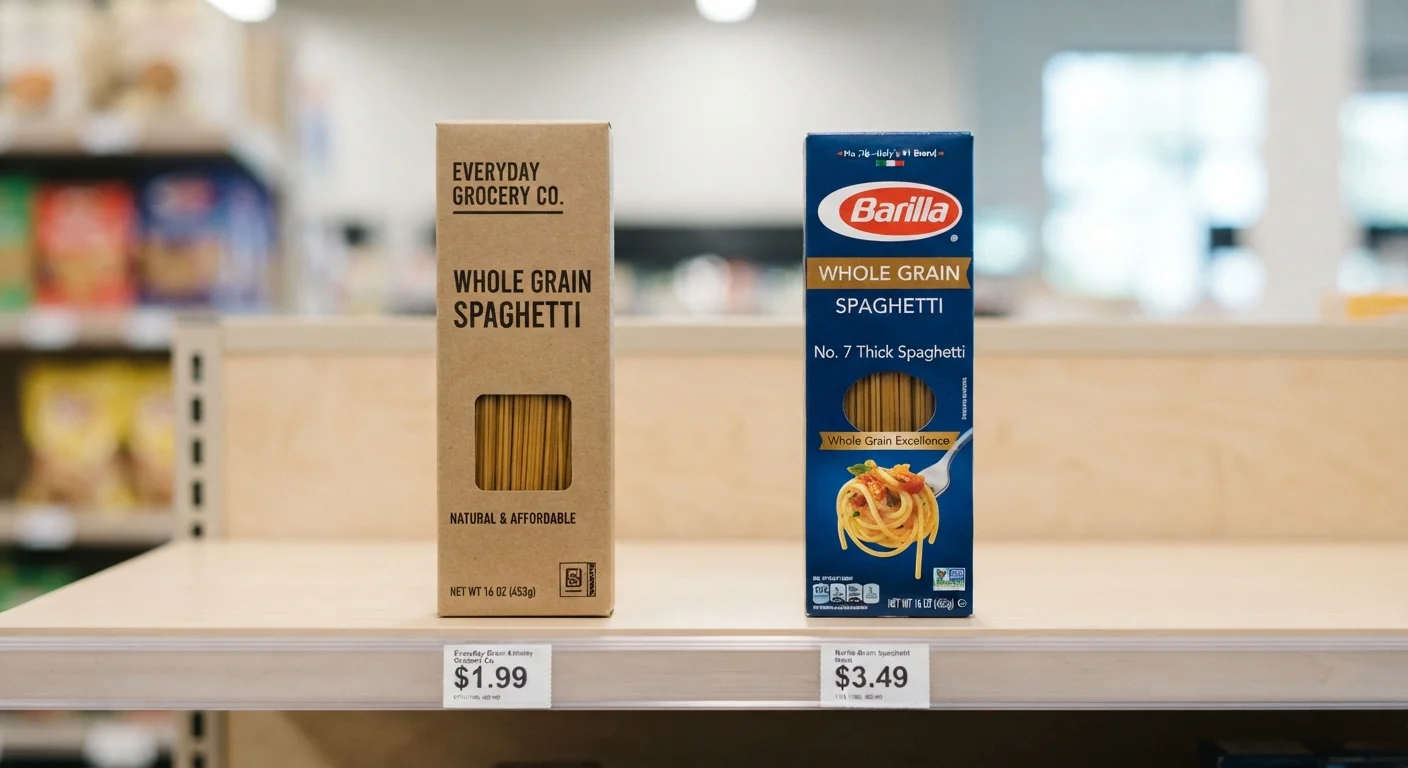
Option A
Name Brand
The familiar, heavily marketed option.
Best for: Shoppers who prioritize brand consistency, specific formulations, or products where independent testing shows a meaningful quality gap.
Option B
Store Brand
The retailer-controlled, lower-priced alternative.
Best for: Budget-conscious families who want comparable quality in categories where ingredient lists and testing confirm little difference.
The Shared-Manufacturer Secret the Label Won't Confirm
Here's something the packaging industry has no obligation to advertise: a significant portion of store-brand products are manufactured by the same companies that produce name-brand goods. The retailer contracts with a manufacturer, adjusts the label, and sets a lower price point. The product itself may be chemically identical to what's sitting one shelf over at twice the cost.
This practice — called contract manufacturing or co-packing — is legal, common, and almost entirely invisible to shoppers. U.S. food labeling law, overseen by the FDA and USDA, requires accurate ingredient and nutrition information but does not require brands to disclose who actually made the product. So the packaging tells you what's in the box, not who filled it.
That gap between disclosure and reality is where smart shopping begins. Rather than guessing, you can do something concrete: read the ingredient list on both products side by side. If the first five ingredients match in the same order with the same quantities implied, you're looking at functionally the same product. This technique works in the cereal aisle, the cleaning products aisle, and the pharmacy section alike. See our what the research actually shows about quality for a deeper look at how consumer studies approach this question.
Where the Differences Are Real — and Where They're Marketing
Not every category is equal. Independent testing organizations — including Consumer Reports, which has evaluated store versus name brands for decades — repeatedly find that in commoditized categories like canned vegetables, cooking oils, bleach-based cleaners, and basic OTC pain relievers, store brands perform on par with or identically to name brands. The price gap in these categories is largely attributable to advertising spend, packaging design, and brand equity rather than ingredient or manufacturing differences.
Where genuine differences tend to emerge:
- Processed foods with proprietary recipes — Flavor formulations for snack foods or condiments are often trade secrets. The store brand may taste noticeably different even when the core ingredients overlap.
- Infant formula — While FDA regulates minimum nutritional standards for all infant formula, formulations vary, and any switch should involve a pediatrician's guidance.
- Specialty dietary products — Gluten-free, allergen-controlled, or therapeutic foods may have tighter formulation requirements where slight ingredient differences matter more.
- Prescription-equivalent OTC drugs — Federal law requires the same active ingredient, strength, and dosage form as the name-brand equivalent. The inactive ingredients (binders, fillers) can differ, which occasionally matters for people with specific sensitivities.
| Criterion | Name Brand | Store Brand |
|---|---|---|
| Average price premium | Typically 20–30% higher | Lower baseline price |
| Ingredient disclosure | Required by law; same rules apply | Required by law; same rules apply |
| Manufacturer transparency | Not required to disclose | Not required to disclose |
| OTC drug active ingredients | Sets the reference standard | FDA-required to match exactly |
| Advertising investment | High — reflected in price | Low — savings passed to shopper |
| Flavor/texture consistency | Proprietary; highly controlled | May differ even if ingredients overlap |
| Independent testing performance | Varies by category | Frequently comparable in commodities |
| Infant formula safety | FDA-regulated minimum standards | FDA-regulated; consult pediatrician before switching |
Understanding these distinctions lets you make category-specific decisions rather than a blanket rule. For a practical primer on reading what nutrition panels and ingredient lists are actually communicating, see Packaged Food Labels Decoded.
The Retail Psychology Behind the Price Gap
Retailers design store-brand packaging to communicate quality while staying visually distinct from name brands — a deliberate positioning move. The color palette, font choices, and label language all signal trustworthiness while keeping cost expectations lower. This isn't accidental; it's a studied response to decades of consumer research on shelf perception.
Name brands, meanwhile, invest heavily in what marketers call brand salience — the instinctive recognition that makes you reach for a familiar product without thinking. That recognition has real value for companies, but it's paid for by you at checkout. Industry estimates have consistently placed the average store-brand price advantage somewhere between 20% and 30% across grocery categories, though this varies considerably by product type and retailer.
~25%
Typical store-brand price discount vs. name brand
Industry analyses of grocery scanner data consistently find store brands priced roughly 20–30% below comparable name-brand products across major categories.
1 in 5
Grocery dollars spent on store brands
Private-label products have captured a substantial and growing share of U.S. grocery spending, according to trade industry tracking data from the Private Label Manufacturers Association.
80%+
Categories where Consumer Reports found store brands comparable
Consumer Reports has historically found that in the majority of tested food and household categories, store brands scored similarly to their name-brand counterparts on quality measures.
The tactics used to maintain name-brand loyalty are worth understanding. Scarcity cues, loyalty rewards tied to specific brands, and end-cap placement are all tools that nudge shoppers toward higher-margin products. Our overview of retail tricks families encounter most often explains the mechanics behind these strategies without alarm.
A practical counter-move: combine your ingredient-list comparison with a unit price check. The unit price — cost per ounce, per count, or per serving — cuts through package size manipulation. When store brand ingredients match and the unit price is lower, the case for switching is straightforward. Unit pricing decoded explains exactly how to read that shelf tag most shoppers scroll past.
A Note on OTC Medications and Inactive Ingredients
Federal law mandates that store-brand over-the-counter drugs contain the same active ingredient at the same strength as the name-brand version. However, inactive ingredients — binders, dyes, and fillers — can differ between products. For most people this makes no practical difference. If you or a family member has known allergies or sensitivities to specific additives, it's worth reviewing the full inactive ingredient list before switching. When in doubt, a pharmacist can help you compare.
The content provided on our blog site traverses numerous categories, offering readers valuable and practical information. Readers can use the editorial team’s research and data to gain more insights into their topics of interest. However, they are requested not to treat the articles as conclusive. The website team cannot be held responsible for differences in data or inaccuracies found across other platforms. Please also note that the site might also miss out on various schemes and offers available that the readers may find more beneficial than the ones we cover.