

Why These Tactics Work — and Why Awareness Matters
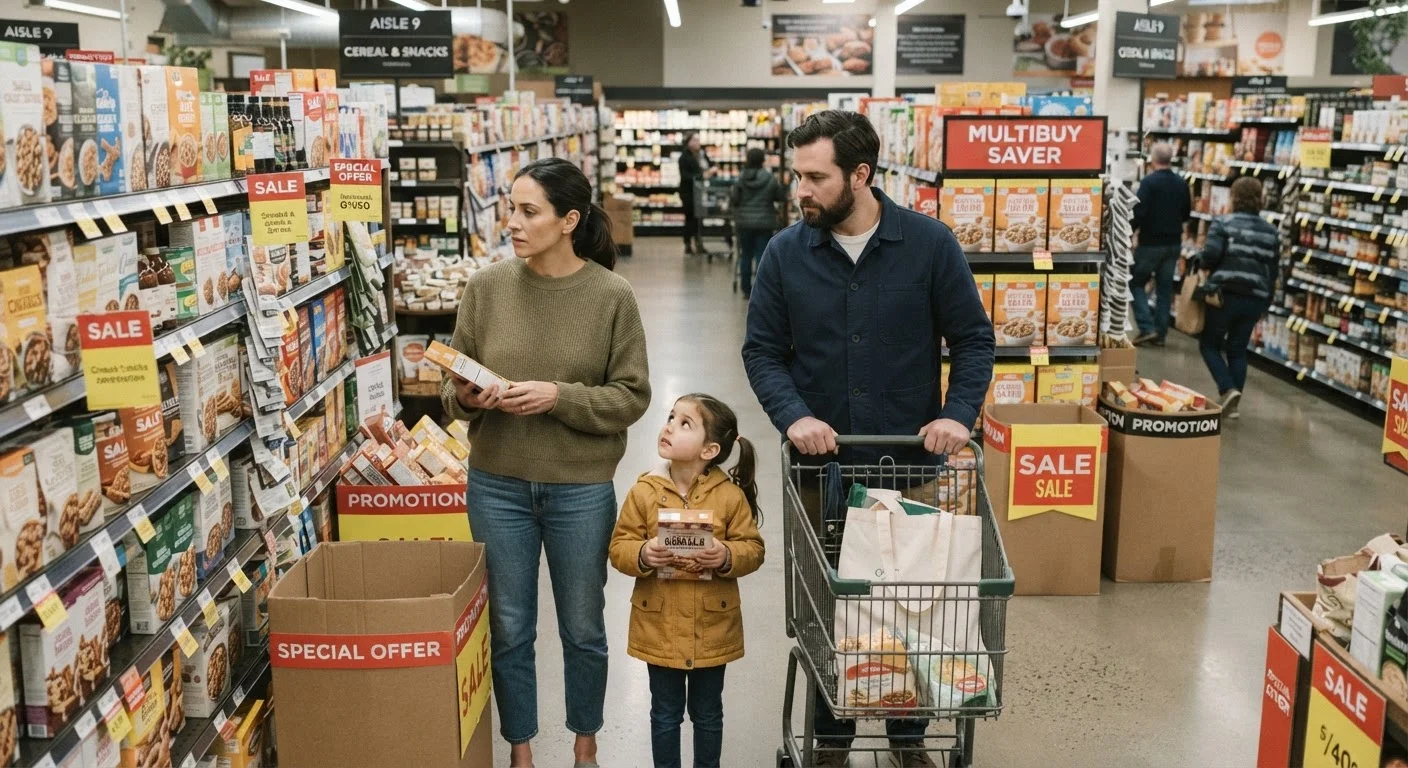
Retail environments are engineered spaces. Lighting, shelf placement, signage, and pricing formats are all calibrated — often with input from behavioral research — to encourage unplanned purchases and higher spending per visit. Most of these tactics are perfectly legal, but that doesn't mean families have to be passive about them.
The goal here isn't to make grocery runs feel adversarial. It's to give you a plain-language explanation of what's actually happening when a display or price format catches your eye — so that you can make the decision you actually intended to make. If you've noticed your grocery cart drifting over budget on a regular basis, common grocery overspending patterns are worth understanding too. And for a broader look at how store design itself shapes behavior, store layout strategies explain the physical framework these tactics operate within.
Anchor Pricing (The Inflated 'Original' Price)
When a tag shows an item marked down from $49.99 to $29.99, the $49.99 figure is doing most of the persuasive work. This is called anchor pricing — the higher number establishes a reference point that makes the sale price feel like a substantial win, even if the item was rarely or never sold at the anchor price. Consumer researchers have documented this effect extensively: people tend to judge value relative to an initial number, not on its own terms.
The counter-move is straightforward: ask whether you would consider this item worth buying at the current price if there were no 'was' figure on the label. If the answer is no, the anchor is doing its job on you.
Ask if you'd buy it at the sale price with no 'original' price shown — that's the real test.
Artificial Scarcity and Urgency Cues
'Only 3 left in stock.' 'Today only.' These messages activate loss aversion — a well-documented tendency for people to respond more strongly to the prospect of missing out than to the prospect of gaining something. Online retailers in particular surface low-stock indicators that may reflect warehouse quantities across multiple regions, not genuine local scarcity at all.
The practical response: if you weren't planning to buy the item before you saw the scarcity cue, treat the message as a flag rather than a fact. Genuine time pressure is real sometimes, but it's far less common than the frequency of these prompts suggests.
Scarcity cues trigger loss aversion — check whether urgency existed before the sign told you it did.
Bundle Pricing That Obscures Individual Cost
Bundles can be genuine value — but they can also be a way to move slower-selling items alongside popular ones. A common version: buy two, get one free on a product you'd normally buy one of. The math can still favor you, but it's worth doing. Take the bundle price, divide by the number of units, and compare that to the per-unit price of buying individually (or buying a different size or brand).
The store brand versus name brand comparison is often relevant here — a bundled name-brand item may still cost more per unit than an unbundled store-brand alternative.
Always divide a bundle's total price by unit count before deciding if it's actually cheaper.
Shrinkflation — Smaller Package, Same Price
Shrinkflation refers to a product being reduced in quantity — fewer ounces, fewer sheets, fewer servings — while the package size, shape, and price stay roughly the same. It's difficult to notice without a point of comparison, which is exactly why it persists. The package looks identical; only the net weight line on the back (or the unit price tag on the shelf) tells the real story.
Shelf unit-price labels — typically shown as cost per ounce, per count, or per fluid ounce — are your most reliable tool here. Comparing unit prices across sizes and brands takes about ten seconds and neutralizes this tactic entirely.
Unit price labels on shelves expose shrinkflation instantly — make them your default comparison tool.
Checkout-Zone Placement
The items displayed near checkout lines — small snacks, single-use batteries, travel-size products, seasonal novelties — are placed there intentionally. Retailers pay significant attention to this real estate because purchase resistance is lower when shoppers are already mentally committed to buying and are waiting with nothing else to do. These items are also typically priced at a premium relative to the same products found elsewhere in the store.
Having a pre-set rule — nothing goes in the cart in the checkout zone unless it was already on the list — is a simple and surprisingly effective habit. It removes the in-the-moment decision entirely.
A checkout-zone rule — list items only — removes the decision before the temptation appears.
Markdown Cycles Designed to Feel Timely
Sales are not random events. Most retailers follow predictable markdown cycles tied to inventory turnover, seasonal transition, and promotional calendars. The implication is that many 'sale' events are not exceptional opportunities — they're scheduled. Understanding when a category typically goes on markdown can shift your purchasing timeline and remove the urgency framing. How retailers decide what goes on sale explains the underlying logic retailers use when setting discount timing.
Most sales are scheduled, not spontaneous — knowing markdown cycles removes manufactured urgency.
Turning Awareness Into a Shopping Habit
Recognizing these tactics in the moment is a learnable skill, and it gets easier with repetition. A short mental checklist before checkout — did anything go in the cart because of a sign rather than a genuine need? — can quietly reduce impulse spending over time. Shopping with a list, comparing unit prices rather than package prices, and giving yourself a 24-hour window on non-essential purchases are low-effort habits with meaningful impact. For a fuller set of practical approaches, smarter consumer habits for overwhelmed shoppers covers the mechanics in detail.
If you have children along, the store is also one of the most natural places to build media literacy. Teaching kids to recognize marketing hype in context — rather than through lectures — tends to stick. And before any larger purchase, it's worth checking the retailer's return policy before you need it.
One Rule Before Every Shopping Trip
Write your list before you leave home and treat it as a closed document — not a starting point. Research on shopping behavior consistently finds that unplanned purchases increase significantly when shoppers enter without a list. It doesn't have to be exhaustive; even a rough list reduces drift. If something isn't on it and it's not a genuine household emergency, give yourself until the next trip to decide.
The content provided on our blog site traverses numerous categories, offering readers valuable and practical information. Readers can use the editorial team’s research and data to gain more insights into their topics of interest. However, they are requested not to treat the articles as conclusive. The website team cannot be held responsible for differences in data or inaccuracies found across other platforms. Please also note that the site might also miss out on various schemes and offers available that the readers may find more beneficial than the ones we cover.