

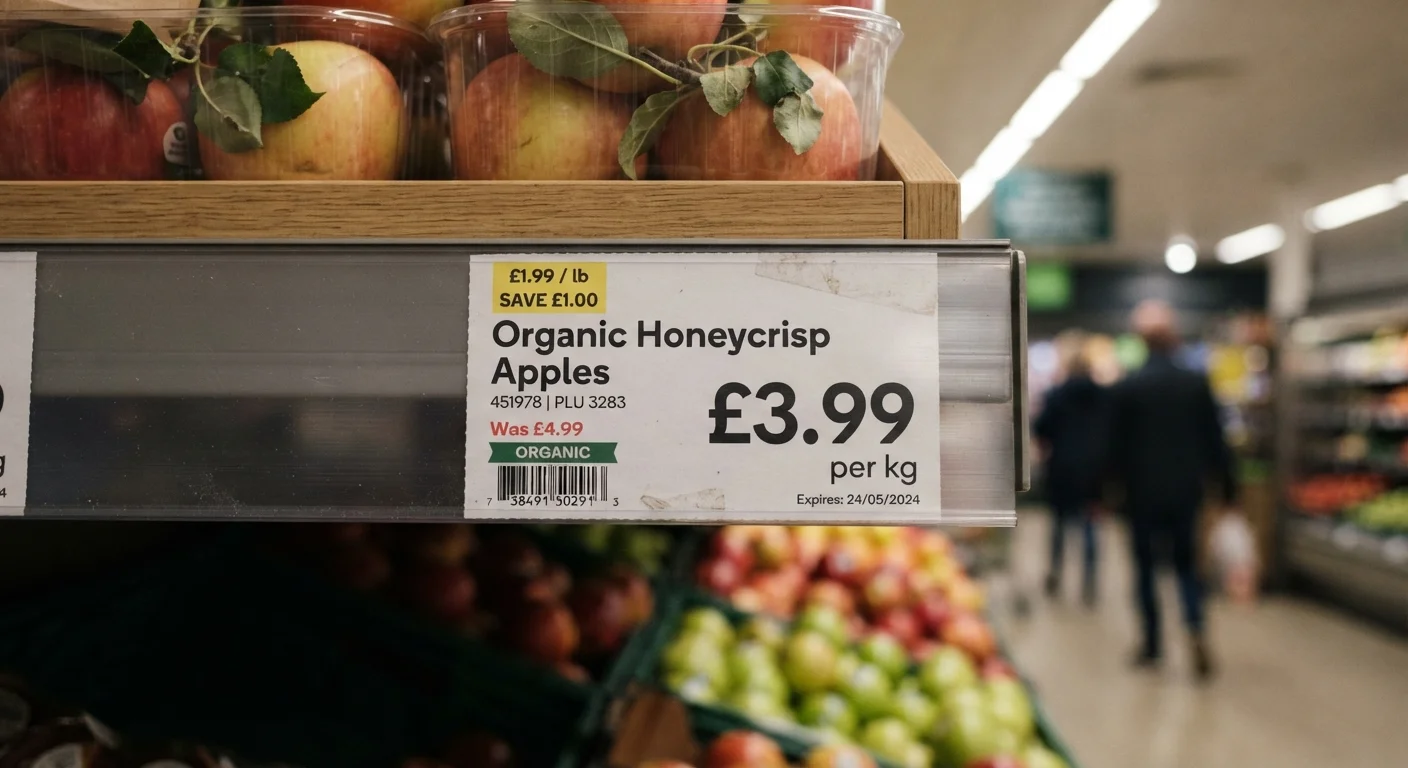
The Number Most Shoppers Walk Past
Every grocery shelf tag carries at least two prices. The large number — the one marketers designed you to notice — is the package price. The small number, often tucked into a corner in modest type, is the unit price. Most shoppers glance at the big number and move on. That habit, repeated across dozens of items per shopping trip, can quietly inflate a grocery bill without anyone noticing.
Unit pricing exists precisely because package sizes are not standardized. A "family size" box of cereal at one brand holds a different amount than a "family size" box from another. Without a common denominator, comparing them is guesswork. The unit price converts everything to the same scale — cost per ounce, per sheet, per count, per fluid ounce — so you're always comparing apples to apples.
Understanding this label doesn't require math skills or a spreadsheet. It just requires knowing where to look and what to do with what you find. That's what this article covers.
~35
U.S. states with unit pricing requirements
According to the National Conference of State Legislatures, the majority of U.S. states have some form of unit pricing law for grocery retailers, though coverage and enforcement vary by state and store size.
Up to 30%
Potential per-unit cost difference within the same category
Consumer research has found that per-unit price differences between package sizes and competing brands in the same grocery category can reach 30% or more, with larger packages not always winning.
How Unit Pricing Works in Practice
Imagine two bottles of olive oil on the same shelf. One is 16.9 oz for $6.49. The other is 33.8 oz for $11.99. The bigger bottle costs more in total, so many shoppers assume the smaller one is the "affordable" choice. But the unit prices tell a different story: the smaller bottle works out to roughly $0.38 per oz, while the larger one is about $0.35 per oz. The bigger bottle is cheaper per unit — but only barely, and that gap could easily reverse during a promotion on the smaller size.
This kind of scenario plays out constantly across grocery categories. Bulk purchases don't automatically save money — spoilage, storage space, and whether you'll actually use the product before it expires all factor in. Unit pricing gives you the cost side of that equation; whether the quantity makes sense for your household is the other half.
Unit pricing is also the fastest way to reality-check a sale. A "20% off" banner is marketing. The unit price is math. If a sale item's unit price still exceeds the everyday unit price of a comparable product, the sale isn't actually the better deal for your budget. For more on how sale framing can distort value, see why sale prices are often less of a deal than they appear.
Where Unit Pricing Gets Complicated
The main friction point is inconsistency. Within a single store aisle, one shelf tag might show cost per ounce while another shows cost per 100 grams and a third shows cost per count. These are not interchangeable without conversion, and many shoppers don't realize the units differ until they've already made a choice.
Unit Labels Aren't Always Consistent
Within a single grocery aisle, you may see unit prices expressed in ounces, grams, counts, or liters — sometimes mixed across adjacent products. Before concluding one item is cheaper, confirm both tags are using the same base unit. When in doubt, divide each total price by the package quantity yourself and convert to a common unit.
Store apps and grocery websites increasingly display unit pricing in a more consistent format than physical shelf tags. If you shop with a list, it can be worth previewing unit prices online before you go — especially for categories like paper goods, beverages, or cleaning supplies where size variation is widest.
A subtler complication: unit pricing tells you the cost per measure, but not the value per measure. Two cereals priced at the same per-ounce rate may have very different serving sizes, nutrition profiles, or household acceptance rates. Reading nutrition labels alongside unit prices gives a more complete picture, particularly for families with specific dietary needs.
Applying Unit Pricing to Common Grocery Decisions
A few categories where unit pricing pays off most reliably:
- Paper goods: Per-sheet pricing on paper towels and per-sheet pricing on toilet tissue cuts through the noise of "double roll" and "mega roll" marketing instantly.
- Canned and jarred goods: Different brands pack different net weights. Unit price makes the comparison immediate.
- Beverages: Per-fluid-ounce pricing across bottle sizes and multipacks reveals whether the "value pack" actually delivers value.
- Store brands: Store brands often share manufacturers with name brands and typically carry a lower unit price. The unit price comparison makes this visible at a glance.
Make Unit Price Your Default Comparison
Before putting any item in your cart, glance at the unit price rather than the package price. After a few shopping trips this becomes automatic and takes less than a second per item. Keep your phone handy for quick division if two items use different units — a $4.99 / 12 oz calculation is faster than it sounds.
Unit pricing also helps when dealing with anchor pricing tactics, where a "was" price is shown next to a "now" price to make a discount feel larger than it is. Instead of comparing the two prices on the same tag, compare the unit price to nearby alternatives. That resets the frame entirely. For a deeper look at how reference prices shape perception, see how anchor pricing shapes what feels like a bargain.
Frequently Asked Questions
It's usually printed in smaller type in one corner of the label — often the upper left or lower left. It's typically labeled something like "Price Per Oz" or "Per Unit." If you can't find it, check the store's app or website, which often displays unit pricing digitally.
Not always. Retailers sometimes price mid-size or smaller packages competitively, and bulk sizes can carry a premium in certain categories. The only reliable way to know is to compare unit prices directly rather than assuming size equals savings.
Yes — most shelf tags update the unit price to reflect the sale price. That said, a sale on a name-brand item can still leave it more expensive per unit than the everyday price on a store brand. Always compare unit prices, not just sale percentages.
You can, but be careful: different stores may use different base units for the same product category (per oz vs. per 100g, for example). Convert to the same unit before comparing, or use a calculator app to do the math quickly.
Yes — it's especially useful for paper goods, cleaning products, and personal care items, where package sizes vary widely. The per-sheet price on paper towels or the per-load price on laundry detergent can reveal dramatic differences between products.
Divide the total price by the total quantity in the same unit to calculate your own unit price. For example, if one product lists price per ounce and another per pound, convert one: multiply the per-ounce price by 16 to get the per-pound equivalent.
The content provided on our blog site traverses numerous categories, offering readers valuable and practical information. Readers can use the editorial team’s research and data to gain more insights into their topics of interest. However, they are requested not to treat the articles as conclusive. The website team cannot be held responsible for differences in data or inaccuracies found across other platforms. Please also note that the site might also miss out on various schemes and offers available that the readers may find more beneficial than the ones we cover.