

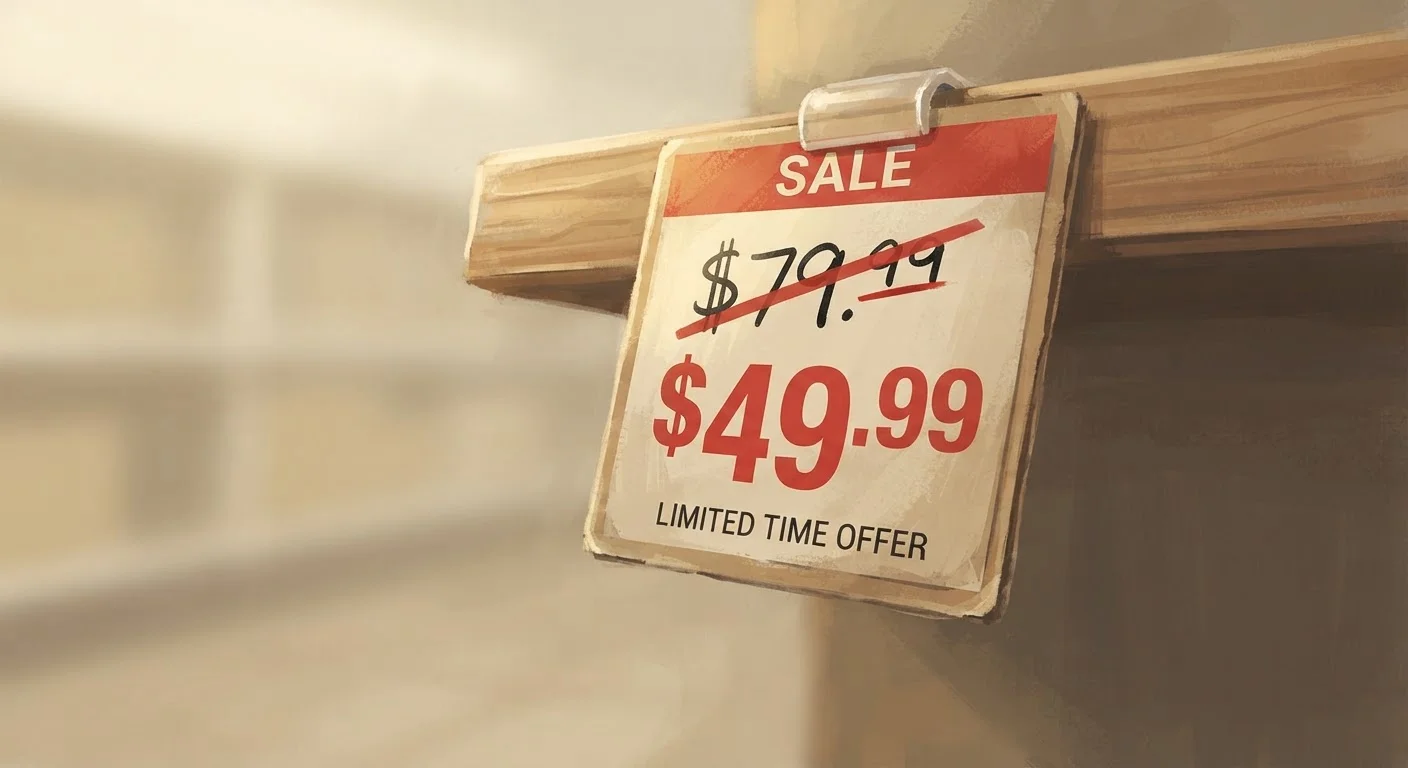
Option A
Anchor Pricing
The reference point retailers set to frame every other number.
Best for: Understanding how stores manufacture a sense of savings before you've evaluated whether the price is genuinely good.
Option B
Actual Value
What an item is objectively worth based on market data and your real needs.
Best for: Shoppers who want to assess whether a price is fair independent of any comparison a retailer has set up.
What Anchor Pricing Actually Is
Anchor pricing is the practice of displaying a high reference price — often labeled "was," "original," or "MSRP" — alongside a lower selling price. The gap between the two is presented as your savings. The anchoring effect, a well-documented concept in behavioral economics, describes how people use the first number they encounter as a mental reference point for every subsequent number. Retailers design their price displays to exploit exactly this tendency.
The critical detail most shoppers miss: the anchor price doesn't have to reflect what the item genuinely sold for. It may represent a brief period of elevated pricing, a manufacturer's suggested retail price that was rarely charged, or in some documented cases, a figure set purely to make the sale price look dramatic. As our explainer on inflated original prices details, retailers sometimes raise a price before marking it down — meaning the "savings" is partly or wholly constructed.
| Criterion | Anchor Pricing | Actual Value |
|---|---|---|
| What sets the number | Retailer's strategic decision | Market competition and utility |
| Purpose | Create perception of savings | Reflect fair, independent worth |
| Verified by | Rarely — varies by jurisdiction | Price comparison and unit cost data |
| Changes with promotions | Yes — often inflated before sales | Moves slowly with real market forces |
| Consumer control | Low — set entirely by the store | High — you research it independently |
| Risk to buyer | Overpaying while feeling good about it | Requires effort; low risk if done |
How Actual Value Is Determined
Actual value has nothing to do with the number a store crossed out. It reflects what a comparable item genuinely costs across the market, what it costs per unit of use, and how well it serves your specific need. Three practical anchors for actual value:
- Market price benchmarking: Independent price-tracking tools and retailer comparison sites show what an item sells for across multiple sellers over time, stripping out promotional distortions.
- Unit pricing: Unit price labels on shelf tags convert any package size into a cost-per-ounce, count, or serving figure, making true comparisons possible without doing the math yourself.
- Utility fit: A $90 item discounted to $60 is not a good value if you needed a $30 item. Anchor pricing often expands what shoppers are willing to spend, not just what they're happy to save.
Actual value is also informed by markdown cycles. Understanding how retailers time their markdowns tells you when a category is genuinely discounted versus when it's simply dressed to look that way.
~60%
Shoppers influenced by reference prices
Consumer research consistently finds a majority of shoppers use a displayed 'original' price as their primary benchmark for judging deal quality, even when they cannot verify it.
1/3
Holiday 'deals' at same or higher price
Investigations by consumer journalists, including analyses of major retail promotions, have found roughly a third of items advertised as sale prices during peak shopping events were not cheaper than their pre-promotion prices.
Where the Two Concepts Diverge Most Sharply
The gap between anchor pricing and actual value is widest in three common scenarios:
Big-ticket retail categories
Furniture, mattresses, and consumer electronics are notorious for high anchor prices that stay posted for months with periodic "sales" applied on top. The anchor functions as a permanent psychological fixture rather than a real historical price.
Seasonal and holiday promotions
Research by consumer advocacy groups and journalists has repeatedly shown that many items advertised as holiday deals were the same price — or occasionally lower — in the weeks before the promotional period began. The sense of urgency is real; the savings may not be.
Online marketplace listings
Third-party sellers on large platforms can set their own reference prices with limited oversight. A "60% off" badge may reference a list price the seller set themselves. Evaluating whether a discounted price is a genuine deal requires independent verification, not trust in the platform's badge.
Regulations on Reference Pricing Vary Widely
In the United States, the Federal Trade Commission publishes guidance discouraging deceptive reference pricing — for example, advertising a "former price" that was never genuinely offered for a reasonable period. However, enforcement varies significantly by state and retailer type, and not all anchor prices are subject to meaningful oversight. When in doubt, independent price research is more reliable than assuming a displayed reference price was ever real.
A Practical Framework for Shopping Anchor-Aware
Awareness alone doesn't neutralize anchoring — the effect persists even when you know it's happening. What helps is replacing the retailer's anchor with your own before you walk in or click through.
- Set your own price ceiling first. Decide what you'd pay for the item before you see any store pricing. This self-set anchor competes with the retailer's and reduces susceptibility to inflated reference prices.
- Research the going rate independently. A few minutes with a price-tracking tool or a basic search showing competitor prices gives you a market-based anchor to use instead.
- Ask: would this price feel good without the strikethrough? If the sale price still seems high without the "was" number next to it, the anchor did its job — and you can choose not to let it.
- Check deal-finding resources that compare prices over time, not just at a single moment.
Pairing this approach with awareness of checkout-line upsell tactics — which use similar psychological pressure at the point of purchase — helps protect the full shopping journey, not just the initial pricing decision.
The content provided on our blog site traverses numerous categories, offering readers valuable and practical information. Readers can use the editorial team’s research and data to gain more insights into their topics of interest. However, they are requested not to treat the articles as conclusive. The website team cannot be held responsible for differences in data or inaccuracies found across other platforms. Please also note that the site might also miss out on various schemes and offers available that the readers may find more beneficial than the ones we cover.