

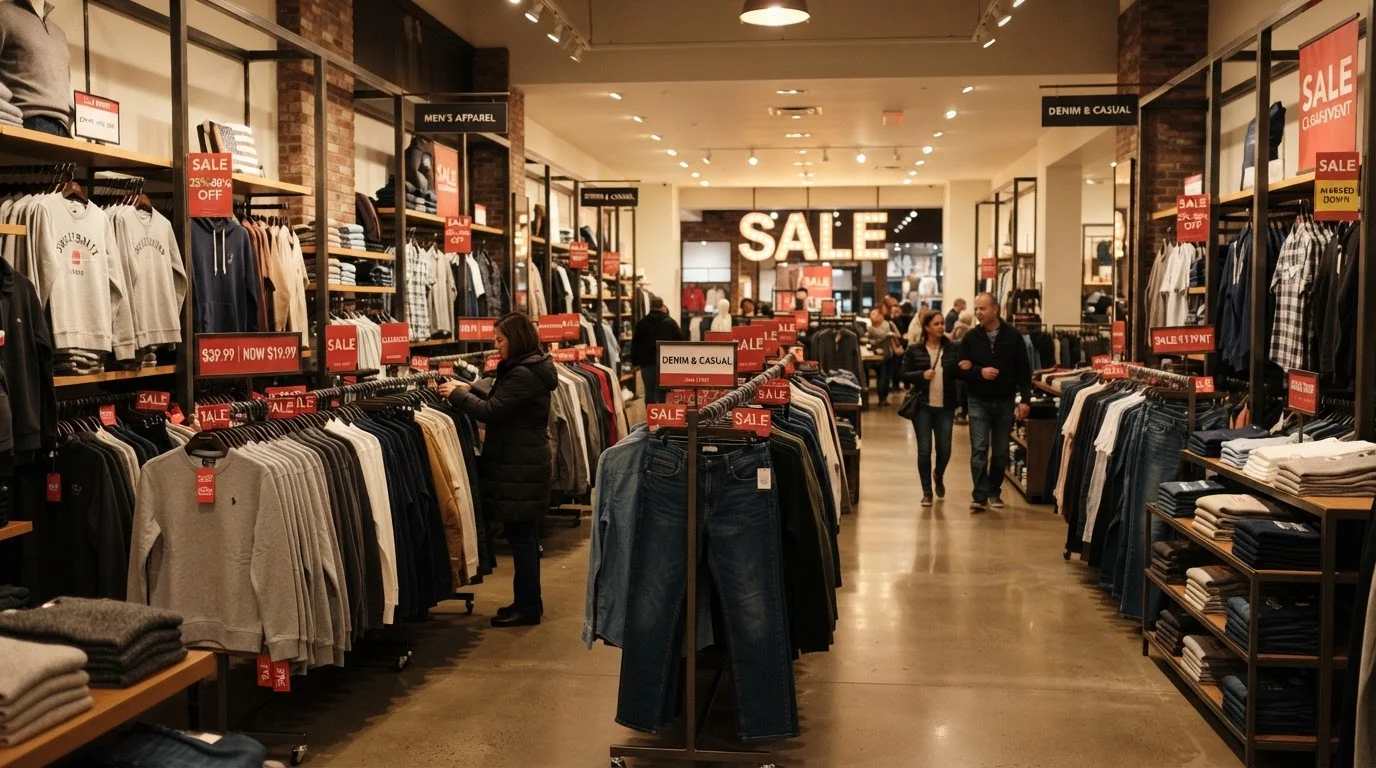
Why Retailers Mark Down: The Business Logic
Every item on a retail shelf has a cost clock running against it. Space costs money, holding inventory ties up capital, and when new merchandise arrives, old stock becomes a liability. Markdowns are how retailers convert that liability back into cash — and understanding that dynamic is the first step toward shopping with more intention.
Retailers track something called a sell-through rate: the proportion of stocked inventory that sells within a target period. When that rate falls below internal thresholds, a markdown is the operational response. It isn't a reward for loyal shoppers — it's a cost-management tool. Knowing this reframes what a sale tag actually communicates.
Two types of price reduction often get lumped together but work very differently. A promotional markdown is a planned, temporary discount designed to generate store traffic or move a specific category. These prices typically reset. A permanent markdown happens when a product is being phased out, a season is closing, or overstock needs to clear. These reductions usually deepen over time rather than reverse. Promotional prices in particular deserve scrutiny, since they sometimes involve inflated reference prices that make the discount look larger than it is.
Promotional vs. Permanent Markdowns: A Key Distinction
Retailers use both types strategically but for different reasons. Promotional markdowns are planned in advance as traffic drivers — they often repeat. Permanent markdowns are reactive to inventory problems and tend to deepen over time as the store tries harder to clear stock. Only the latter reliably signals a price floor approaching. When timing matters, identifying which type you're looking at changes the calculus significantly.
The Markdown Calendar Most Stores Follow
Retail buying happens months in advance. A winter coat ordered in spring must sell by February — or it occupies expensive shelf space heading into a new season. That constraint creates predictable markdown windows that repeat annually across most major retail categories.
Apparel typically begins promotional markdowns mid-season and accelerates end-of-season clearance in the final weeks. Home goods often align with post-holiday periods when display inventory rotates. Electronics follow product launch cycles — prior-generation models frequently see price movement when successors arrive. These patterns aren't guaranteed, but they're consistent enough to be useful when planning larger purchases.
For families trying to build a practical buying calendar, seasonal buying windows by category map this out in more detail. The core principle: purchasing ahead of a known markdown window usually means paying more, while purchasing just after one often captures the deepest discount before inventory runs out.
30–40%
Typical end-of-season apparel markdown depth
Retail industry analysts broadly report that end-of-season clearance markdowns commonly reach 30–40% off original prices, with further reductions possible as inventory ages.
~60 days
Common sell-through window before markdown review
Many mid-to-large retailers review sell-through performance at approximately 60-day intervals, triggering markdown decisions for underperforming stock.
2 in 3
Shoppers influenced by 'sale' signage regardless of actual savings
Consumer behavior research has consistently found a majority of shoppers report increased purchase likelihood when items are labeled as 'on sale,' even when the price reduction is minimal.
How to Verify Whether a Markdown Is Real
Retailers have significant discretion in how they present a marked-down price. The original or 'regular' price shown alongside a sale price is sometimes a reference to a price the item rarely sold at — a practice known as anchor pricing. This makes a modest actual reduction look substantial by contrast. Anchor pricing shapes perception of value in ways that don't always reflect what the item typically costs.
The most reliable check is a product's price history. Price history tools track what an item has sold for over time and can reveal whether a current 'sale' price is actually below the normal selling price or simply where the item has hovered all along. For any purchase above a routine grocery run, this is worth two minutes of checking.
For in-store grocery shopping, unit pricing on shelf labels provides a parallel tool — it strips away package-size confusion and lets you compare what you're actually paying per ounce or unit rather than per box.
Check Price History Before Acting on a Sale
Before any non-routine purchase flagged as 'on sale,' spend two minutes checking the item's price history using a free tracking tool. If the current price matches or exceeds the typical selling price, the markdown is likely promotional framing rather than a genuine reduction. This habit is especially valuable for electronics, appliances, and seasonal goods.
What This Means for Your Next Shopping Trip
Retailers are skilled at creating urgency and the feeling of opportunity. But most markdown decisions follow predictable internal logic, not random timing. When you understand that a markdown is triggered by the store's inventory pressure rather than your benefit, you can approach a sale tag more calmly — and more strategically.
Before acting on a 'sale,' consider two questions: Is this a promotional price that will reset, or a permanent markdown likely to deepen? And does the marked-down price actually fall below where this item normally sells? Answering both takes very little time and filters out a significant portion of retail marketing noise.
Families who track these patterns — even informally — tend to buy at genuinely better moments rather than in response to urgency cues. The goal isn't to game every purchase, but to avoid paying full price for something that was going to fall in price anyway, and to recognize when a markdown is genuinely worth acting on. For a broader look at the tactics shaping these decisions, common retail tactics explained clearly covers the landscape without the alarm.
Frequently Asked Questions
Retailers use sell-through rates — the percentage of inventory sold versus what was stocked. When a product underperforms against internal targets, a markdown is triggered to accelerate sales. Seasonal deadlines and new-product arrivals also force the timeline.
Not always. A sale price can be a short-term promotional discount with no change to the underlying cost structure. A markdown usually means the retailer has permanently lowered the price, often because the product needs to clear shelves. Markdowns tend to deepen over time; promotional sales reset.
No. Markdowns often reflect inventory timing rather than product quality. Perfectly good seasonal merchandise, last year's model, or simply overstocked items all get marked down regardless of their condition or usefulness.
Price history tools that track an item's pricing over time can confirm whether today's price represents a genuine drop or is close to the typical selling price. Checking those records before buying is a practical habit for larger purchases.
Most categories follow predictable patterns: apparel marks down at the end of each season, electronics often drop after major product launches or in the weeks following major holiday shopping periods. Understanding category-specific cycles helps with timing.
The content provided on our blog site traverses numerous categories, offering readers valuable and practical information. Readers can use the editorial team’s research and data to gain more insights into their topics of interest. However, they are requested not to treat the articles as conclusive. The website team cannot be held responsible for differences in data or inaccuracies found across other platforms. Please also note that the site might also miss out on various schemes and offers available that the readers may find more beneficial than the ones we cover.