

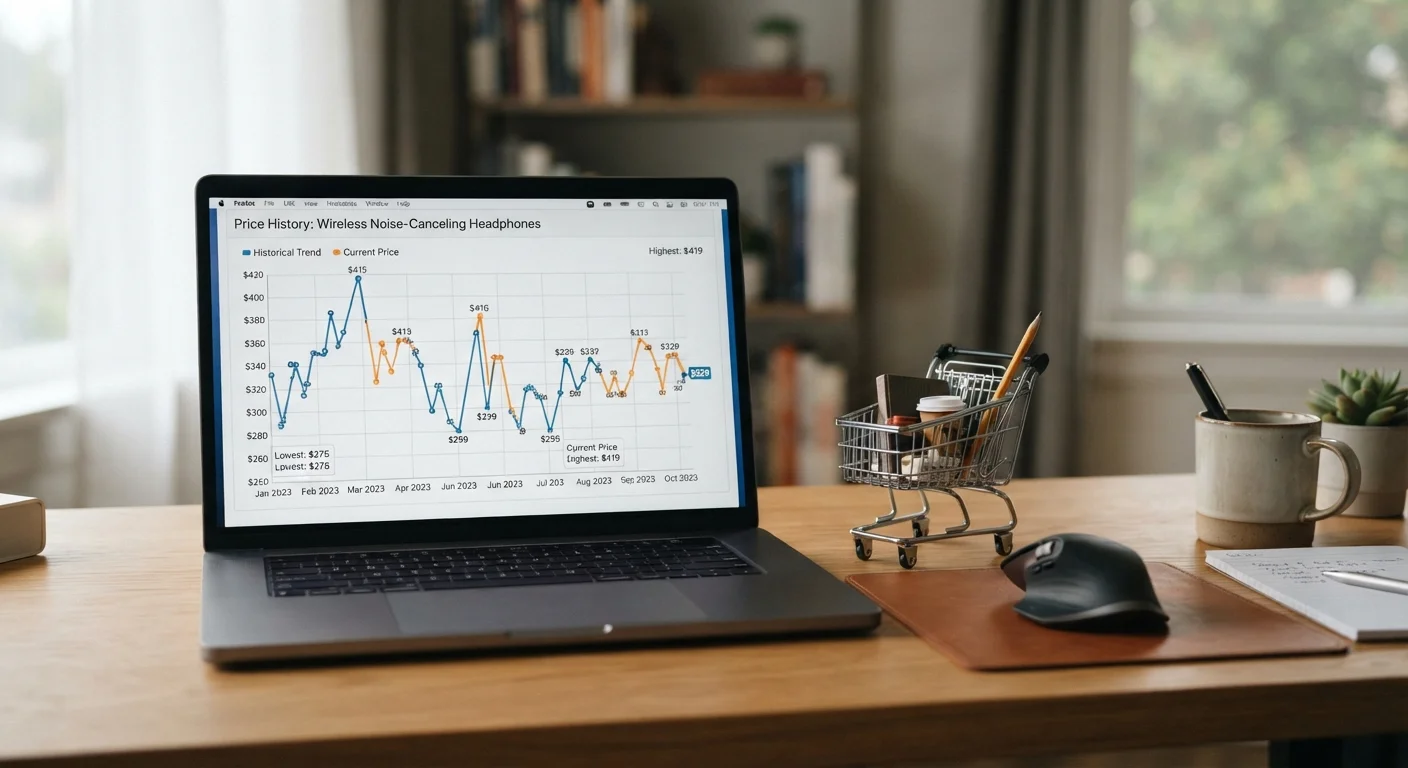
What Price History Tools Actually Do
Price history tools are browser extensions or web-based services that record how much a specific product has sold for on major retail sites over weeks, months, or even years. When you land on a product page, these tools pull up a chart showing price fluctuations over time — so you can judge at a glance whether today's listed price is genuinely low or simply average.
| What they track | Product price changes on major retail platforms over time |
| Typical history window | 30 days to several years, depending on the tool |
| Common delivery format | Browser extension or standalone website |
| Alert feature | Many tools allow email or push notifications when a price drops |
| What they don't do | Predict future prices or verify seller intent |
| Best use case | Verifying whether a 'sale' price reflects a genuine discount |
Most tools track prices on large e-commerce platforms automatically, logging changes as they happen. Some send alerts when a tracked item drops below a price you set. Others display the historical low alongside the current price, giving you an immediate reference point.
What they don't do is guarantee future prices or tell you the seller's intent. They are data-display tools, not predictive engines. Understanding that distinction keeps expectations realistic — and helps families use the data confidently without over-relying on it.
What Price History Reveals That a Sale Tag Cannot
A sale tag tells you the current price and sometimes a "was" price. A price history chart tells you whether that "was" price ever existed at scale — or whether it was briefly inflated before the markdown. This is especially relevant during high-profile shopping events, when some items appear discounted but are actually priced at or near their normal range.
~30%
Of 'sale' prices may not reflect genuine discounts
Consumer advocacy research has suggested a significant share of promoted sale prices are at or near the item's normal price, underscoring the value of independent price verification.
2 min
Typical time to check a product's price history
Most browser-based price history tools surface a chart immediately on the retailer's product page, making the habit low-effort for routine purchases.
Retailers set reference prices strategically. Understanding how that works is explained in detail in our article on how reference pricing operates. Price history data gives you an independent check on those references.
When a chart shows a product has held steady at the same price for six months, a "limited time" sale banner loses its urgency. Conversely, if the chart shows a genuine dip below the product's typical range, that's a meaningful signal — not a guarantee, but solid context.
It's also worth pairing price history with an understanding of seasonal buying windows, since some categories drop predictably at specific times of year regardless of what a retailer's sale banner says.
How to Use Price History in a Practical Shopping Routine
For families managing a household budget, the habit doesn't need to be complicated. A reasonable approach:
- Check before any purchase over $30–$50. The time investment (under two minutes) is worthwhile at this threshold. Below it, the mental overhead usually outweighs the benefit.
- Look at the 90-day or 6-month view. Short windows can be misleading. A price that looks low on a 30-day chart may be normal on a 6-month chart.
- Note the historical low vs. current price. If the current price is within a few dollars of the all-time low, that's useful context. If it's 20% above the typical range, waiting may make sense.
- Set a price alert for non-urgent purchases. Tools that email or notify you when a price drops let you step back from impulse timing and buy on your schedule.
Price history
A chronological record of how much a specific product has been listed or sold for on a given retail platform. Displayed as a chart, it shows highs, lows, and typical price ranges over a selected period.
Reference price
A higher price shown alongside a sale price to make the discount appear larger. Reference prices may reflect a brief or inflated original listing rather than what most customers actually paid.
Price alert
A notification feature that contacts you when a tracked product drops below a price you specify. Useful for non-urgent purchases where you're willing to wait for a lower price.
Historical low
The lowest price recorded for a product within the tool's tracked period. Comparing the current price to the historical low helps gauge whether a deal is genuinely unusual.
Anchor pricing
A retail tactic in which a higher 'original' price is displayed to make the current price feel like a bargain, regardless of whether the higher price reflects real market value.
Price history doesn't replace judgment — it informs it. A product at its historical low is still only worth buying if you actually need it. That's a point our piece on true value versus sale price covers in more depth.
If you want to go further, pairing price history data with knowledge of how retailers time their markdowns gives you a sharper picture of when a price drop is likely to be genuine versus scheduled marketing.
The content provided on our blog site traverses numerous categories, offering readers valuable and practical information. Readers can use the editorial team’s research and data to gain more insights into their topics of interest. However, they are requested not to treat the articles as conclusive. The website team cannot be held responsible for differences in data or inaccuracies found across other platforms. Please also note that the site might also miss out on various schemes and offers available that the readers may find more beneficial than the ones we cover.