

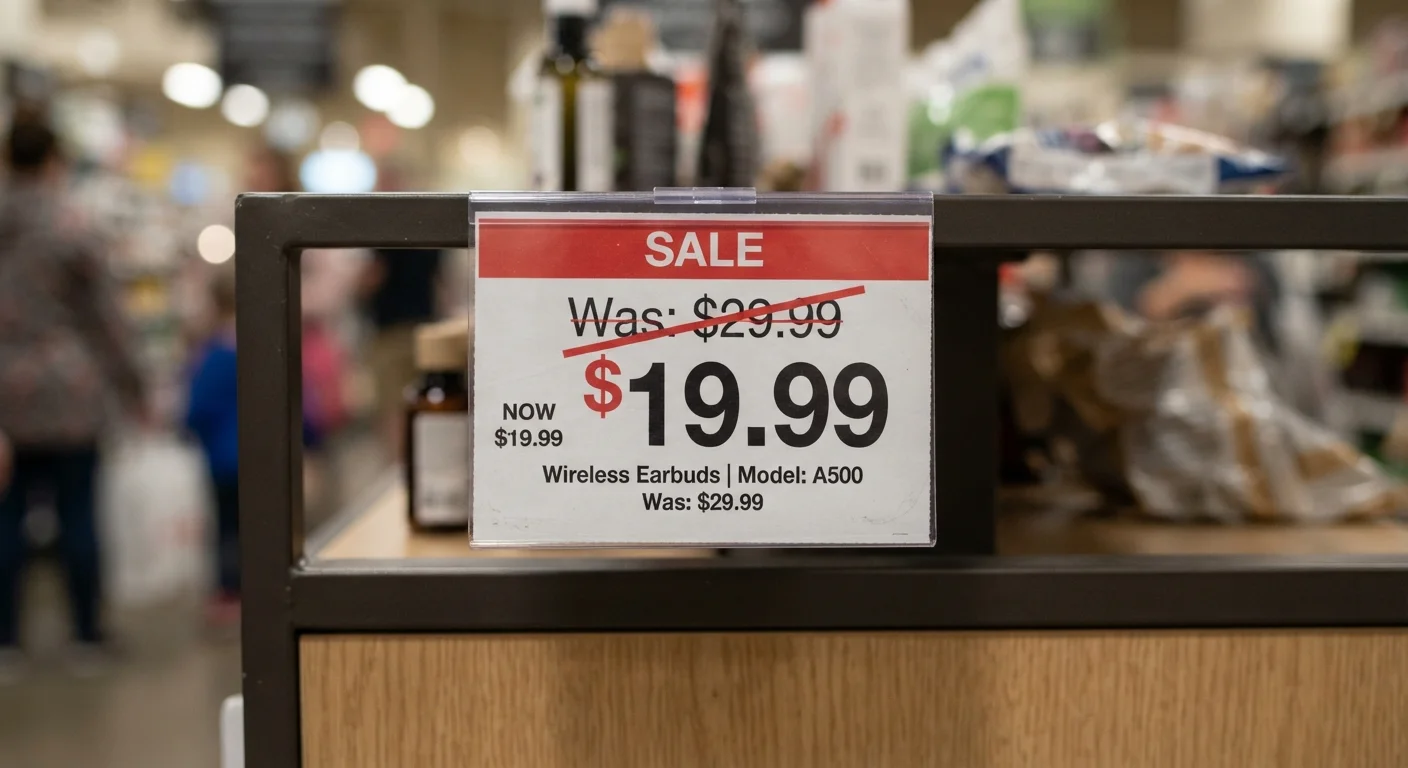
Why the Percentage Doesn't Tell the Whole Story
Walk through any store during a sale event and you'll see tags promising 30%, 50%, even 70% off. These numbers feel significant — and they are, but only relative to the reference price printed beside them. That reference price, often labeled "original," "regular," or "was," is set by the retailer and may not reflect what the item actually sold for in the recent past.
This is the foundation of a common retail practice sometimes called reference pricing or anchor pricing. By establishing a high starting point, retailers make the discounted price feel like a rescue. Understanding this mechanic doesn't require cynicism about every sale — it just requires knowing what question to ask: Is this price lower than what this item normally sells for?
Anchor pricing and how it shapes perceived value is worth understanding before you evaluate any promotion. The contrast between a "was" and "now" number is designed to create a feeling of urgency and value — not necessarily to reflect a genuine market reduction.
Reference Pricing and U.S. Regulations
The Federal Trade Commission provides guidance on deceptive pricing, including the use of fictitious "original" prices. While federal guidelines exist, enforcement and specific rules vary by state. If a "was" price seems implausible, it may be worth checking whether the retailer actually sold the item at that price — or whether the label was used primarily to create a discount impression.
How to Establish True Value Before You Buy
True value has two components: the market price and the personal utility. Both matter, and neither should be skipped.
Market price
This is what the item consistently sells for across multiple sellers and over a reasonable span of time. A price that appears heavily discounted at one store may be the normal price at another. Checking competitors — even briefly — before buying can reveal whether the "sale" is a genuine reduction or just selective framing.
Price history tools take this further by showing you an item's pricing over weeks or months. Price history tools and how families can use them are particularly useful for electronics, appliances, and other items that cycle through promotional pricing regularly. If an item's chart shows it at the "sale" price 80% of the time, the sale tag loses its meaning.
Personal utility
The second component is simpler but equally important. A deeply discounted item you don't need, won't use regularly, or are buying only because the tag feels compelling is not a deal — it's spending. Before completing any sale purchase, ask whether you would buy this item at its market price if no sale tag were present. If the answer is no, the discount is doing persuasion work, not savings work.
Build a Two-Question Habit Before Buying on Sale
Before committing to any sale purchase, ask yourself two things: (1) Is this price actually lower than what this item normally sells for? and (2) Would I buy this at its regular price if no sale tag were present? If the answer to either question is uncertain or no, take a few minutes to check a competitor's price or the item's price history. This two-step pause catches most impulse decisions driven by marketing rather than genuine value.
Practical Checks You Can Do Before Any Purchase
Applying these ideas doesn't require elaborate research. A few targeted habits cover most everyday shopping situations.
- Compare unit prices: Especially for groceries and household goods, the unit price (cost per ounce, count, or serving) cuts through packaging and promotional noise. Unit pricing on shelf tags often reveals that a "value size" on sale costs more per unit than a smaller package at regular price.
- Check price history for significant purchases: For anything over roughly $50, a quick look at an item's price history can confirm whether today's price is genuinely below its normal range.
- Compare at least one other retailer: Even a single comparison against a second seller establishes whether a "sale" price is competitive or simply the going rate.
- Evaluate the reference price skeptically: If a "was" price appears on a product you've never seen priced that high before, that's worth noting. How retailers use inflated original prices is a documented practice, and awareness is the simplest defense.
37%
Shoppers who check prices before buying on sale
A survey by Consumer Reports found that a significant share of shoppers do not verify whether a sale price is actually lower than the item's regular market price before purchasing.
~60%
Of "sale" prices that match or exceed typical prices
Research published in the Journal of Marketing found that a majority of items labeled as on sale were priced at or above their average selling price at the time of promotion.
None of these steps takes more than a few minutes, but together they shift your evaluation from how a deal feels to what it is.
What Genuine Savings Actually Look Like
A real discount has a few consistent characteristics. The sale price is meaningfully below the item's sustained market price — not just below a "was" label. The reduction holds up when compared against at least one other retailer. And the item is something you'd buy anyway at or near the regular price.
When all three conditions are present, a promotional price represents genuine value. When one or more is missing, what you're seeing is effective merchandising — which is not the same thing.
“Consumers are generally poor at knowing actual prices, which is why reference prices are so powerful. Knowing that the 'original' price may be set strategically — not descriptively — is one of the most useful things a shopper can internalize.”
— Consumer pricing researcher, paraphrased from published academic literature on reference price effects, Behavioral economics researcher specializing in retail pricing
Being a careful shopper doesn't mean doubting every promotion. Plenty of sales are legitimate, and retailers do reduce prices to clear inventory, respond to competition, or reward loyalty. The goal is simply to have a way to distinguish those real reductions from ones that exist primarily on a tag.
For a broader look at the pricing tactics that affect everyday shopping, the Avoiding Buyer Traps section covers the most common patterns families encounter — and how to navigate them without second-guessing every grocery run.
Frequently Asked Questions
True value reflects what an item consistently sells for across time and across multiple retailers. It accounts for quality, typical market price, and whether the item meets a genuine need. A sale price is only meaningful if it falls noticeably below that baseline.
Price history tools can show you what an item actually sold for over the past weeks or months. If the "original" price rarely or never appeared in the price history, it was likely set high to make the discount look larger. Comparing prices at competing retailers is another useful check.
Not necessarily. The percentage only tells you the discount relative to the stated reference price. If that reference price was inflated before the sale, a 50% discount may still leave you paying more than the item's normal market price. The actual dollar amount and competitive pricing matter more than the percentage.
Absolutely. An item you won't regularly use has low personal value regardless of how deeply it's discounted. True value includes both market price and practical fit for your household — both factors should inform your decision.
Understanding how anchor pricing works is a useful starting point. Retailers often display a high "was" price next to a lower "now" price to shape how the deal feels, a technique known as reference pricing. Learning these mechanics helps you evaluate promotions more objectively.
The content provided on our blog site traverses numerous categories, offering readers valuable and practical information. Readers can use the editorial team’s research and data to gain more insights into their topics of interest. However, they are requested not to treat the articles as conclusive. The website team cannot be held responsible for differences in data or inaccuracies found across other platforms. Please also note that the site might also miss out on various schemes and offers available that the readers may find more beneficial than the ones we cover.