

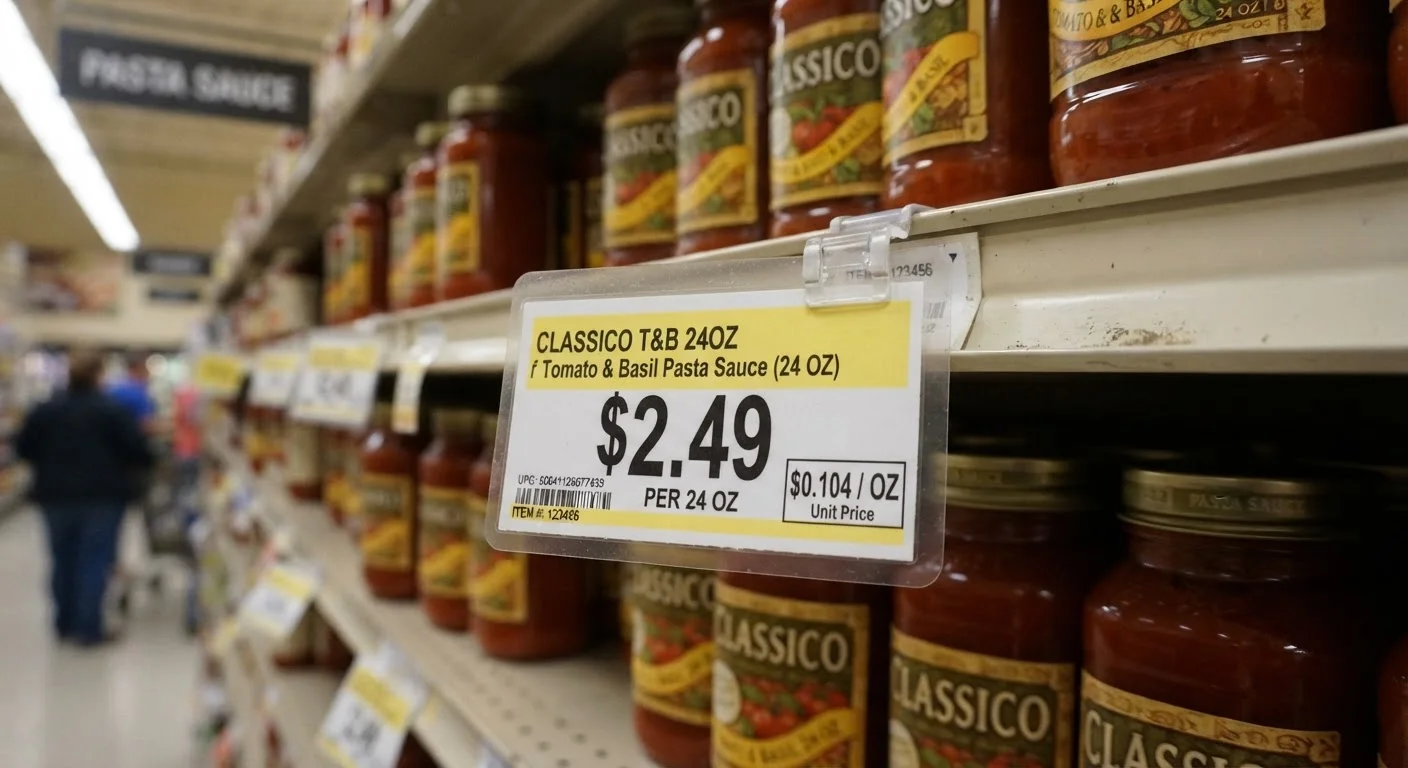
The Number Most Shoppers Walk Right Past
Every week, millions of shoppers compare package prices and assume the lower sticker wins. But the sticker price only tells you what you're paying for that particular box or bottle — it says nothing about whether you're getting more or less product for your money.
That's exactly what unit pricing is designed to solve. The unit price — usually displayed in small text on the shelf tag — converts the package price into a cost per standard unit, like per ounce, per count, or per liter. When two competing products use the same unit of measure, you can compare them directly without doing mental arithmetic in the aisle.
The problem is that most shoppers focus on the large, bold package price and overlook the smaller figure. Retailers know this. Package sizes, promotional framing, and shelf placement are all optimized for the big number — not the honest comparison.
Unit Price Laws Vary by State
Not every retailer in every state is legally required to display unit pricing. Large grocery chains in densely populated states tend to have the most consistent unit pricing displays, while smaller stores, specialty shops, and states with looser regulations may display unit prices less reliably. When a unit price isn't shown, you can calculate it yourself by dividing the package price by the total weight, volume, or count listed on the packaging.
How Unit Pricing Works in Practice
Imagine two containers of oats on the same shelf. One is a 42-ounce canister priced at $4.99. The other is an 18-ounce bag priced at $2.49. The bag looks cheaper — and it is, in absolute terms. But the canister costs roughly $0.12 per ounce, while the bag costs about $0.14 per ounce. If you buy oats regularly, the larger container is the better value, assuming you'll use it before it goes stale.
That's unit pricing doing its job. Without it, most shoppers would grab the lower sticker price and move on. With it, you have enough information to make a genuinely informed choice.
It's worth understanding that unit pricing doesn't make every decision simple. Some shelf tags use different base units for similar products — one salad dressing might show cost per ounce while another shows cost per serving. When that happens, you'll need to do a small conversion before the numbers are actually comparable. See our guide to decoding shelf labels for a closer look at how to handle those situations.
Why Bigger Isn't Always Cheaper — and Other Misconceptions
The assumption that buying in bulk always saves money is so widespread that it functions almost like received wisdom. In reality, it depends entirely on the unit price at a given moment.
Promotional pricing can temporarily flip the math. A mid-size package on sale may have a lower unit price than the warehouse-size equivalent at full price. Private-label (store brand) products in smaller sizes can also undercut national brands in larger sizes on a per-unit basis. Without checking the unit price, you'd have no reliable way to know.
~30%
Shoppers who regularly check unit prices
Consumer research has consistently found that a minority of grocery shoppers actively use unit pricing to guide purchase decisions, despite its widespread display in stores.
Varies by state
U.S. jurisdictions requiring unit price display
Unit pricing laws differ across states, with some requiring it for all grocery items and others having more limited or no mandates for certain store types.
This is also where misleading packaging tactics can enter the picture. A product may be reformulated to contain slightly less content while keeping the same package size and price — a practice sometimes called "shrinkflation." The package looks identical, but the unit price quietly increases. Checking the unit price on repeat purchases, not just the total price, is one of the few ways to catch this. For more on how promotional framing can distort perceived value, see how reference pricing works.
Check Unit Prices on Repeat Purchases
For products you buy regularly — cereal, coffee, cleaning supplies — make a mental or written note of the unit price you normally pay. If it increases without an obvious reason, the package content may have changed even if the packaging looks the same. This takes seconds and is one of the most practical ways to notice shrinkflation before it quietly drains your grocery budget.
Making Unit Pricing Part of Your Shopping Routine
Using unit pricing doesn't require a spreadsheet or a smartphone app — though both can help. The simplest approach is to make it a habit to glance at the small number on the shelf tag before placing anything in your cart, particularly for pantry staples, cleaning supplies, and personal care items you buy repeatedly.
When comparing across brands or sizes, confirm that the unit of measure is the same on both tags. If it isn't, use the package weight or count to calculate the unit price yourself: divide the package price by the total number of units. It takes about ten seconds and can quickly reveal which option actually costs less.
Understanding unit pricing also pairs well with a broader awareness of retail pricing tactics. Things like what a sale price actually represents or how anchor pricing shapes perceived value are all part of the same consumer literacy picture. Unit pricing is simply the most concrete, math-based tool available to you in the aisle — and it costs nothing to use.
Frequently Asked Questions
Look at the small text on the shelf tag directly below or beside the large package price. It's usually labeled as 'price per oz,' 'per count,' or similar. Online grocery platforms often display it near the product name.
Not always. While bulk sizes frequently offer a lower unit price, that's not guaranteed. Promotions, store-brand pricing, and packaging changes can make smaller sizes competitive or even cheaper on a per-unit basis.
Retailers and manufacturers are not always required to standardize the unit of measure across a category. One brand of juice may display cost per fluid ounce while another shows cost per serving, making direct comparison difficult without some mental math.
Coverage varies by state law and store type. Grocery and household staples are most commonly covered. Specialty, prepared, or single-item products may not carry unit pricing at all.
It can help you make more informed decisions, which over time may reduce spending on items where you were unknowingly paying more per unit. However, the actual savings depend on your purchasing habits and what's available in your area.
Not necessarily. Cost per serving uses the manufacturer's defined serving size, which can be set very low to make a product appear cheaper. Unit price uses a fixed, objective measurement like weight or volume, which is generally more reliable for comparison.
The content provided on our blog site traverses numerous categories, offering readers valuable and practical information. Readers can use the editorial team’s research and data to gain more insights into their topics of interest. However, they are requested not to treat the articles as conclusive. The website team cannot be held responsible for differences in data or inaccuracies found across other platforms. Please also note that the site might also miss out on various schemes and offers available that the readers may find more beneficial than the ones we cover.