

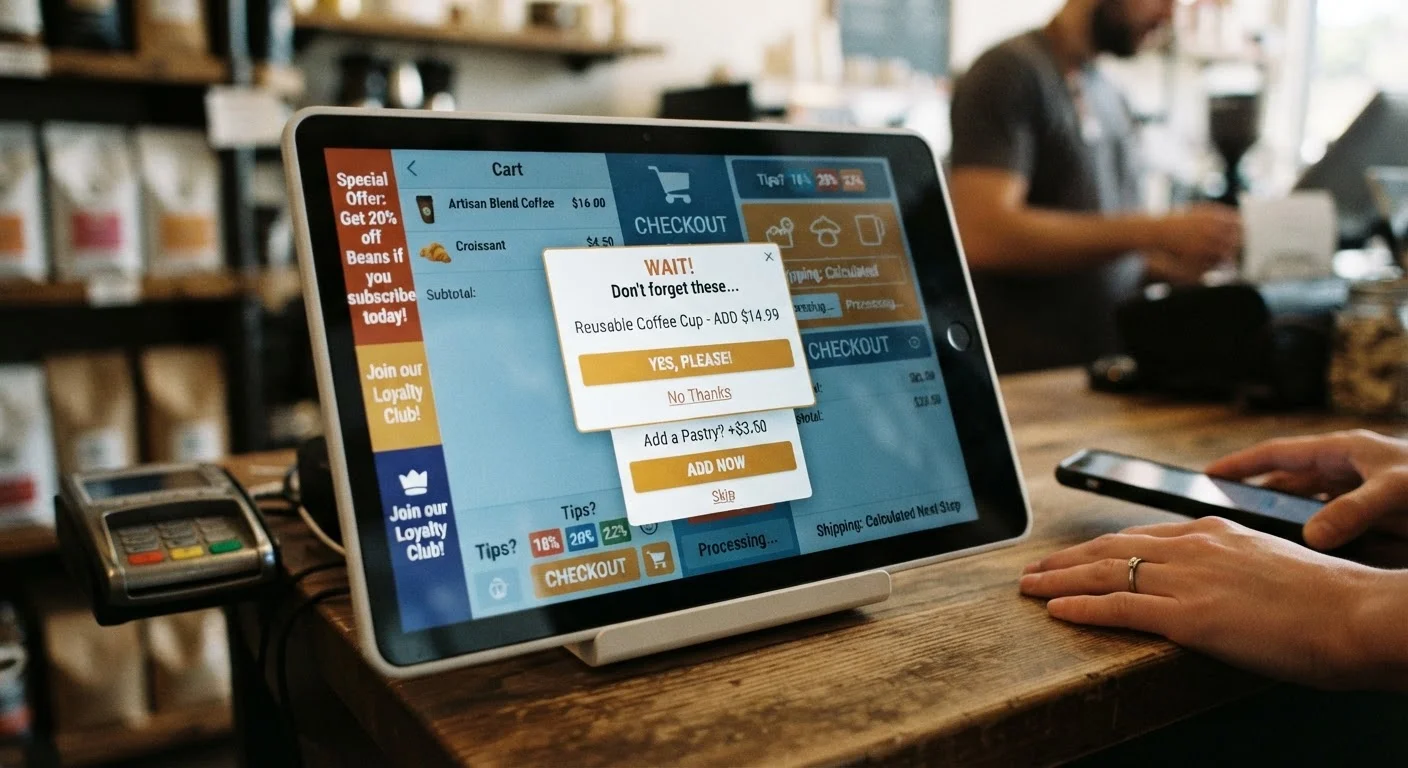
How Checkout Is Designed to Work Against Your Budget
By the time you reach the checkout — whether in a physical store lane or on a final order screen — you have already made dozens of small decisions. What to buy, what to skip, how to compare options. That accumulated mental effort is called decision fatigue, and retailers understand it well. Checkout is positioned at the exact moment when your capacity for careful evaluation is lowest and your desire to simply finish is highest.
Upsells, add-ons, and last-minute offers are not random. They are placed strategically, priced to appear modest relative to your total basket, and framed to feel like logical extensions of what you already chose. 'Since you're buying a laptop, protect it for just $X more.' The logic sounds reasonable. But reasonable-sounding is exactly what the design aims for.
Understanding this structure is not about distrust for its own sake — it's about recognizing that checkout pressure is a deliberate commercial mechanism, and you are entitled to evaluate it on your own terms. The psychology behind checkout impulse spending runs deeper than most shoppers realize, and awareness is the first practical defense.
~$1,800
Estimated annual U.S. household impulse spending
Research from the Slickdeals consumer survey found American shoppers reported spending roughly this amount annually on unplanned purchases, with checkout zones among the most cited triggers.
40–80%
Typical retail margin on extended warranties
Industry analysts and consumer advocacy groups have consistently reported that service plan profit margins far exceed those of the underlying products they cover.
The Most Common Checkout Upsell Mistakes — and How to Avoid Them
The mistakes below appear across in-store and online checkout environments. Each one is common precisely because it exploits a normal human tendency rather than a lapse in intelligence. Recognizing the pattern is what allows you to pause before you spend.
Accepting an extended warranty or protection plan at the point of sale without comparing it to existing coverage.
Why it happens: Checkout staff are often trained and sometimes incentivized to present these plans as near-essential, and the framing ('protect your investment for just a few dollars more') sounds reasonable when you're already committed to a purchase.
Agreeing to a subscription or membership upgrade mid-checkout because a one-time discount makes it seem worthwhile.
Why it happens: A discount framed as 'free shipping for a year' or 'save 15% today with membership' creates an immediate, visible benefit that obscures the recurring cost. Decision fatigue makes the math feel too complicated to challenge in the moment.
Treating a bundled 'add-on deal' as genuinely discounted just because the price appears lower than the standalone item.
Why it happens: Retailers often set reference prices for add-on items at inflated levels so that the bundled price looks like savings. This is a direct application of anchor pricing — the technique explained in depth in our guide on how retailers shape what feels like a bargain.
Clicking through pre-checked add-on boxes at online checkout without reviewing every line item.
Why it happens: Checkout flows are designed to move quickly. Pre-selected options take advantage of the tendency to accept defaults, especially when shoppers are eager to complete a transaction.
Responding to urgency language at checkout — 'only 2 left,' 'offer expires at checkout' — by adding an upsell without deliberation.
Why it happens: Scarcity and time-pressure cues trigger a fear-of-missing-out response that short-circuits slower, more analytical thinking. Retailers know this and place these cues at the exact moment shoppers are most likely to act impulsively.
Extended Warranties Rarely Pay Off
Consumer researchers and financial educators consistently note that most extended warranties are purchased far more often than they are ever claimed. Retailers and manufacturers typically earn their highest profit margins on these plans. Before accepting one at checkout, consider whether the item's manufacturer warranty already covers the most likely failure window, and whether a credit card you already own offers complimentary purchase protection.
A Simple In-the-Moment Test for Any Add-On Offer
No framework works perfectly under pressure, but a short mental checklist helps. When a checkout add-on appears, ask yourself three things in quick succession:
- Did I plan to buy this before arriving at checkout? If the answer is no, that alone justifies a default decline.
- Can I verify the standalone price in under a minute? If not, the offer is designed to prevent comparison. Decline and look it up later.
- Does accepting this create any ongoing obligation? Memberships, subscriptions, and auto-renewals deserve extra scrutiny. What feels like a one-time deal often is not.
If you're working to build smarter habits around layering discounts and evaluating whether an offer represents real value, our piece on when coupons, rebates, and sales genuinely combine offers a useful contrast — it shows what legitimate savings structures actually look like, which makes spotting manufactured ones easier.
Pre-Checked Add-On Boxes Cost Real Money
Both in-store and online checkout flows frequently include add-ons that are pre-selected by default — things like donation round-ups, accidental damage plans, or expedited shipping. Clicking through quickly without reviewing each line means you may pay for items you never consciously chose. Slow down at the final summary screen and read every line before confirming.
The goal is not to refuse every add-on reflexively. Occasionally a checkout offer is genuinely useful and fairly priced. The goal is to make that judgment deliberately, not under the specific conditions retailers have engineered to bypass your usual scrutiny.
The content provided on our blog site traverses numerous categories, offering readers valuable and practical information. Readers can use the editorial team’s research and data to gain more insights into their topics of interest. However, they are requested not to treat the articles as conclusive. The website team cannot be held responsible for differences in data or inaccuracies found across other platforms. Please also note that the site might also miss out on various schemes and offers available that the readers may find more beneficial than the ones we cover.