

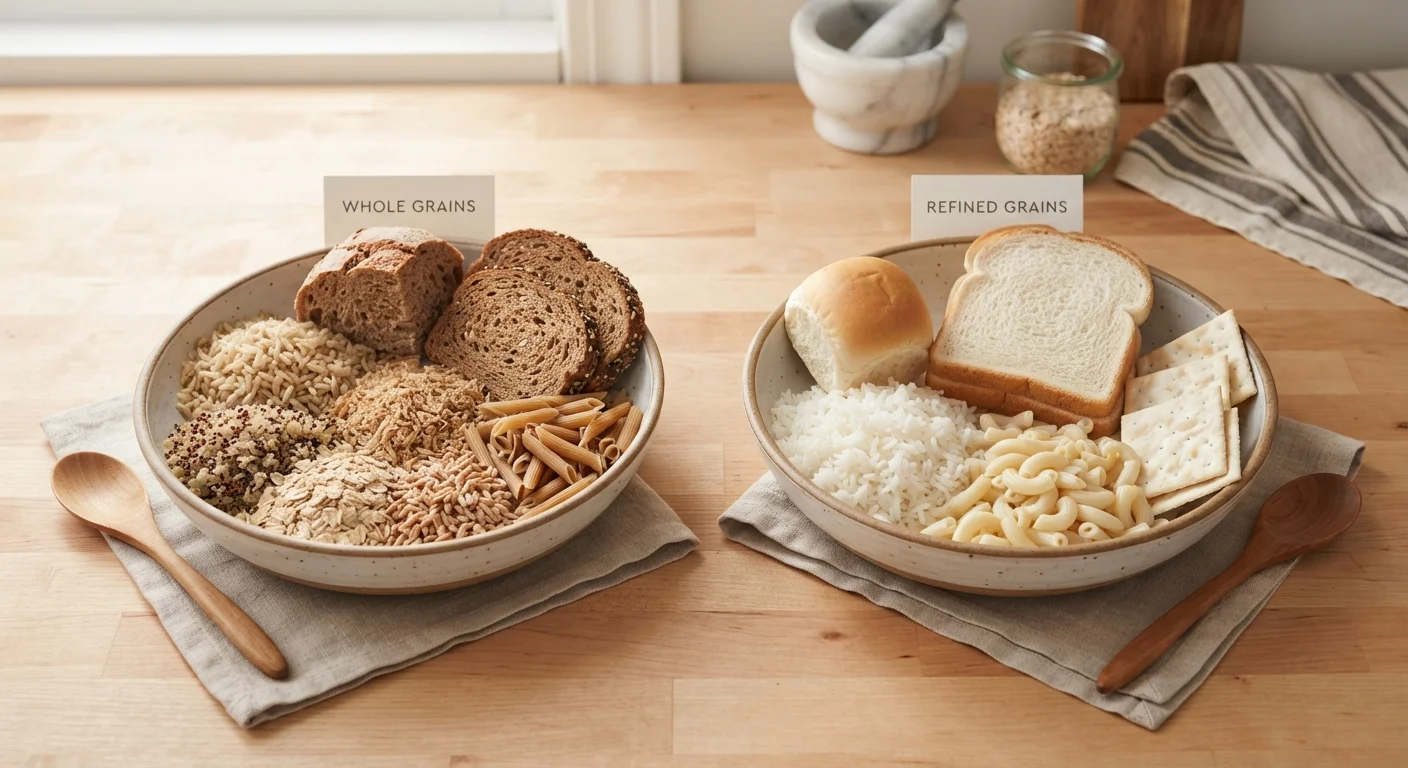
Option A
Whole Grains
The nutritionally complete, minimally processed option.
Best for: Families looking to support steady energy, digestive health, and longer-lasting fullness across all age groups.
Option B
Refined Grains
The widely available, longer-shelf-life staple found in most kitchens.
Best for: Households managing texture preferences or specific dietary needs where fortified, lighter-textured grains are more practical.
What Makes a Grain 'Whole' or 'Refined'?
Every grain kernel has three parts: the bran (outer layer, rich in fiber and B vitamins), the germ (nutrient-dense inner seed), and the endosperm (the starchy middle). A whole grain keeps all three parts intact through processing. A refined grain has had the bran and germ stripped away, leaving mostly the starchy endosperm.
This distinction matters because the bran and germ contain the bulk of the grain's fiber, magnesium, zinc, B vitamins, and antioxidants. Once those layers are removed, the grain's nutritional profile changes significantly. Manufacturers often enrich refined grains by adding back certain B vitamins and iron — but fiber is generally not restored.
Common whole grains include oats, brown rice, whole wheat, quinoa, barley, and bulgur. Refined grains include white rice, white flour, and most standard pasta and bread made from white flour. Understanding this structural difference is the foundation for making grain choices that work for your family. For broader context on how grains fit into your household's energy needs, see what macronutrients actually do for your family's energy levels.
| Criterion | Whole Grains | Refined Grains |
|---|---|---|
| Grain parts retained | Bran, germ, and endosperm | Endosperm only |
| Dietary fiber | Higher (bran intact) | Lower (bran removed) |
| Key micronutrients | B vitamins, magnesium, zinc (natural) | B vitamins, iron (enriched/added) |
| Common examples | Oats, brown rice, whole wheat bread | White rice, white bread, regular pasta |
| Texture and taste | Denser, nuttier flavor | Lighter, milder flavor |
| Shelf life | Shorter (oils in germ go rancid) | Longer, more stable storage |
| USDA recommendation | At least half of daily grain servings | Up to half of daily grain servings |
Nutritional Trade-Offs and Why They Matter for Families
The most significant practical difference between whole and refined grains is dietary fiber. Fiber supports healthy digestion, contributes to feelings of fullness, and plays a role in maintaining healthy cholesterol levels, according to general guidance from the National Institutes of Health. For school-age children and busy adults, a higher-fiber breakfast or lunch can mean fewer hunger-driven snack requests and more consistent focus.
95%
Americans falling short on whole grain intake
According to USDA data, the vast majority of Americans consume well below the recommended amount of whole grains daily.
3x
More fiber in whole wheat vs. white bread
A typical slice of whole wheat bread contains roughly three times the fiber of a comparable slice of white bread, based on standard USDA nutritional data.
½
Recommended share of grains from whole sources
The USDA Dietary Guidelines for Americans recommend that at least half of all grain servings come from whole grain sources.
Refined grains aren't nutritionally worthless, though. Enriched white rice and white bread still provide readily available carbohydrate energy and restored B vitamins like folate — particularly important during pregnancy (always consult a healthcare provider for specific nutritional needs during pregnancy). The USDA's Dietary Guidelines for Americans suggest making at least half of daily grain servings whole grains, which leaves genuine room for both types in a realistic family eating pattern.
It's also worth noting that not every product labeled "multigrain" or "wheat" is a whole grain. Look for "whole wheat" or "whole grain" as the first ingredient on a nutrition label — this is the clearest signal that you're getting the full kernel. See common family nutrition myths dietitians hear every day for more on label confusion and food misconceptions that affect everyday choices.
Practical Ways to Shift the Balance at Home
Switching entirely to whole grains overnight rarely sticks — especially with children who have established texture preferences. A gradual, low-pressure approach tends to work better for most households.
- Mix it in: Combine half whole wheat pasta with half regular pasta to ease the transition without a noticeable taste change.
- Swap breakfast first: Rolled oats, whole grain cereal, or whole wheat toast at breakfast is one of the easiest whole grain upgrades with minimal mealtime resistance.
- Use brown rice in casseroles: Dishes with sauces, vegetables, and protein mask texture differences well — making casseroles and stir-fries good vehicles for brown rice.
- Read labels on bread: Many loaves that look like whole grain bread are primarily refined flour with coloring added. Checking the ingredient list takes seconds and makes a real difference.
For a wider look at how small daily habits shape overall family nutrition, where families quietly lose the nutrition plot at mealtimes offers helpful context. If your household is also exploring more plant-focused eating, plant-forward family meals discusses how whole grains can anchor that approach.
This article is for general informational purposes only and is not a substitute for personalized nutrition or medical advice. Consult a registered dietitian or qualified healthcare professional for guidance specific to your family's health needs.
The content provided on our blog site traverses numerous categories, offering readers valuable and practical information. Readers can use the editorial team’s research and data to gain more insights into their topics of interest. However, they are requested not to treat the articles as conclusive. The website team cannot be held responsible for differences in data or inaccuracies found across other platforms. Please also note that the site might also miss out on various schemes and offers available that the readers may find more beneficial than the ones we cover.