

Our Verdict
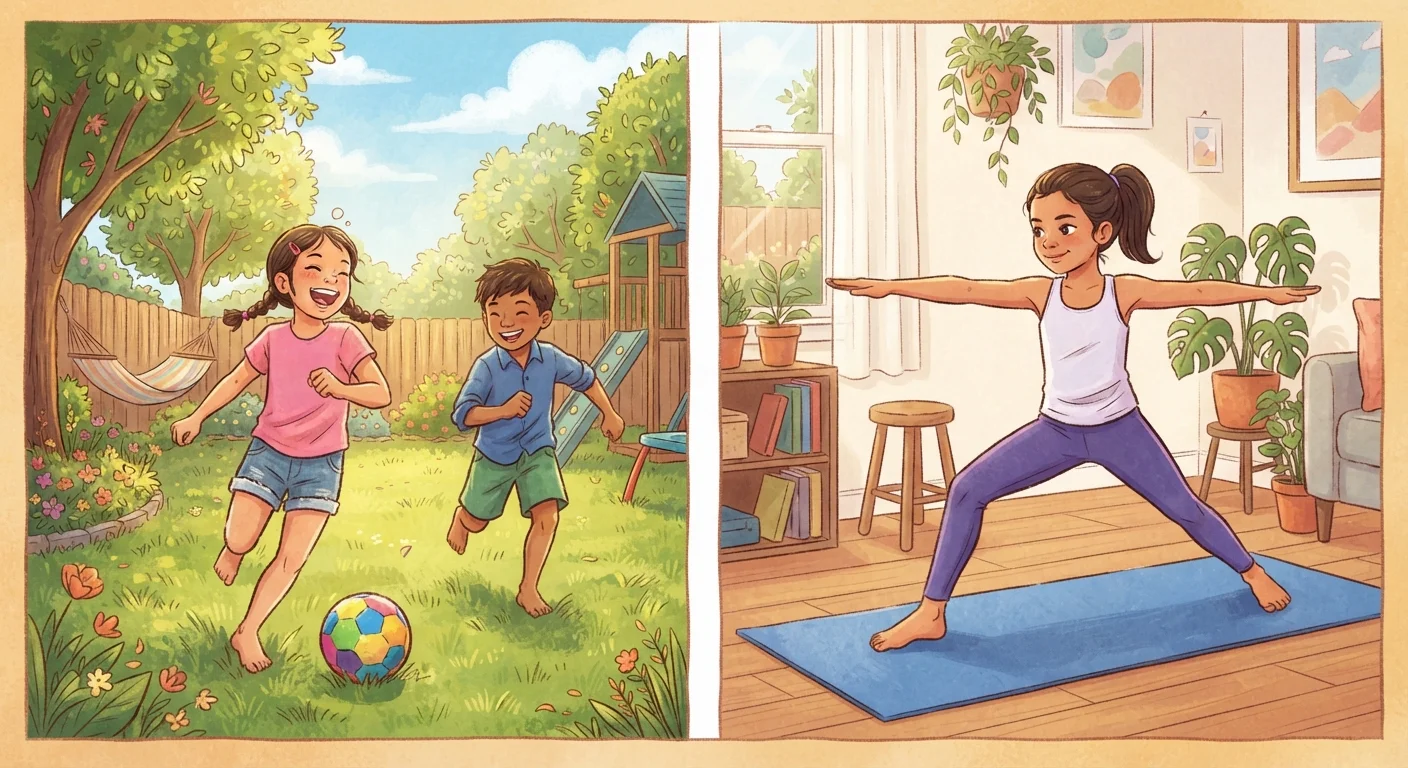
Outdoor activity and indoor workouts each bring distinct, complementary benefits to children's physical and mental development. Rather than choosing one over the other, most families will find that a flexible blend — leaning outdoor in favorable weather and shifting indoors when conditions require — produces the most consistent and enjoyable results. The goal is sustained daily movement, not a perfect setting.
Families with children of any age who want practical, low-cost ways to keep kids active regardless of season, living situation, or access to facilities.
Why the Setting Actually Matters
When it comes to keeping kids active, most conversations focus on how much children move — but the where shapes the experience in meaningful ways. The CDC and the American Academy of Pediatrics both emphasize that children aged 6–17 need at least 60 minutes of moderate-to-vigorous physical activity each day. What those guidelines leave open is the environment. For a fuller picture of how activity recommendations break down by age, see our plain-language guide to activity guidelines.
Outdoor and indoor settings each carry trade-offs that shift depending on your family's location, season, budget, and the individual child. Understanding those trade-offs helps parents make smarter, less stressful decisions day to day rather than defaulting to habit or convenience alone.
A Note on Terminology
In this article, 'outdoor activity' refers to any physical movement that takes place outside — including free play, walking, backyard games, and organized outdoor sports. 'Indoor workouts' covers structured and unstructured movement done inside the home, school, or community center. Neither term implies a formal exercise program is required. The goal in both cases is simply getting children's bodies moving consistently.
Pros and Cons of Outdoor Activity for Kids
Spending time moving outside offers benefits that go well beyond basic fitness. Exposure to natural light supports vitamin D synthesis, and research consistently links time in green spaces with improved attention, reduced anxiety, and better sleep in children. Unstructured outdoor play also encourages imagination, risk assessment, and social negotiation in ways that structured indoor sessions rarely do — see why active play counts as genuine exercise for more on this.
Supports vitamin D production through sun exposure
Natural sunlight triggers vitamin D synthesis in the skin, which plays a role in bone health and immune function. Many children have insufficient vitamin D levels, making regular outdoor time a simple, cost-free way to help address that gap.
Encourages unstructured, imaginative free play
Open outdoor environments naturally invite creative, child-led activity that builds problem-solving skills and emotional resilience. This type of play is harder to replicate in structured indoor settings.
Develops balance, coordination, and spatial awareness
Uneven terrain, climbing structures, and open spaces challenge children's bodies in varied, unpredictable ways that improve proprioception and motor development beyond what flat indoor floors offer.
Linked to improved attention and reduced stress
Research, including studies drawing on attention restoration theory, suggests that time in natural settings can reduce mental fatigue and anxiety in children, supporting focus when they return to school or homework.
Low cost and accessible without equipment
A backyard, local park, or safe sidewalk requires no membership, gear, or scheduled class — making outdoor activity one of the most budget-friendly movement options available to families.
That said, outdoor activity comes with real constraints. Weather, air quality, traffic, and neighborhood safety all affect whether going outside is practical on any given day. Seasonal limitations are particularly significant — something our guide on keeping kids moving through every season addresses directly.
Weather and seasons limit reliable access
Extreme heat, cold, rain, snow, and poor air quality days can all make outdoor activity unsafe or impractical, sometimes for weeks at a time in certain regions.
Safety concerns vary widely by neighborhood
Traffic, limited green space, and neighborhood safety concerns mean that unsupervised outdoor play is not equally accessible or appropriate for all children, particularly in dense urban areas.
Sun exposure requires sun safety precautions
While sunlight has benefits, unprotected exposure raises skin damage risk. Families need to factor in sunscreen, protective clothing, and shade — especially during peak UV hours — adding steps to outdoor activity.
The Case for Indoor Workouts and Movement
Indoor physical activity solves the consistency problem that outdoor play can't always guarantee. Dance videos, yoga, jump rope, stair circuits, and active video games can all deliver meaningful movement without requiring ideal weather or safe outdoor access. For families in apartments, dense urban areas, or regions with harsh winters, indoor options are often the more reliable backbone of a child's daily activity. As we explore in why everyday movement matters more than gym time, even household tasks and short movement breaks accumulate meaningfully over the course of a day.
60 min
Daily activity recommended for school-age children
The CDC recommends children and adolescents aged 6–17 get at least 60 minutes of moderate-to-vigorous physical activity every day, from any setting or activity type.
Only 24%
U.S. children meeting daily activity guidelines
According to CDC surveillance data, fewer than one in four American children and adolescents meet the recommended daily physical activity guidelines, highlighting the importance of any consistent movement source.
The limitations of indoor activity are real, too. Without natural light and varied terrain, children miss certain sensory and developmental inputs. Confined spaces can restrict the range of movement, and screen-based activity programs require supervision to ensure children are engaged rather than passive. The comparison between structured and free-play formats — explored in structured sports vs. free play — is worth considering when selecting indoor activity types.
Building a Routine That Uses Both
The most practical approach for most families is a flexible blend rather than a firm commitment to one setting. On days with good weather, prioritize outdoor play — even 20 minutes of backyard or park time after school counts. On rainy days, cold snaps, or days with poor air quality, have a short indoor routine ready to go: a 15-minute dance session, a simple stretching circuit, or active indoor games require no equipment and minimal space.
Comparing weekend activity bursts versus daily scattered movement shows that frequency tends to matter more than duration for children's overall health outcomes. The same logic applies here — consistent movement across both settings outperforms sporadic use of either alone. For a broader framework on building lasting family habits, Family Fitness From All Angles is a useful starting point.
This article is for general informational and educational purposes only and does not constitute medical advice. Consult a qualified healthcare professional before making changes to your child's physical activity routine, particularly if your child has any health conditions or special needs.
The content provided on our blog site traverses numerous categories, offering readers valuable and practical information. Readers can use the editorial team’s research and data to gain more insights into their topics of interest. However, they are requested not to treat the articles as conclusive. The website team cannot be held responsible for differences in data or inaccuracies found across other platforms. Please also note that the site might also miss out on various schemes and offers available that the readers may find more beneficial than the ones we cover.