

Our Verdict
Neither structured sports nor free play is universally superior — each meets different developmental needs that the other cannot fully replicate. The most effective approach for most families is a thoughtful blend: enough organised activity to build physical skills and social habits, with ample unscheduled time for child-led exploration. Families facing time or budget pressures can prioritise free play as a no-cost, high-value option without sacrificing their child's wellbeing.
| Best for | Recommended |
|---|---|
| Families seeking skill-building and social structure | Structured Sports |
| Families with limited time or budget | Free Play |
| Most children across age groups | A balanced combination of both |
| Children showing signs of burnout or pressure | Free Play (prioritised temporarily) |
What Each Approach Actually Involves
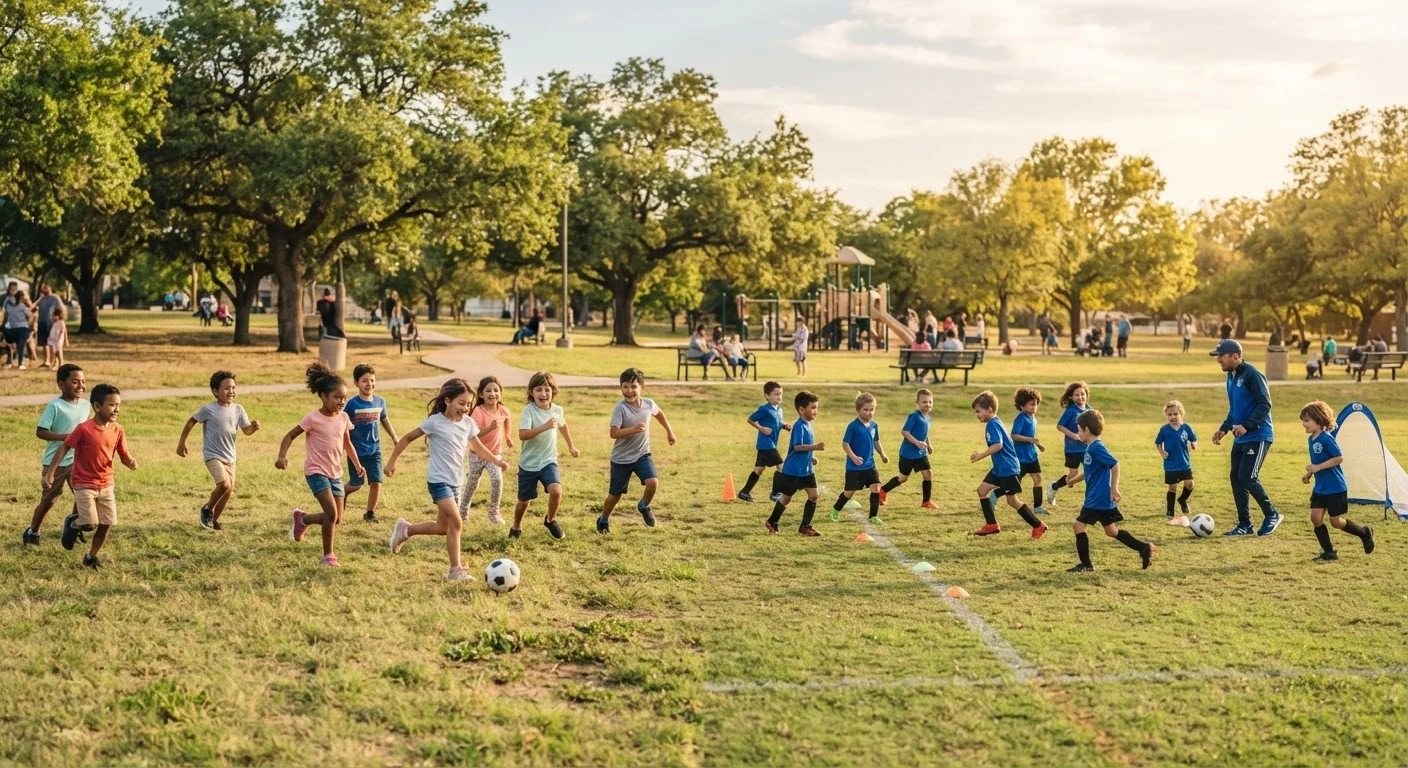
Structured sports include any adult-organised, rule-based physical activity — youth soccer leagues, swim teams, martial arts classes, and similar programmes with scheduled practices, coaching, and competitive or performance goals. Free play refers to child-initiated, self-directed activity with minimal adult interference — neighbourhood games, backyard exploration, pickup basketball, or simply running around a park.
These aren't just different ways to get kids moving. They cultivate different skills and serve different developmental purposes. Understanding what each does — and what it doesn't — helps families make intentional choices rather than defaulting to whichever one feels easiest or most familiar.
For a broader look at how movement fits into family life, see the comprehensive family fitness guide that covers building lasting physical activity habits without a gym or rigid plan.
What the Research Suggests Each Approach Builds
The CDC recommends children aged 6–17 get at least 60 minutes of moderate-to-vigorous physical activity daily. Both structured sports and free play can contribute meaningfully to that goal — but in different ways.
Structured sports tend to support:
- Consistent aerobic conditioning through regular, progressive practice
- Sport-specific motor skills such as throwing mechanics or swimming stroke technique
- Teamwork, following instructions, and respecting rules
- A sense of belonging and peer connection within a team
Free play tends to support:
- Fundamental movement skills — balance, coordination, spatial awareness — that transfer across activities
- Problem-solving and negotiation (children setting their own rules)
- Intrinsic motivation to move, which research associates with longer-term physical activity habits
- Emotional self-regulation and resilience when outcomes aren't adult-managed
Explore how each play type shapes emotional development in more depth, including creativity and resilience outcomes.
| Structured Sports | Free Play | |
|---|---|---|
| Primary developmental focus | Skill-building, discipline, teamwork | Creativity, self-regulation, intrinsic motivation |
| Typical cost | Moderate to high (fees, gear, travel) | Low to none |
| Schedule flexibility | Fixed times, advance commitment | Anytime, no planning required |
| Adult involvement | High (coaches, referees, parents) | Minimal — child-led |
| Physical fitness benefit | Consistent conditioning, sport-specific | Broad motor skills, variable intensity |
| Social learning | Team dynamics, rule-following | Peer negotiation, conflict resolution |
| Suitability by age | Most beneficial from age 6+ | Valuable from infancy through adolescence |
Practical and Financial Realities Families Face
Organised sports participation involves real costs — registration fees, equipment, uniforms, and travel — that add up quickly for families managing tight budgets. Free play, by contrast, is largely cost-free and schedule-flexible, making it accessible regardless of income or work hours.
Time is equally significant. Structured programmes lock in specific days and times, which can clash with work schedules, sibling activities, or homework demands. Free play can happen in spare pockets of the day — after school, on weekends, or during community time — without advance coordination.
Protect Unscheduled Time Intentionally
Even when children are enrolled in organised sports, build at least a few hours of genuinely unstructured time into each week. Resist the urge to fill every gap with productive activity. Child development researchers broadly agree that boredom and self-directed play are where problem-solving and imagination flourish — outcomes that structured programmes rarely replicate on their own.
Families balancing sports costs with household budgets can find practical strategies in our family budgeting hub. It's worth treating activity costs as a planned line item rather than a surprise expense.
For families who do enrol children in structured sports, the comparison of weekend activity patterns vs. daily movement can help you identify how to fill remaining activity gaps throughout the week.
Finding the Right Balance for Your Child
There's no single correct ratio of structured to unstructured activity. A useful starting framework: if a child is consistently tired, anxious about performance, or resistant to going to practice, that's a signal the balance may be off — not a character flaw to push through. Equally, a child with entirely unscheduled time who gravitates toward screens rather than movement may benefit from the natural accountability a team or class provides.
Practical steps families can take:
- Ask the child — genuine preference matters and affects long-term adherence.
- Check the schedule honestly — overscheduled children benefit from protected unstructured time.
- Rotate seasonally — one organised sport per season alongside daily free-play time is a manageable baseline for most families.
- Validate active play as real exercise — tag, bike rides, and playground time all count toward daily movement goals.
Also consider the environment: outdoor versus indoor activity trade-offs affect which option is most accessible across seasons and living situations.
This article is for general informational purposes only and does not constitute medical or professional advice. Consult a qualified healthcare provider with any concerns about your child's physical activity, development, or health.
The content provided on our blog site traverses numerous categories, offering readers valuable and practical information. Readers can use the editorial team’s research and data to gain more insights into their topics of interest. However, they are requested not to treat the articles as conclusive. The website team cannot be held responsible for differences in data or inaccuracies found across other platforms. Please also note that the site might also miss out on various schemes and offers available that the readers may find more beneficial than the ones we cover.