

Our Verdict
Structured and unstructured play each develop different but equally important emotional skills. Structured play strengthens cooperation, goal-setting, and frustration tolerance within clear frameworks, while unstructured play nurtures self-direction, emotional regulation, and creative problem-solving. Most child development experts suggest a flexible blend of both rather than prioritizing one over the other.
| Best for | Recommended |
|---|---|
| Families looking to build cooperation and social skills | Structured Play |
| Children who need to develop independence and resilience | Unstructured Play |
| Households seeking a well-rounded developmental approach | A balanced blend of both |
What Each Type of Play Actually Means
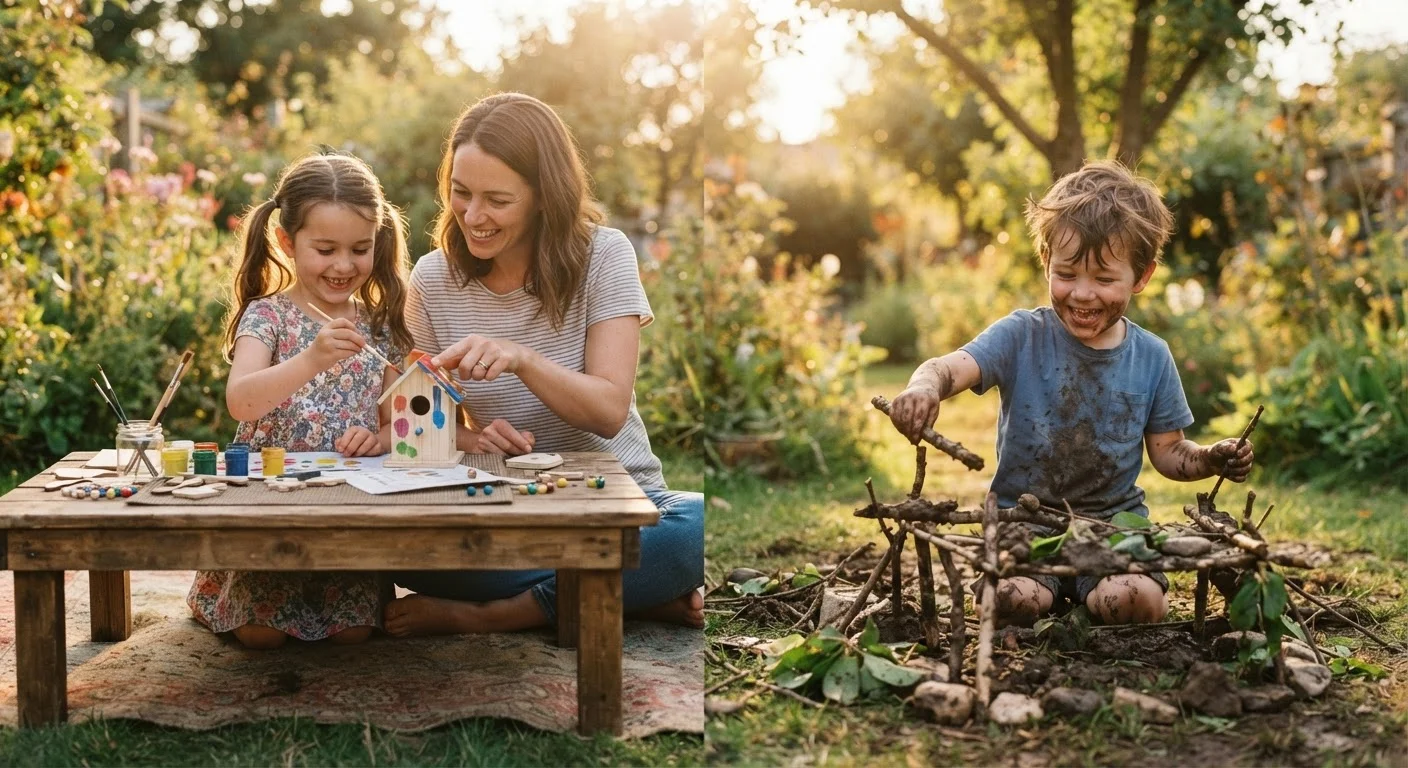
Structured play involves activities with defined rules, goals, or adult guidance — think organized sports, board games, art classes, or guided reading time. An adult or a set of instructions shapes how the activity unfolds.
Unstructured play, by contrast, is child-directed and open-ended. There is no predetermined outcome. Kids might build a fort, invent characters, dig in the backyard, or simply wander and imagine. The child decides what happens, how long it lasts, and what the rules are — if there are any at all.
Both exist on a spectrum. A partially guided craft activity, for example, sits somewhere in the middle. What matters for emotional development is less about the label and more about who is driving the experience.
For a deeper look at how physical activity fits into this picture, see what qualifies as active play and why movement matters for growing bodies.
How Structured Play Shapes Emotional Skills
When children participate in structured activities, they practice a set of emotionally demanding skills in a supported environment:
- Frustration tolerance: Following rules means sometimes losing, waiting a turn, or not getting to go first. These moments — when handled with calm adult support — help children recognize and manage disappointment.
- Cooperative behavior: Games and team activities require negotiating, taking turns, and sharing goals with others, which are foundational social-emotional skills.
- Goal orientation: Completing a structured task (finishing a puzzle, learning a skill step-by-step) builds a sense of competence and self-efficacy.
Research published in child development literature consistently links adult-guided play environments with stronger early executive function — the cluster of skills that includes impulse control, working memory, and cognitive flexibility. However, experts also caution that over-scheduling children with too many structured activities can crowd out the time children need to develop internal motivation and self-regulation on their own terms.
| Structured Play | Unstructured Play | |
|---|---|---|
| Who directs activity | Adult or rules-based framework | Child-led and self-determined |
| Primary emotional skill developed | Frustration tolerance, cooperation | Self-regulation, resilience |
| Creativity level | Within defined parameters | Open-ended and imaginative |
| Conflict resolution | Adult-mediated | Child-negotiated |
| Stress relief potential | Moderate — depends on pressure level | High — child controls the experience |
| Best developmental window | Grows with age, peaks mid-childhood | Valuable from infancy onward |
How Unstructured Play Builds Resilience and Creativity
Unstructured play is where children become the authors of their own emotional experience. Without an adult scripting outcomes, children must navigate uncertainty — and that is precisely where resilience is built.
Key emotional benefits include:
- Emotional self-regulation: When children invent their own games, disputes arise naturally. Working through these without adult intervention teaches children to manage conflict, tolerate discomfort, and recover from setbacks.
- Intrinsic motivation: Following their own curiosity — rather than external rewards — develops the inner drive that sustains wellbeing across life stages.
- Stress relief: The American Academy of Pediatrics has highlighted free play as important to children's mental health, noting that play-deprived environments are associated with higher rates of childhood anxiety.
Unstructured play also connects naturally to how children process big emotions through imaginative scenarios. This links directly to how families talk about big feelings — play is often where emotional vocabulary first develops.
Give Boredom Some Space
When children say they're bored, the instinct is often to solve it quickly. But brief boredom can be a gateway to creative, self-directed play. Rather than stepping in immediately, try waiting a few minutes — children often surprise themselves with what they come up with. This small habit builds the inner resourcefulness that underpins long-term emotional resilience.
Finding a Balance That Works for Your Family
There is no fixed formula, but developmental guidance generally supports giving children regular access to both types of play. A few practical principles can help families navigate this:
- Watch for over-scheduling signals. If a child seems persistently fatigued, irritable, or resistant to activities they previously enjoyed, it may indicate too little downtime and too much structured commitment.
- Protect unstructured time deliberately. In today's activity-dense schedules, free play rarely happens by accident. Build buffer time into afternoons or weekends and resist filling it with screens or organized tasks.
- Let structured activities stay age-appropriate. Younger children generally benefit from shorter, more loosely guided activities. The capacity to engage meaningfully in rule-based, goal-driven play increases through middle childhood.
- Stay nearby without hovering. During unstructured play, a calm adult presence without interference helps children feel safe enough to take emotional risks — like resolving a disagreement or trying something new.
For families exploring how physical activity fits into the structured vs. unstructured question, structured sports versus free play offers a useful companion perspective on physical and developmental trade-offs.
It's also worth noting that emotional regulation doesn't happen in play alone — rest plays a crucial role too. How sleep shapes emotional regulation in both children and parents is an important part of the bigger picture.
This article is for general informational purposes only and does not constitute medical or psychological advice. For concerns about your child's development or emotional wellbeing, please consult a qualified healthcare or child development professional.
The content provided on our blog site traverses numerous categories, offering readers valuable and practical information. Readers can use the editorial team’s research and data to gain more insights into their topics of interest. However, they are requested not to treat the articles as conclusive. The website team cannot be held responsible for differences in data or inaccuracies found across other platforms. Please also note that the site might also miss out on various schemes and offers available that the readers may find more beneficial than the ones we cover.