

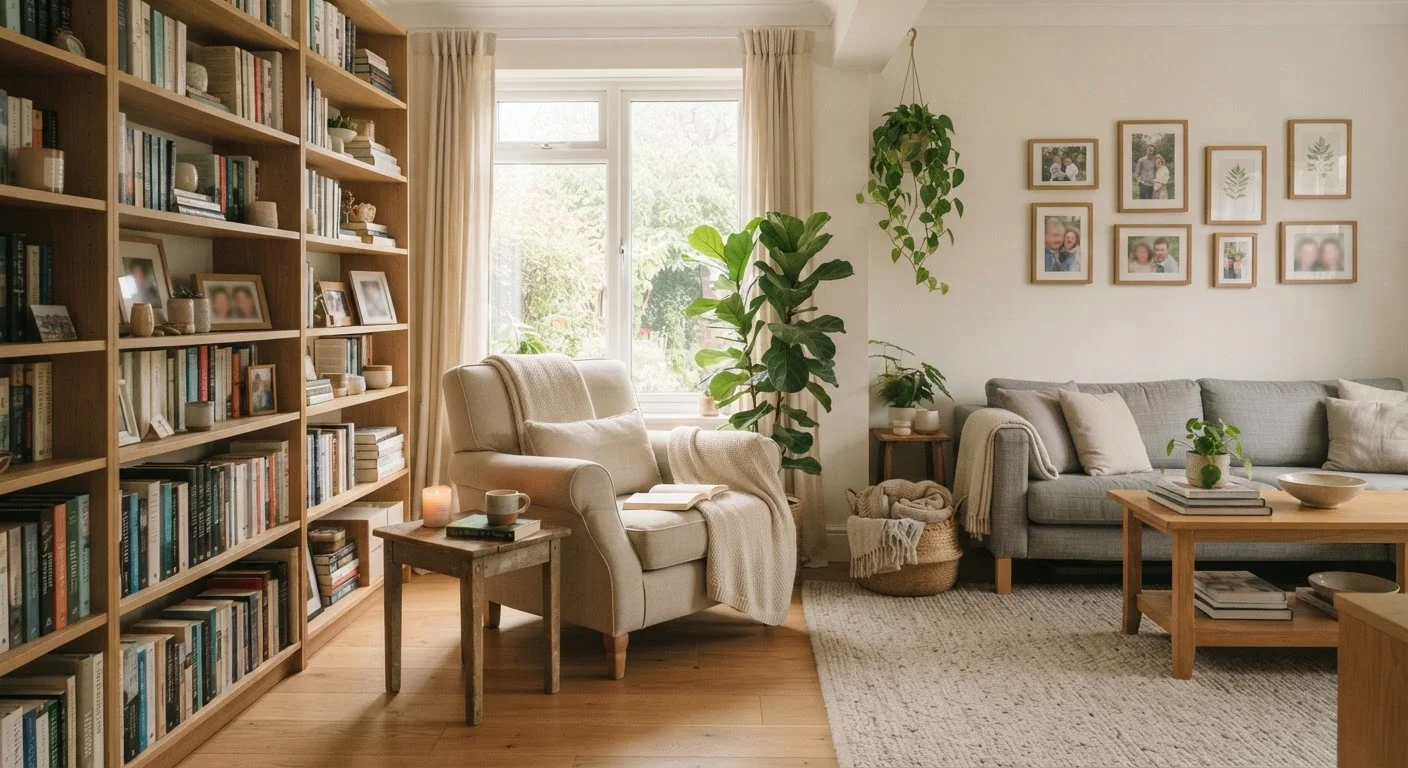
Why Your Home Environment Shapes Stress
Most families focus on what happens at home — conflicts, schedules, finances — but the physical and structural backdrop of those events matters just as much. Environmental psychology research consistently shows that our surroundings influence mood, arousal, and cognitive load in ways we often don't consciously register.
Noise levels, lighting quality, spatial crowding, and even how predictably a day unfolds all send signals to the nervous system about whether the environment is safe and manageable. For families juggling work, school, and caregiving, a home that amplifies stress rather than buffers it can compound an already stretched emotional baseline.
The good news: you don't need a renovation budget or a minimalist aesthetic. Many of the most effective changes are structural and behavioral — things like where objects live, when transitions happen, and how conflict or downtime is handled spatially.
~75%
Adults reporting home as primary stress environment
The American Psychological Association's Stress in America surveys consistently show that home and family responsibilities rank among the top reported sources of stress for U.S. adults.
2x
Cortisol elevation linked to cluttered home spaces
A study in Personality and Social Psychology Bulletin found measurably higher cortisol profiles in participants who described their homes as cluttered versus those who described them as restful.
10 min
Minimum daily reset shown to reduce perceived disorder
Behavioral research on home organization suggests that brief, consistent tidying sessions — as short as 10 minutes — can meaningfully reduce the psychological burden of household clutter.
Clutter, Sensory Load, and the Brain
Research published in the journal Personality and Social Psychology Bulletin found that women who described their homes as cluttered or unfinished had higher levels of cortisol — the body's primary stress hormone — throughout the day compared to those who described their homes as restful. This isn't about perfectionism; it's about how the brain processes an environment full of unresolved visual signals.
Clutter functions as a kind of background noise. The brain registers incomplete tasks and disordered objects as open loops, which consume attentional resources even when you're not consciously thinking about them. For children, particularly those who are highly sensitive or who process sensory input intensely, a chaotic environment can make emotional regulation genuinely harder.
Understanding why clutter feels so overwhelming is a useful first step. Simple interventions — consistent storage homes for frequently used items, a daily 10-minute reset, and one-in-one-out habits — can reduce the cognitive drag without requiring a full overhaul. See our home organization hub for practical room-by-room approaches.
Designing Calm Into Your Physical Space
A stress-aware home doesn't need to look any particular way, but a few evidence-informed design principles are worth considering:
- Natural light: Exposure to daylight regulates circadian rhythms and is associated with improved mood. Where possible, keep daytime gathering areas bright and save warmer, dimmer lighting for evenings.
- Acoustic management: Persistent noise — TVs left on, overlapping conversations, hard floors that echo — raises ambient arousal. Rugs, soft furnishings, and door habits all help. This is especially relevant if you're weighing open-plan layouts, which can amplify sound across the home.
- Designated retreat space: Every family member benefits from a physical spot they can go to decompress — a reading corner, a bedroom, even a chair. This doesn't require extra square footage; it requires agreement that the space is used that way.
- Shared anchor points: A kitchen table used for meals without screens, a couch corner for conversation — these create low-effort opportunities for connection that buffer stress at the household level.
Assign a physical 'landing zone' near your front door for bags, shoes, and daily items. When arrival triggers immediate disorganization, it sets a stressed tone for the whole household.
The transition from outside to inside is a high-friction moment. A defined drop zone reduces the micro-decisions and visual chaos that accumulate at entry points.
Use warm-toned, lower-intensity bulbs in living and bedroom areas after 7 p.m. to help the household's nervous system shift toward rest mode.
Light temperature directly influences melatonin production. Bright, cool-toned lighting in the evening signals daytime alertness to the brain, making family wind-down harder.
When thinking about seasonal shifts, adjusting your home's setup throughout the year can help you maintain calm in changing conditions without a constant reset.
Daily Rhythms That Buffer Household Stress
Predictability is a powerful stress regulator, especially for children. When the sequence of a day is broadly consistent — even if the specific timing varies — the nervous system operates with less background vigilance. Behavioral science research consistently finds that routines reduce decision fatigue for adults and provide emotional security for children.
A few high-leverage rhythm points for families:
- Morning anchors: A brief, consistent start to the day (same wake time, a shared few minutes before devices come on) sets a calmer tone than reactive mornings.
- Transition rituals: The shift between school/work and home is a stress flashpoint. A brief buffer — a snack, a short walk, even 10 quiet minutes — helps everyone reorient before the evening begins.
- Evening wind-down: Screens, particularly those emitting blue light, interfere with melatonin production and make the nervous system harder to settle. Building a family wind-down routine doesn't need to be elaborate — it just needs to be consistent.
Small daily habits carried out consistently tend to outperform occasional large interventions when it comes to household wellbeing. For families also navigating financial stress, which is among the most common sources of household tension, the family budgeting hub offers grounded, practical starting points.
Start With One Routine, Not a System
If your household has no consistent daily structure, the temptation is to design an elaborate schedule. Instead, identify the single highest-stress transition of your day and build one consistent ritual around it. Anchor that habit for two to three weeks before adding another. Small, maintained changes outperform ambitious systems that collapse under real-life pressure.
Supporting Children in a Stress-Aware Home
Children absorb the emotional tone of their environment even when adults think they aren't paying attention. A home that models calm — through how conflict is handled, how transitions are communicated, and how feelings are named — builds the emotional vocabulary children need to manage their own stress over time.
A few principles worth applying:
- Name the environment: When the home feels chaotic, saying so plainly — "It's been a loud day, let's all take a break" — normalizes the experience without escalating it.
- Separate stress from anxiety: Not all distress is the same. Understanding the difference between stress and anxiety in children can help parents respond more precisely.
- Screen placement matters: Where and when children encounter screens shapes their attention patterns and emotional regulation. The research on screen time and family mental health is more nuanced than headlines suggest — context and content both matter.
- Physical activity as a buffer: Movement genuinely helps children (and adults) discharge stress hormones. Whether that's structured activity or scattered daily movement, the key is regularity rather than intensity.
Avoid Framing Calm as a Standard Children Must Meet
A stress-aware home is a support structure, not a performance expectation. Children who feel they must appear calm or happy to avoid upsetting the household atmosphere may suppress genuine distress rather than express it. Prioritize openness over appearance of calm — model naming emotions rather than hiding them.
When to Seek Outside Support
Environmental strategies and routine-building are meaningful tools, but they work best as prevention and maintenance — not as substitutes for professional support when stress has become chronic, disabling, or is affecting a family member's safety or functioning.
If a parent or child is showing persistent signs of overwhelm, withdrawal, difficulty sleeping, or behavioral changes that don't ease with routine adjustment, it's worth speaking with a qualified healthcare provider or mental health professional. Parents may also find it useful to do a regular mental wellbeing check-in to catch patterns before they escalate.
Persistent Stress Warrants Professional Guidance
If any family member is experiencing chronic stress, anxiety, or mood changes that persist beyond a few weeks or interfere with daily functioning, environmental adjustments alone are not sufficient. Please reach out to a qualified healthcare provider or licensed mental health professional. In a mental health emergency, contact the 988 Suicide and Crisis Lifeline by calling or texting 988.
This article is for general informational and educational purposes only and does not constitute medical or mental health advice. Always consult a qualified healthcare professional for concerns about your own or your family's physical or mental health.
The content provided on our blog site traverses numerous categories, offering readers valuable and practical information. Readers can use the editorial team’s research and data to gain more insights into their topics of interest. However, they are requested not to treat the articles as conclusive. The website team cannot be held responsible for differences in data or inaccuracies found across other platforms. Please also note that the site might also miss out on various schemes and offers available that the readers may find more beneficial than the ones we cover.