

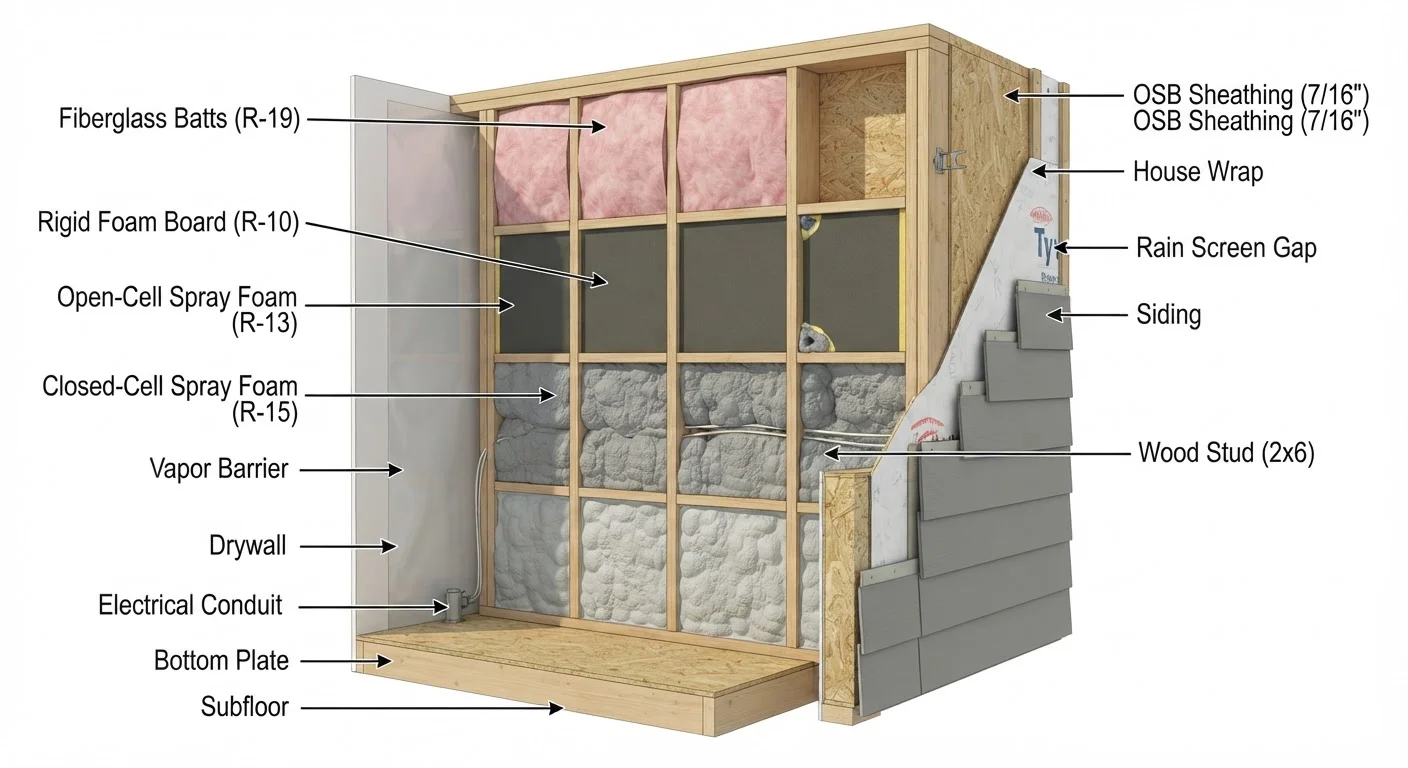
Why Insulation Type Matters
Not all insulation performs the same way — and using the wrong type in the wrong location can undercut both energy efficiency and home comfort. Each insulation material has a distinct structure, installation method, and ideal application. Before choosing one, it helps to understand the fundamental measure: R-value, or thermal resistance. The higher the R-value, the more resistance the material provides against heat flow.
Most U.S. climate zones require different R-values for attics, walls, and floors — and local building codes often specify minimums. Always verify requirements with your local building department or a licensed contractor before starting a project. If you want to pinpoint where your home is already losing heat or cool air, a room-by-room weatherproofing audit is a smart first step.
| R-value range: Fiberglass batts | R-2.9 to R-3.8 per inch (U.S. Department of Energy) |
| R-value range: Blown-in cellulose | R-3.2 to R-3.8 per inch (U.S. Department of Energy) |
| R-value range: Closed-cell spray foam | R-6.0 to R-7.0 per inch (U.S. Department of Energy) |
| R-value range: Polyisocyanurate rigid board | R-5.6 to R-8.0 per inch (U.S. Department of Energy) |
| Recommended attic R-value (most U.S. zones) | R-38 to R-60 (DOE Climate Zone Guidelines) |
| Spray foam: DIY-appropriate? | No — professional installation recommended |
The Four Main Insulation Types
Batt Insulation
Batts — sometimes called blanket insulation — come pre-cut in rolls or panels sized to fit standard stud and joist spacing. Fiberglass is the most common material, though mineral wool (also called rock wool) batts are also widely available. Batts are a popular DIY choice for open wall cavities, attic floors, and crawl spaces because they require no special equipment. Proper installation matters: gaps, compression, or facing errors can significantly reduce effective performance.
Blown-In (Loose-Fill) Insulation
Blown-in insulation consists of small particles — typically fiberglass, cellulose, or mineral wool — blown into place with a pneumatic machine. This makes it excellent for irregularly shaped spaces, attic floors with obstructions, and existing walls without open cavities. Cellulose, made largely from recycled paper, is treated for fire and pest resistance. Because the blowing machine is usually rented or provided by a contractor, this method sits at the edge of advanced DIY territory.
Spray Foam Insulation
Spray polyurethane foam (SPF) expands after application, sealing both air gaps and providing thermal resistance simultaneously. It comes in two forms: open-cell foam, which is softer and more vapor-permeable, and closed-cell foam, which is denser and delivers a much higher R-value per inch. Closed-cell foam also acts as a vapor barrier in many climates. Spray foam is best applied by licensed professionals — improper application can create moisture problems or off-gas irritants during curing. This is not a recommended DIY project.
Rigid Board Insulation
Rigid foam boards — including expanded polystyrene (EPS), extruded polystyrene (XPS), and polyisocyanurate (polyiso) — offer high R-values in thin profiles. They're commonly used on exterior walls, under slabs, and in basement applications where moisture resistance is important. Boards must be covered with a fire-rated material like drywall when used indoors. Cutting and fitting boards requires care, but the process is manageable for experienced DIYers on appropriate projects.
R-value
A measure of an insulation material's resistance to heat flow. Higher R-values mean greater insulating effectiveness. Required minimums vary by climate zone and building location.
Vapor barrier
A material that resists the movement of moisture (water vapor) through walls, ceilings, or floors. Some insulation types, like closed-cell spray foam, can function as vapor barriers.
Thermal bridging
Heat loss that occurs through structural elements like studs, joists, or concrete that conduct heat more easily than insulation materials. Rigid board on exterior walls can help reduce thermal bridging.
Open-cell vs. closed-cell foam
Two types of spray polyurethane foam. Open-cell foam has a softer texture and lower R-value per inch. Closed-cell foam is denser, provides higher R-values, and resists moisture more effectively.
Loose-fill (blown-in)
Insulation made of small particles or fibers blown into place using a machine. It conforms to irregular spaces and is commonly used in attics and existing wall cavities.
Climate zone
A geographic designation used by the DOE and building codes to define minimum insulation requirements. The U.S. is divided into eight zones based on heating and cooling demands.
Choosing the Right Insulation for Your Project
The best insulation choice depends on where it's going, your budget, your climate zone, and whether you plan to hire a professional or handle installation yourself.
Permits and Codes May Apply
Insulation work can require building permits in many jurisdictions, particularly when part of a larger renovation. Local energy codes may also specify minimum R-values for specific applications. Always check with your local building department before beginning, and ask a licensed contractor if you're uncertain whether your project requires inspection.
- Attic floor: Blown-in cellulose or fiberglass; batts also work in open joist bays
- Open wall cavities (new construction or renovation): Batts or open-cell spray foam
- Existing finished walls: Blown-in loose-fill via small drilled holes
- Rim joists and tight gaps: Closed-cell spray foam (professional application)
- Exterior walls, basement walls, under slabs: Rigid foam board
When in doubt, consult a certified home energy auditor or licensed insulation contractor. They can assess your home's specific conditions — including moisture levels, existing insulation, and local code requirements — before recommending a solution.
The content provided on our blog site traverses numerous categories, offering readers valuable and practical information. Readers can use the editorial team’s research and data to gain more insights into their topics of interest. However, they are requested not to treat the articles as conclusive. The website team cannot be held responsible for differences in data or inaccuracies found across other platforms. Please also note that the site might also miss out on various schemes and offers available that the readers may find more beneficial than the ones we cover.