

Why Mental Stimulation Can't Be an Afterthought
Most families focus on walktime when thinking about their dog's needs — and exercise absolutely matters. But a dog's brain needs a workout just as much as its body. When a dog doesn't have enough mental engagement, boredom can show up as chewing, excessive barking, or restless energy that makes an already busy household feel more chaotic.
The good news: meaningful mental enrichment doesn't require hours of free time. It requires creativity and consistency. Even on packed school-and-work days, there are simple ways to keep your dog's mind engaged. The structure of a predictable daily routine also plays a big role — dogs feel calmer and more settled when they know what to expect.
Below are seven practical enrichment ideas sized for real family life.
Use mealtimes as training opportunities
Instead of setting a bowl down and walking away, turn feeding into a brief training session. Ask your dog to sit, stay, or practice a new cue before placing the food down. Even two to three minutes of this at each meal adds meaningful mental effort to your dog's day — and reinforces good manners at the same time.
If mornings are rushed, simply scattering dry kibble across a snuffle mat (a mat with fabric strips that hides food) gives your dog several minutes of nose-driven foraging that taps into natural instincts.
Two minutes of training before meals delivers outsized mental benefits without disrupting your morning.
Offer food puzzles and enrichment feeders
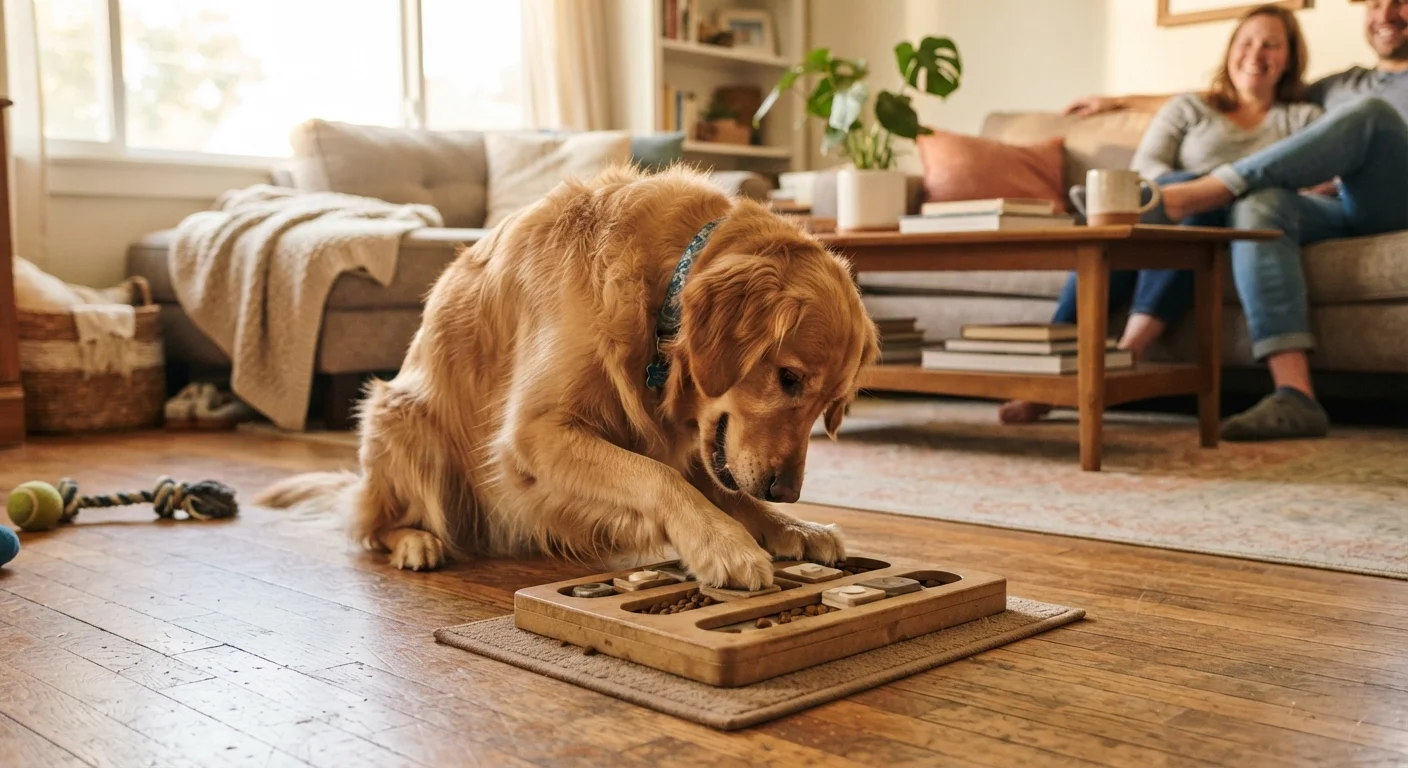
Food puzzles — devices that require your dog to push, roll, or flip compartments to release kibble or treats — are one of the most time-efficient enrichment tools available. They can occupy a dog for 10 to 20 minutes with no supervision needed once your dog understands how they work.
Start with a simpler design and gradually increase the difficulty as your dog becomes more confident. A dog that figures out a puzzle independently builds problem-solving confidence, which can reduce anxiety-driven behaviors over time.
Food puzzles give dogs meaningful solo mental work when family attention isn't available.
Incorporate "sniff breaks" into walks
Structured walks are valuable, but a shorter walk that allows genuine sniffing can be more mentally satisfying for your dog than a brisk 30-minute pace with a tight leash. Scent processing is cognitively demanding for dogs — research in animal behavior consistently suggests that sniffing actually tires dogs out more efficiently than physical exertion alone.
Try designating a portion of each walk as a "free sniff" zone where your dog leads and explores. This requires almost no extra time from you but meaningfully shifts the mental load of the outing.
Sniffing tires a dog's brain faster than running — don't underestimate a slow, nose-led walk.
Rotate toys to keep novelty alive
A dog surrounded by the same toys every day quickly loses interest in them. Toy rotation — keeping most toys stored out of sight and swapping in a few different ones every few days — restores novelty and encourages play without requiring you to buy anything new.
This approach mirrors the same principle behind why incidental variety in daily life matters for engagement. You might think of it the way everyday movement matters more than a single gym session — consistent small variety beats occasional big events.
Rotating toys costs nothing and reliably refreshes your dog's interest in what they already own.
Teach one new skill at a time
Learning a new behavior — whether it's "leave it," "find it," or simply a fun trick like spinning — is one of the richest forms of mental stimulation a dog can experience. Five-minute training sessions two or three times a week are enough to make real progress while fitting into any family schedule.
Keep sessions short and always end on a successful repetition. Dogs learn better in brief, frequent sessions than in long ones, and a training win at the end leaves them in a positive, engaged state of mind.
Five focused minutes of skill-building training several times a week is enough to see real progress.
Set up backyard or indoor "scent games"
Hide small amounts of your dog's regular food or a favorite treat around the yard, garden, or even across a few rooms indoors, then release your dog to find them. This "find it" game engages your dog's most powerful sense and can last 10 to 15 minutes with minimal effort from you.
Children often enjoy hiding the treats themselves, making this a natural family activity. Just keep track of where treats are hidden so nothing is forgotten in upholstery or corners.
A backyard scent hunt keeps dogs genuinely busy and naturally includes the kids.
Use grooming sessions as calm engagement time
Regular brushing and handling — done calmly and positively — give your dog sensory input and low-key interaction that counts as enrichment. When a dog is comfortable being handled, grooming becomes a settling ritual rather than a stressor. If your dog tends to get anxious during grooming, our guide to grooming at home without causing stress walks through techniques for making it a peaceful routine.
Even a five-minute daily brush gives your dog dedicated one-on-one attention, which itself is a form of mental and emotional enrichment for social animals.
Calm, consistent grooming sessions provide sensory enrichment and strengthen your dog's trust in you.
Making It a Family Effort
The most sustainable enrichment strategies are ones the whole household can share. When children are involved in feeding puzzles, training games, or backyard sniff sessions, the dog benefits from extra interaction and the kids build empathy and responsibility. If you're also working on teaching your dog to stay calm around children, structured enrichment games give kids and dogs a safe, positive way to interact under light supervision.
Start with one or two ideas from this list and build from there. Small, consistent moments of engagement add up quickly — and a mentally satisfied dog is generally a calmer, more enjoyable companion for the entire family.
Start small and build gradually
If enrichment feels like another item on an already long to-do list, begin with just one strategy — like a snuffle mat at dinnertime — and run it consistently for a week before adding anything else. Habits that stick are more valuable than elaborate plans that fade. Even one reliable enrichment moment per day makes a measurable difference to your dog's emotional state.
The content provided on our blog site traverses numerous categories, offering readers valuable and practical information. Readers can use the editorial team’s research and data to gain more insights into their topics of interest. However, they are requested not to treat the articles as conclusive. The website team cannot be held responsible for differences in data or inaccuracies found across other platforms. Please also note that the site might also miss out on various schemes and offers available that the readers may find more beneficial than the ones we cover.