

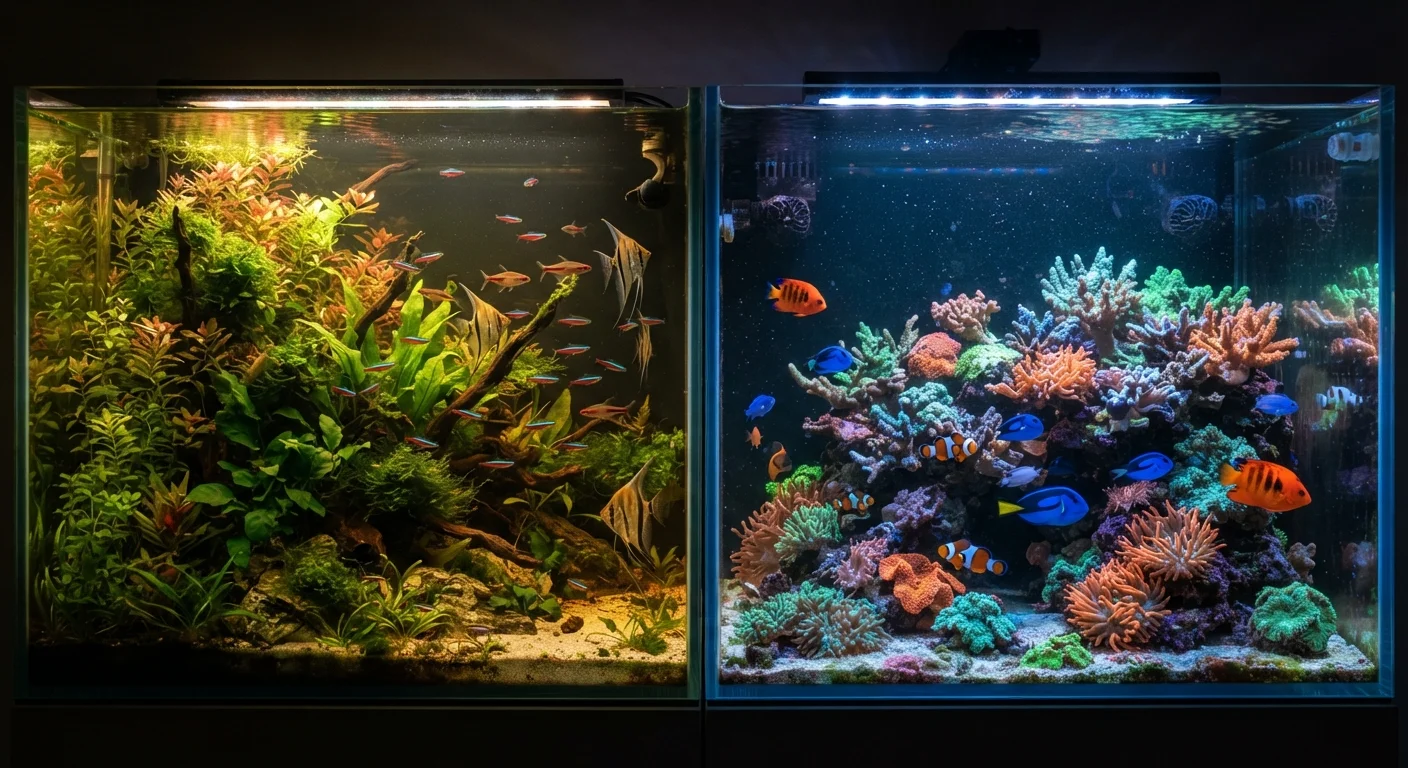
Option A
Freshwater Aquarium
The accessible, forgiving starting point for most families.
Best for: Families new to fishkeeping who want an engaging, lower-maintenance tank without a steep learning curve.
Option B
Saltwater Aquarium
The visually stunning, high-commitment reef experience.
Best for: Experienced or dedicated hobbyists ready to invest significant time, money, and ongoing attention into a living ecosystem.
Setting Up: Equipment and Starting Costs
One of the most immediate differences between freshwater and saltwater aquariums shows up before a single fish enters the water — in the equipment list and the total outlay required to get started.
A basic freshwater setup — tank, filter, heater, lighting, substrate, and a water conditioner — can come together for a relatively modest investment. Many families launch a functional 20-gallon freshwater tank without spending heavily, and starter fish like tetras, livebearers, or danios are widely available and inexpensive. If goldfish interest you, our guide to goldfish care myths can help you separate fact from fiction before you commit to a species.
Saltwater systems demand considerably more. A protein skimmer — a device that removes organic waste from the water column — is considered essential rather than optional. Live rock (porous rock that hosts beneficial bacteria and organisms) adds both biological filtration and significant cost. If you plan a reef tank with live coral, high-output lighting suited to coral growth is necessary, adding further expense. Altogether, a modestly sized saltwater tank often requires two to four times the upfront investment of a comparable freshwater setup.
| Criterion | Freshwater Aquarium | Saltwater Aquarium |
|---|---|---|
| Typical startup cost | Lower (modest investment) | Higher (2–4× freshwater) |
| Weekly time commitment | 30–60 minutes | 1–3+ hours |
| Water chemistry complexity | Moderate (pH, hardness, ammonia) | High (salinity, alkalinity, calcium) |
| Fish hardiness | Generally forgiving | Often sensitive |
| Livestock cost | Low to moderate | Moderate to very high |
| Beginner-friendliness | High | Low to moderate |
| Visual impact potential | High (planted tanks) | Very high (reef tanks) |
Ongoing Maintenance: Time and Attention Required
Both tank types need regular care, but the depth of attention saltwater aquariums demand is markedly higher. For freshwater tanks, a typical weekly routine involves a partial water change (around 20–25% of tank volume), checking the filter, and monitoring water temperature. Most hardy freshwater species tolerate minor parameter fluctuations without serious harm.
Saltwater tanks require all of that and more. Hobbyists must regularly test for salinity (using a hydrometer or refractometer), along with parameters such as alkalinity, calcium, and magnesium — especially if keeping coral. Evaporation in a saltwater tank raises salinity, so topping off with fresh water is a near-daily task. Equipment failures in a marine tank can cause rapid, cascading harm to its inhabitants, so attentive monitoring matters more.
~80%
Of new aquarium hobbyists start with freshwater
Industry hobbyist surveys consistently show freshwater tanks represent the large majority of first-time setups in the US.
2–4×
Higher typical startup cost for saltwater vs. freshwater
Equipment differences — protein skimmers, live rock, specialized lighting — account for the bulk of the cost gap.
This is not meant to discourage saltwater enthusiasm — many families find the ritual of reef care genuinely meditative. But setting realistic expectations upfront prevents the frustration of a neglected, struggling tank.
Livestock: Fish, Coral, and Compatibility
The variety of freshwater fish available to hobbyists is extraordinary. Community tanks can mix peaceful species from South America, Africa, and Southeast Asia, and planted aquascapes — tanks designed with live aquatic plants as the centerpiece — have become a deeply creative branch of the hobby. Freshwater fish are also considerably hardier, making them better suited to the occasional beginner error in water quality or feeding.
Marine fish and invertebrates are among the most visually striking animals kept as pets, but they come with trade-offs. Many popular saltwater species, such as clownfish and tangs, are sensitive to water quality, incompatible with certain tank mates, or require specific feeding routines. Coral, if you choose a reef tank, adds another layer: different coral species have varying needs for water flow, light intensity, and nutrient levels.
A Note on Cycling — Both Tanks Need It
Regardless of which type you choose, all aquariums must go through a nitrogen cycle before fish are added. This process, which can take four to six weeks, establishes beneficial bacteria that convert toxic ammonia from fish waste into less harmful compounds. Skipping or rushing this step is one of the most common causes of early fish loss. Both freshwater and saltwater tanks require patience during this phase — there are no shortcuts that reliably protect your fish.
Livestock costs reflect this complexity. A common freshwater species might cost a few dollars, while desirable marine fish or coral frags frequently run into the tens or even hundreds of dollars per specimen. Losses in a saltwater tank are therefore both more emotionally and financially costly.
The content provided on our blog site traverses numerous categories, offering readers valuable and practical information. Readers can use the editorial team’s research and data to gain more insights into their topics of interest. However, they are requested not to treat the articles as conclusive. The website team cannot be held responsible for differences in data or inaccuracies found across other platforms. Please also note that the site might also miss out on various schemes and offers available that the readers may find more beneficial than the ones we cover.