

Why a Maintenance Log Is Worth the Effort
Most families track their finances, medical appointments, and school schedules carefully - but leave their vehicle's service history to memory or luck. That gap has real consequences. When you can't tell a mechanic whether the transmission fluid was ever changed, or whether the timing belt is original, diagnosis takes longer and guesswork costs you money.
A complete log also supports your car's value when you eventually sell or trade it in. Prospective buyers and dealers are more confident in a vehicle with documented care than one with a blank history. According to general automotive industry guidance, verifiable service records are among the factors that help justify a higher asking price for used vehicles - though actual outcomes vary depending on the vehicle, condition, and market.
Beyond money, there's a safety dimension. The small tasks that quietly turn into big failures - brake fluid degradation, coolant neglect, worn belts - are exactly the items a log helps you catch before they strand your family on the road. And as explored in routine maintenance families tend to skip, the most overlooked services are often the ones with the steepest long-term costs.
Snap a Photo of Every Receipt
After any service visit, photograph the shop invoice and store it in a dedicated folder on your phone or cloud storage. This gives you a backup record even if your written log is lost or damaged. Dealers and private buyers often find physical receipts more convincing than handwritten notes alone.
For families new to vehicle ownership, this habit pairs naturally with the broader guidance in car maintenance for families who know nothing about cars.
What to Track and How to Get Started
Before diving into the steps below, gather what you need and decide on your format.
What you will need
Spiral notebook or pocket binder
Serves as a portable, durable paper log stored in the glove box for quick access at any service visit.
Vehicle maintenance app
Digitizes your log with automatic reminders and cloud backup, useful if you prefer not to manage paper records.
Owner's manual
Provides manufacturer-recommended service intervals so you know what to track and when.
Pen or pencil
For recording entries immediately after each service while details are fresh.
Gather your existing service records
Before you can move forward, establish what you already know. Collect every receipt, sticker, or service summary you can find - check the glove box, your email inbox (many shops send digital summaries), and any past inspection reports. Note the odometer reading for each documented service. If you have no records at all, that's fine; you're simply starting fresh from today's mileage.
Choose your log format
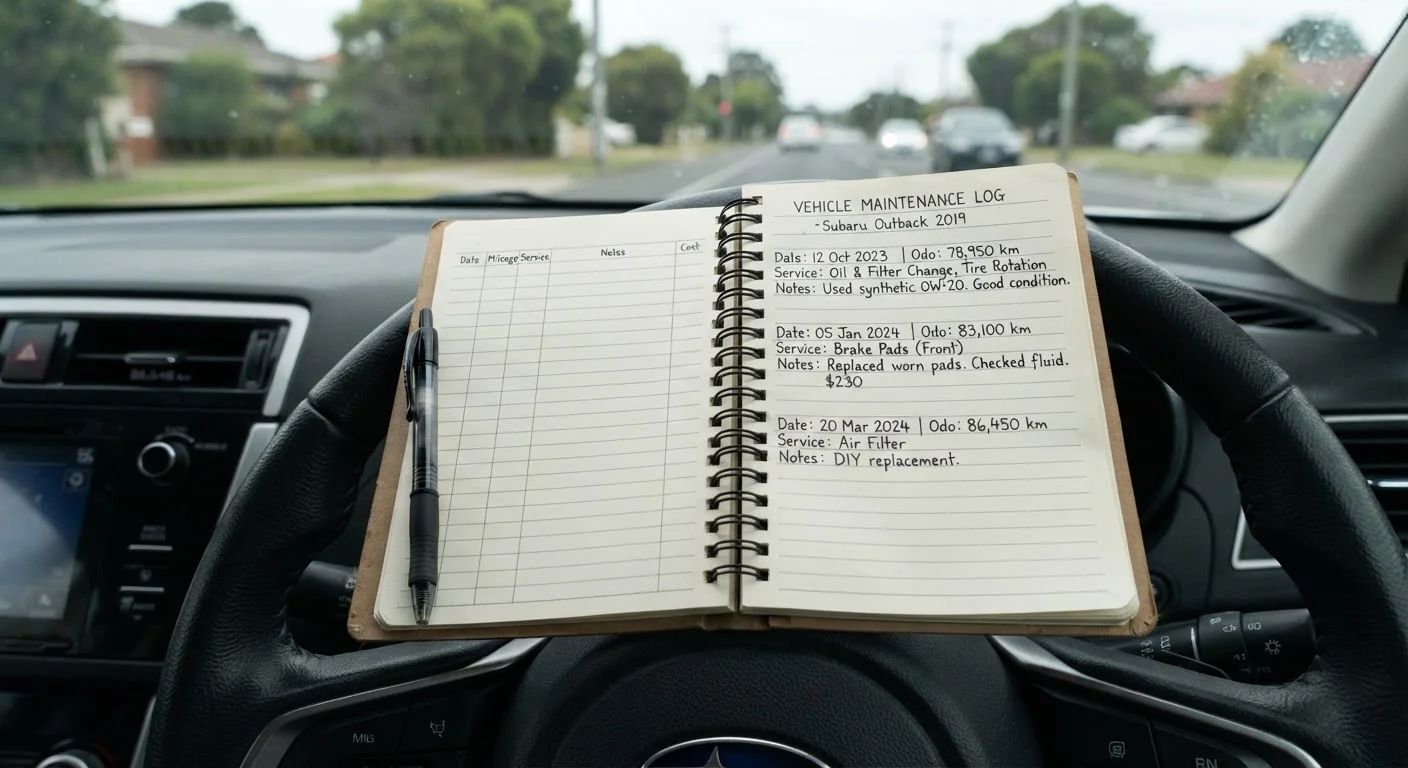
Pick one format and commit to it. A dedicated section of a small spiral notebook kept in the glove box works well for most families. If you prefer digital, look for apps designed specifically for vehicle maintenance tracking - many allow you to set mileage- or time-based reminders. Avoid splitting records between two systems; a single source of truth is far more useful when a mechanic or buyer asks for the history.
Set up your log's basic columns
Every entry in your log should capture at minimum: the date, the current odometer mileage, what was done, where it was done (DIY or shop name), and the cost. You can add a column for parts used or the next recommended service interval. Consistency matters more than complexity - a simple five-column table repeated across pages is enough.
Enter your historical records
Transfer whatever past service data you gathered in Step 1 into your log, oldest first. Even a partial history is better than none. Include the mileage if known, or estimate based on dates and your typical annual mileage. Mark estimated entries clearly so future readers know the data is approximate.
Record each new service immediately
The log only stays accurate if you update it promptly. Fill in an entry the same day a service is performed - before the receipt gets lost in a stack of papers. If a mechanic hands you a detailed invoice, staple it to the corresponding page in a binder, or photograph it as a backup. Delayed entries are frequently incomplete or inaccurate.
Review your log every six months
Set a recurring reminder - aligned with, say, daylight saving time changes - to flip through your log and check what's coming due. Cross-reference upcoming intervals against your owner's manual recommendations. This review takes less than ten minutes and helps you stay ahead of scheduled maintenance rather than reacting to warning lights.
Keep Your Log With the Car
A maintenance log only works if it's accessible when you need it - at the shop, at a dealership trade-in desk, or when a warning light comes on. Store a paper log in the glove box or center console. If you use a digital app, make sure it's backed up to the cloud so you don't lose records if your phone is replaced.
Don't Rely Solely on the Dealer's System
Many dealerships and quick-lube chains keep digital records of work they perform, but those records live in their system - not yours. If you switch shops, move, or the business closes, that history may be unavailable. Your own log is the only record guaranteed to follow the car wherever it goes.
Once your log is running, consider pairing it with a consistent service routine. The car care routine guide for busy families offers practical scheduling strategies that fit around real family life. Think of the log as the memory behind whatever routine you build - it's what turns good intentions into documented results.
Understanding the full picture of car ownership costs is much easier when you have a record showing exactly what you've spent on maintenance over time. Your log becomes both a planning tool and a financial snapshot.
The content provided on our blog site traverses numerous categories, offering readers valuable and practical information. Readers can use the editorial team’s research and data to gain more insights into their topics of interest. However, they are requested not to treat the articles as conclusive. The website team cannot be held responsible for differences in data or inaccuracies found across other platforms. Please also note that the site might also miss out on various schemes and offers available that the readers may find more beneficial than the ones we cover.