

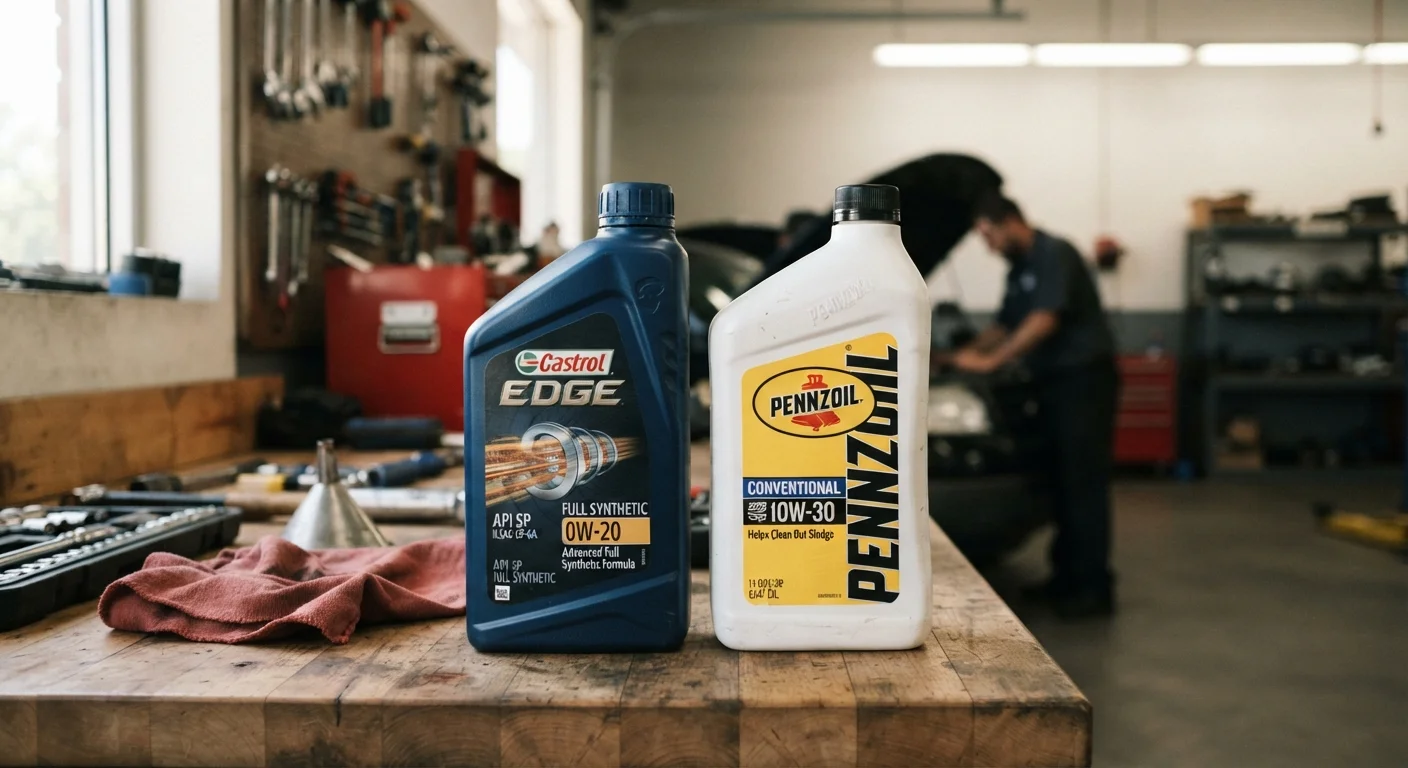
Option A
Synthetic Motor Oil
The engineered, high-performance lubricant.
Best for: Drivers with newer vehicles, turbocharged engines, extreme climates, or longer intervals between oil changes.
Option B
Conventional Motor Oil
The time-tested, widely available standard.
Best for: Owners of older vehicles with lower mileage demands or engines specifically designed for conventional oil.
What Makes These Two Oils Different
Motor oil has one core job: reduce friction between moving metal parts inside your engine. Both synthetic and conventional oil do this, but they're made in fundamentally different ways.
Conventional motor oil starts as crude petroleum pumped from the ground. Refiners process it to remove impurities and blend in additives - but because it originates from a natural substance, its molecules vary slightly in size and shape. That inconsistency is minor in normal conditions, but it matters when temperatures push to extremes or when the oil begins to degrade.
Synthetic motor oil is built in a laboratory. Chemists construct uniform molecules tailored specifically to lubricate and protect engines. The result is a more consistent product that resists breaking down under heat, flows better in cold temperatures, and leaves fewer deposits over time.
Think of it this way: conventional oil is like river water filtered for drinking - functional and widely used - while synthetic is more like purified distilled water engineered for a precise purpose. Neither is inherently dangerous to your engine when used as directed. What matters is matching the right oil to what your engine actually needs.
| Criterion | Synthetic Oil | Conventional Oil |
|---|---|---|
| Origin | Chemically engineered in a lab | Refined from crude petroleum |
| Molecular consistency | Uniform, purpose-built molecules | Variable natural molecules |
| Cold-weather performance | Flows readily at low temperatures | Thickens more in cold conditions |
| Heat resistance | Holds up better under high heat | Breaks down faster at extremes |
| Typical change interval | Often 7,500-10,000+ miles (per manual) | Often 3,000-5,000 miles (per manual) |
| Cost per quart | Generally higher | Generally lower |
| Best suited for | Turbocharged, newer, or extreme-climate use | Older engines built for conventional oil |
How to Know Which Oil Your Engine Needs
The single most reliable source for this answer is your vehicle's owner's manual. Manufacturers specify oil type and viscosity (the thickness rating, shown as something like 5W-30) based on how the engine was designed and tested. Following that specification is more important than any general rule of thumb.
That said, a few patterns hold across most vehicles:
- Turbocharged and direct-injection engines almost universally call for full synthetic, because they generate more heat and rely on rapid oil flow to protect the turbocharger.
- Many late-model vehicles - even standard family sedans - are factory-filled with synthetic and designed around its properties.
- Older, simpler engines built before synthetic became common may perform perfectly well on conventional oil throughout their lives.
It's worth noting that switching from conventional to synthetic in a very high-mileage older engine is a decision best made with a qualified mechanic. Some worn seals or gaskets may respond differently to synthetic's slightly different chemical composition. This isn't a reason to avoid synthetic, but it's a reason to get professional input before making the change.
For a broader look at how oil condition affects your engine over time, see what happens inside your engine when maintenance is overdue.
When Your Dipstick Doesn't Tell the Whole Story
Oil can look clean on the dipstick long after its protective additives have depleted. Color alone isn't a reliable indicator of whether oil still has its full protective properties. Following your manufacturer's mileage or time-based change schedule - whichever comes first - is a more reliable approach than checking appearance. Some newer vehicles also include an oil life monitoring system that calculates degradation based on driving conditions.
Cost, Change Intervals, and Real-World Trade-Offs
Synthetic oil generally costs more per quart than conventional - sometimes two to three times as much at the point of purchase. However, most manufacturers that specify synthetic also allow longer intervals between changes, which can offset some of that upfront cost difference over time.
The old 3,000-mile oil change rule grew up around conventional oil in older engines. Many modern vehicles running synthetic can go 7,500 to 10,000 miles or more between changes - but only if the manufacturer's schedule supports it. Stretching intervals beyond what the manual recommends isn't a savings strategy; it's a way to let oil degrade past its protective ability. Our article on extended oil change intervals walks through this trade-off in detail.
One more common question: can you mix synthetic and conventional oil in an emergency? In most cases, yes - it won't immediately damage the engine. But it's a short-term fix, not a long-term approach. Return to the specified oil type as soon as possible.
~70%
New vehicles factory-filled with synthetic
Industry estimates suggest the majority of new passenger vehicles in the U.S. are now factory-filled with full synthetic or synthetic-blend oil.
2-3×
Typical synthetic cost premium per quart
Synthetic oil commonly costs two to three times more per quart than conventional, though longer change intervals can partially offset this over time.
If you've ever wondered whether some widely repeated oil-change rules are actually worth following, common car maintenance myths that cost drivers money covers several of them with straightforward context.
The content provided on our blog site traverses numerous categories, offering readers valuable and practical information. Readers can use the editorial team’s research and data to gain more insights into their topics of interest. However, they are requested not to treat the articles as conclusive. The website team cannot be held responsible for differences in data or inaccuracies found across other platforms. Please also note that the site might also miss out on various schemes and offers available that the readers may find more beneficial than the ones we cover.