

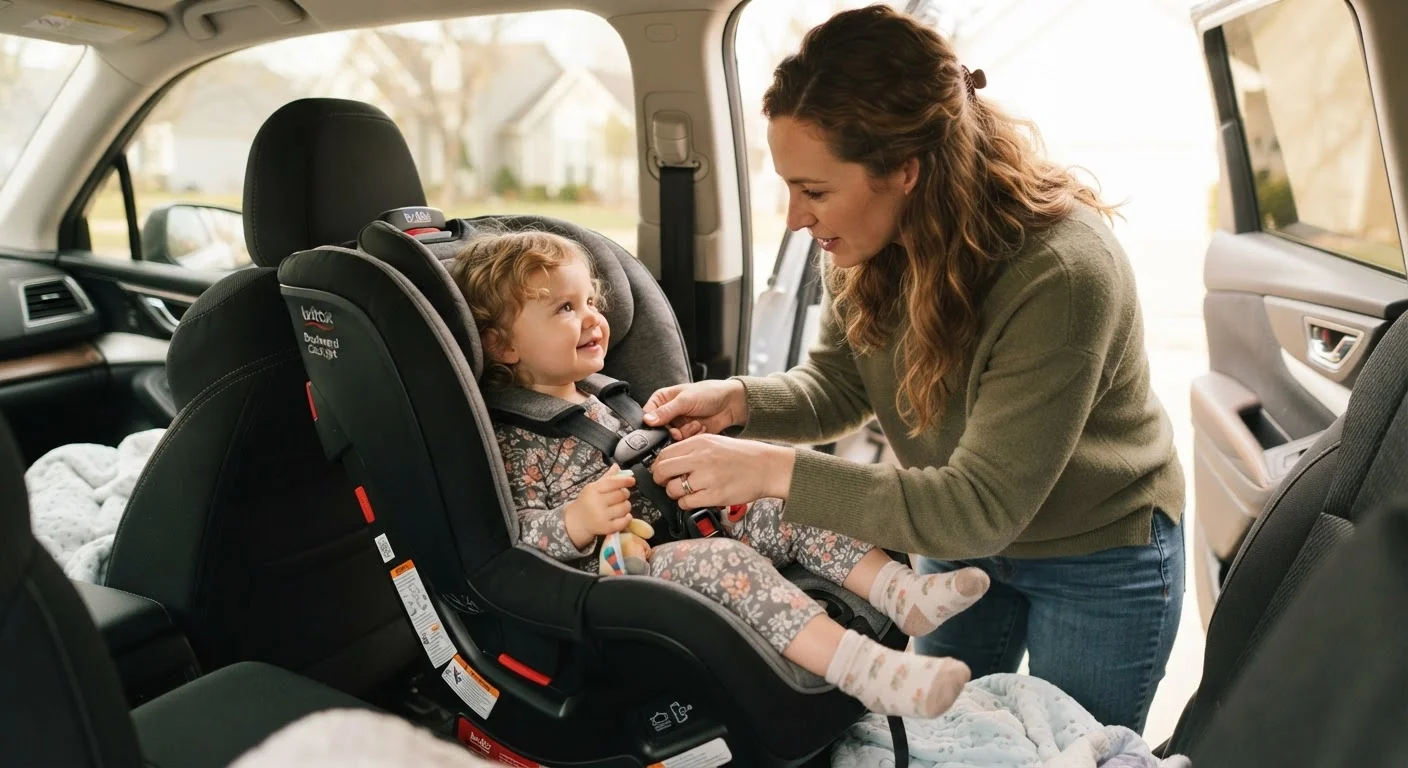
Why Child Passenger Safety Still Matters
Motor vehicle crashes remain one of the leading causes of injury-related death among children in the United States, according to the Centers for Disease Control and Prevention (CDC). The encouraging truth is that properly used child restraint systems dramatically reduce that risk - but the phrase properly used carries real weight. Equipment that is installed incorrectly or used in the wrong stage for a child's size provides far less protection than parents typically assume.
This guide walks through every major stage of child passenger safety using evidence-based recommendations from the National Highway Traffic Safety Administration (NHTSA) and the American Academy of Pediatrics (AAP). Whether you're bringing home a newborn or transitioning a six-year-old to a booster, the fundamentals here apply to your family's everyday driving - not just long road trips.
~46%
Car seats with at least one misuse error
NHTSA observational studies have found that nearly half of child restraints in use have a significant installation or usage error.
71%
Reduction in infant crash fatality risk
According to the CDC, infant car seats reduce the risk of death in crashes by approximately 71% compared to seat belts alone for that age group.
4 ft 9 in
Typical height for seat-belt-only readiness
Most child safety guidelines cite this height as a general threshold at which a vehicle seat belt can fit a child correctly without a booster.
The Four Stages of Child Restraint
Child passenger safety guidelines organize protection into four broad stages, each matched to a child's size and development - not just age.
Stage 1: Rear-Facing Car Seats
Infant carriers and convertible seats used rear-facing are recommended for newborns through toddlers. The AAP advises keeping children rear-facing until they reach the maximum height or weight limit allowed by their specific seat - not simply until age two, as older guidelines suggested. Rear-facing seats distribute crash forces across a child's back, neck, and head, which are the most vulnerable areas in a frontal collision.
Stage 2: Forward-Facing with a Harness
Once a child genuinely outgrows the rear-facing limits of their seat, a forward-facing seat with a five-point harness is the next step. Most seats in this category accommodate children up to 40-65 pounds, depending on the model. Children should stay harnessed as long as the seat allows before transitioning to a belt-positioning booster.
Stage 3: Belt-Positioning Booster Seats
Booster seats raise a child so the vehicle's seat belt crosses the body correctly - lap belt low across the hips, shoulder belt across the chest and collarbone. Boosters are appropriate until a child passes the 5-step test: the seat belt fits properly without any booster assistance, typically around 4 feet 9 inches tall and between 8 and 12 years old.
Stage 4: Seat Belts Alone
When a child can sit with their back flat against the vehicle seat, knees bent at the seat edge, and the belt fitting correctly without a booster, they are ready for a standard seat belt. Until that point, a booster should remain in use.
For a broader view of family vehicle readiness before any trip, see our family vehicle safety walkthrough for a comprehensive pre-departure checklist.
Installation Errors Parents Commonly Make
NHTSA data and independent inspection programs have found that a substantial proportion of child restraints in real-world use have at least one significant misuse error. The most common problems are straightforward to fix once you know what to look for.
- Too much movement at the base: A correctly installed seat should move no more than one inch side-to-side or front-to-back when you grip it at the belt path and tug firmly.
- Wrong recline angle for rear-facing seats: Infant seats require a specific recline angle - usually indicated by a built-in level - to keep a newborn's airway open. Check the seat's manual for the correct range.
- Using both LATCH and seat belt simultaneously: Most manufacturers specify one anchoring method at a time. Combining them does not double protection and can actually interfere with seat function. Always follow your seat's manual.
- LATCH anchor weight limits exceeded: The LATCH system (Lower Anchors and Tethers for Children) has a combined child-plus-seat weight limit of 65 pounds in most vehicles. Above that weight, switch to the vehicle seat belt.
- Skipping the top tether on forward-facing seats: The top tether significantly reduces forward head movement during a crash. It connects to a dedicated anchor - usually on the seat back or rear shelf - and should be used whenever the seat is forward-facing.
Get a Professional Seat Check
No matter how carefully you've read the manual, a hands-on check by a certified Child Passenger Safety Technician (CPST) is the most reliable way to confirm correct installation. NHTSA maintains a free online locator to find inspection stations and events near you. Many are offered at no cost to families.
Many local fire stations, hospitals, and NHTSA-certified Child Passenger Safety Technicians (CPSTs) offer free installation checks. Finding a certified technician in your area takes minutes and gives you confidence that the seat is correctly installed for your vehicle.
Positioning and Harness Fit
Even a perfectly installed seat provides reduced protection if the child isn't secured inside it correctly. Two checks cover most harness fit problems.
The Pinch Test
After buckling your child in and tightening the harness, pinch the webbing at the child's collarbone. If you can pinch a fold of strap between your fingers, the harness is too loose. The straps should lie flat and snug against the child's chest - not biting in, but with no slack.
Harness Slot Height
For rear-facing seats, harness straps should thread through slots at or below the child's shoulders. For forward-facing seats, they should thread through slots at or above the shoulders. Using the wrong slots allows the harness to ride up in a crash rather than holding the child in place.
After adjusting harness straps, run your finger along the full length of each strap to check for twists before you tighten. A twisted harness reduces restraint effectiveness and is easy to miss at a glance.
Twisted harness webbing can reduce the load-bearing surface area against a child's body during a crash, diminishing the protection the harness is designed to provide.
When transitioning a child from rear-facing to forward-facing, keep them harnessed for as long as the seat's weight and height limits allow - there's no safety benefit to moving forward sooner.
Rear-facing seats distribute crash forces over a broader area of the body. Children who transition forward-facing earlier than necessary lose that protective advantage before necessary.
Winter Coats and Bulky Clothing
Thick coats compress dramatically in a crash, creating dangerous slack in the harness. The established guidance from safety organizations: dress children in thin layers for the drive, then place the coat over the buckled harness like a blanket for warmth. If you're unsure how much slack a coat creates, buckle your child without the coat, note the harness setting, then put the coat on and re-buckle - if you had to loosen the harness to accommodate the coat, it's too bulky to wear underneath.
Travel Habits That Reinforce Safety
Hardware matters, but daily habits are what make safety consistent. A few routines go a long way.
- Back seat, every time: All children under 13 are significantly safer in the back seat, away from front airbag deployment zones. Make it a firm household rule with no exceptions.
- No loose cargo near children: Unsecured objects become projectiles in a sudden stop or crash. Our guide to packing the car covers how to organize cargo so it stays put.
- Check the seat before every trip: Takes about 20 seconds. Give the seat a tug to confirm it hasn't shifted, and glance at the harness to make sure nothing is twisted or routed incorrectly.
- Model calm, consistent behavior: Children notice when adults skip seat belts or rush through buckle-up routines. Establishing a no-movement-until-everyone-is-buckled rule from the earliest age sets expectations that are hard to unlearn.
If you're planning longer drives with young children, the honest tradeoffs involved in road tripping with a toddler are worth reading before you go.
Build the Buckle Routine Early
Start the 'everyone buckles before we move' rule from the very first ride home from the hospital. Children who learn this as an absolute - not a sometimes rule - are far more likely to comply without resistance as they get older and gain more independence in the car.
When to Replace a Car Seat
Car seats are not indefinite-use equipment. There are three clear triggers for replacement.
After a Moderate or Severe Crash
NHTSA guidance distinguishes between minor and moderate-to-severe crashes. For a crash to qualify as minor, all of the following must be true: the vehicle was drivable afterward, the door nearest the seat was undamaged, no one in the vehicle was injured, the airbags did not deploy, and the seat shows no visible damage. If any one of those conditions is not met, replace the seat - even if it looks fine. Structural integrity cannot always be assessed visually.
Past the Expiration Date
All car seats carry a manufacture date and an expiration date stamped on the seat or on a sticker attached to it. Expiration dates - typically six to ten years from manufacture - exist because plastic degrades over time, and the seat's structural performance can no longer be guaranteed after that point.
When the Child Outgrows It
A child who has reached the height or weight limit printed on their seat's label should move to the appropriate next stage. Continuing to use a seat beyond its rated limits eliminates the safety margins that were engineered into it.
Keeping the rest of your family vehicle in reliable condition supports every safety system in it - see our plain-language car maintenance guide for foundational upkeep habits that don't require mechanical experience.
This article is for general informational and educational purposes only. For personalized guidance on child passenger safety in your specific vehicle, consult a certified Child Passenger Safety Technician (CPST) or your local NHTSA-affiliated inspection station.
The content provided on our blog site traverses numerous categories, offering readers valuable and practical information. Readers can use the editorial team’s research and data to gain more insights into their topics of interest. However, they are requested not to treat the articles as conclusive. The website team cannot be held responsible for differences in data or inaccuracies found across other platforms. Please also note that the site might also miss out on various schemes and offers available that the readers may find more beneficial than the ones we cover.