

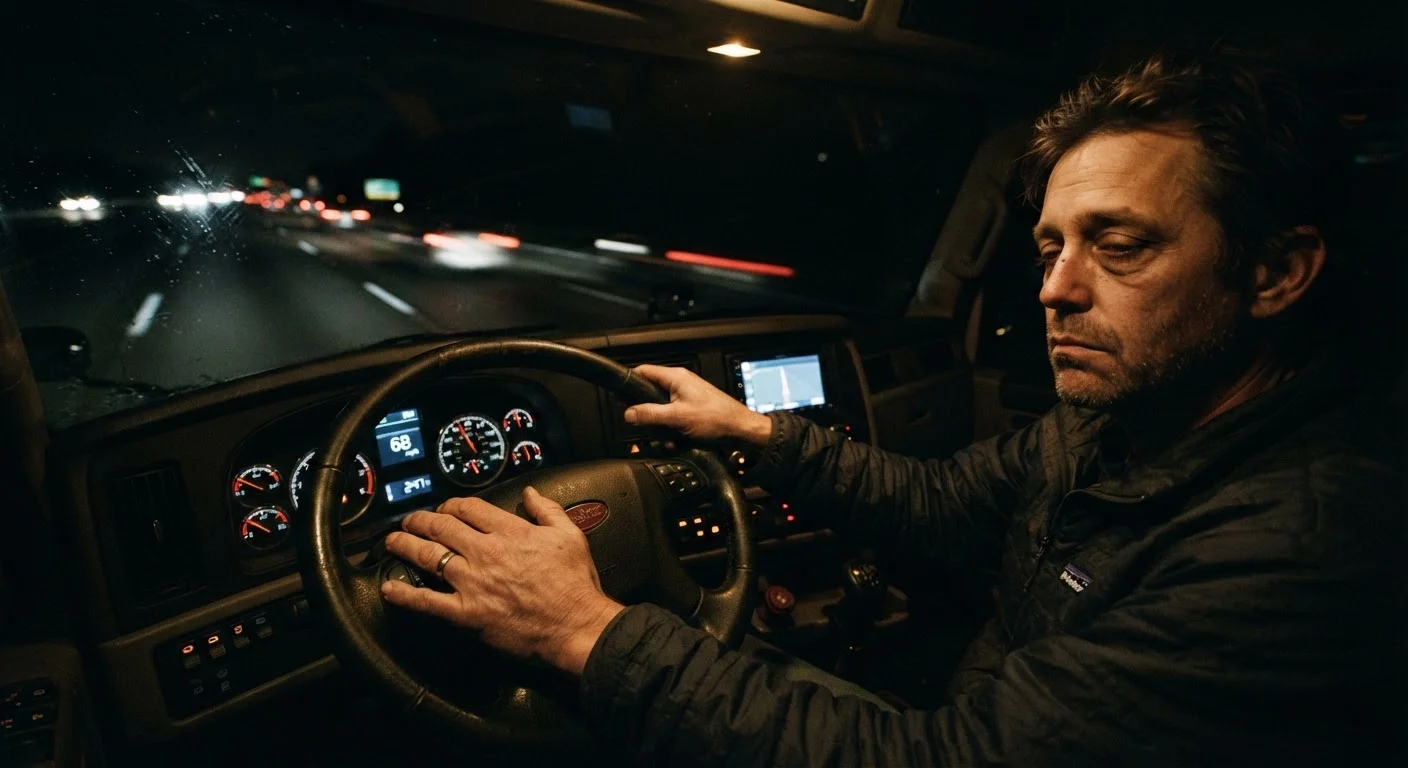
What Fatigue Actually Does to Your Brain
Fatigue is not simply a matter of willpower. When the brain is sleep-deprived, the prefrontal cortex - the region responsible for judgment, planning, and impulse control - begins to underperform first. This means a tired driver may feel capable of driving safely while their actual ability to assess risk and react appropriately has already declined.
Reaction time is one of the most measurable casualties. Studies by the AAA Foundation for Traffic Safety have found that drivers who sleep only 6 hours (instead of the recommended 7-9) have roughly double the crash risk of a fully rested driver. At 18 hours without sleep, impairment mirrors a blood alcohol concentration of around 0.05% - below the legal limit but still meaningfully dangerous. At 24 hours awake, that equivalence rises to approximately 0.10%, above the legal limit in every U.S. state.
“Sleep is not optional for safe driving. The brain does not simply adapt to less sleep - it accumulates a deficit that impairs performance in ways the driver often cannot perceive.”
— AAA Foundation for Traffic Safety, U.S. traffic safety research organization
Attention also narrows under fatigue. Tired drivers tend to fixate on a single point rather than scanning the full road environment - a problem that compounds when combined with other hazards. For a closer look at how reduced attention contributes to crashes, see our article on distracted driving and its many forms.
The Danger of Microsleep
One of the most serious - and least understood - consequences of severe fatigue is microsleep: brief, involuntary sleep episodes that can last from a fraction of a second up to about 30 seconds. During a microsleep, the driver's eyes may remain open, but the brain has temporarily disconnected from conscious awareness. There is no warning, and there is no memory of it afterward.
At highway speeds, the math is unforgiving. Traveling at 60 mph, a vehicle covers approximately 88 feet per second. A 3-second microsleep means nearly 264 feet traveled with zero driver input. That is enough to cross multiple lanes, leave the roadway, or fail to respond to a stopped vehicle ahead.
2×
Crash risk from sleeping only 6 hours
AAA Foundation for Traffic Safety research found drivers getting 6-7 hours of sleep had roughly double the crash risk of those sleeping 8 or more hours.
0.10%
BAC equivalent after 24 hours awake
Multiple peer-reviewed studies have found that 24 hours of wakefulness impairs driving performance comparably to a blood alcohol concentration of about 0.10%.
~91,000
Police-reported drowsy-driving crashes per year
NHTSA estimates approximately 91,000 police-reported crashes annually involve drowsy driving, though researchers believe the actual figure is substantially higher due to underreporting.
Microsleep risk rises sharply after extended periods without sleep and during the body's natural low-alertness windows - particularly between 2-5 a.m. and again in the early afternoon. Families driving long distances, shift workers commuting home, and new parents are all in higher-risk categories. These same low-visibility hours are discussed in our guide to driving after dark.
Recognizing the Warning Signs - and What to Do
Fatigue impairs the very self-awareness needed to recognize it. That said, several physical signals reliably precede serious impairment:
- Frequent, uncontrollable yawning
- Heavy or burning eyelids
- Difficulty maintaining a consistent speed or lane position
- Missing exits, turns, or road signs
- An inability to recall the last few miles driven
- Head nodding or "snapping" back to attention
If you notice any of these, treat it as a safety emergency - not a minor inconvenience. Pull off at the next safe location: a rest stop, a well-lit parking area, or a hotel. A 20-minute nap has been shown in multiple studies to temporarily restore alertness, though it does not eliminate the underlying sleep debt.
Plan Rest Stops Before You Leave
On trips longer than two hours, schedule a stop roughly every 100 miles or every two hours - whichever comes first. A 15-20 minute break, especially one that includes a short nap, helps reset alertness more effectively than caffeine alone. Building stops into your itinerary before departure removes the temptation to push through fatigue.
Fatigue also interacts with other road hazards. Wet roads, reduced visibility, and heavy traffic all demand faster cognitive processing - exactly what a tired brain struggles to provide. Our article on how weather affects driving explains which conditions demand the sharpest attention.
Planning for rest before a long trip is more effective than reacting to fatigue mid-drive. Aim for a full night of sleep the night before, schedule stops every two hours or 100 miles on long routes, and if possible share driving duties with another alert adult.
Frequently Asked Questions
Warning signs include frequent yawning, difficulty keeping your eyes open, drifting between lanes, missing exits or signs, and an inability to recall the last few miles driven. If you notice any of these, pull over as soon as it is safe. Feeling confident you can push through is itself a symptom of impaired judgment.
Caffeine can temporarily reduce feelings of sleepiness, but it does not restore the reaction time or decision-making ability lost to sleep deprivation. It may buy a short window to find a safe place to stop, but it is not a substitute for actual rest.
The body's circadian rhythm creates two natural dips in alertness: between 2-5 a.m. and again between 1-3 p.m. Long highway drives, shift work, and travel across time zones all compound these risk windows significantly.
These are popular strategies, but research suggests they provide only a fleeting boost and can give drivers a false sense of recovery. They do not address the underlying sleep deficit and should not be relied on for sustained alertness.
Several U.S. states have laws that address drowsy or reckless driving resulting from known fatigue. Even where there is no specific statute, a fatigued driver who causes a crash may face civil or criminal liability. Check your state's traffic laws for specifics.
A microsleep is an involuntary sleep episode lasting anywhere from a fraction of a second to about 30 seconds. The driver remains physically in the seat but is functionally asleep. At 60 mph, even a 3-second microsleep means traveling roughly 264 feet with no conscious control of the vehicle.
The content provided on our blog site traverses numerous categories, offering readers valuable and practical information. Readers can use the editorial team’s research and data to gain more insights into their topics of interest. However, they are requested not to treat the articles as conclusive. The website team cannot be held responsible for differences in data or inaccuracies found across other platforms. Please also note that the site might also miss out on various schemes and offers available that the readers may find more beneficial than the ones we cover.