

What Actually Happens When Someone Pulls Your Credit
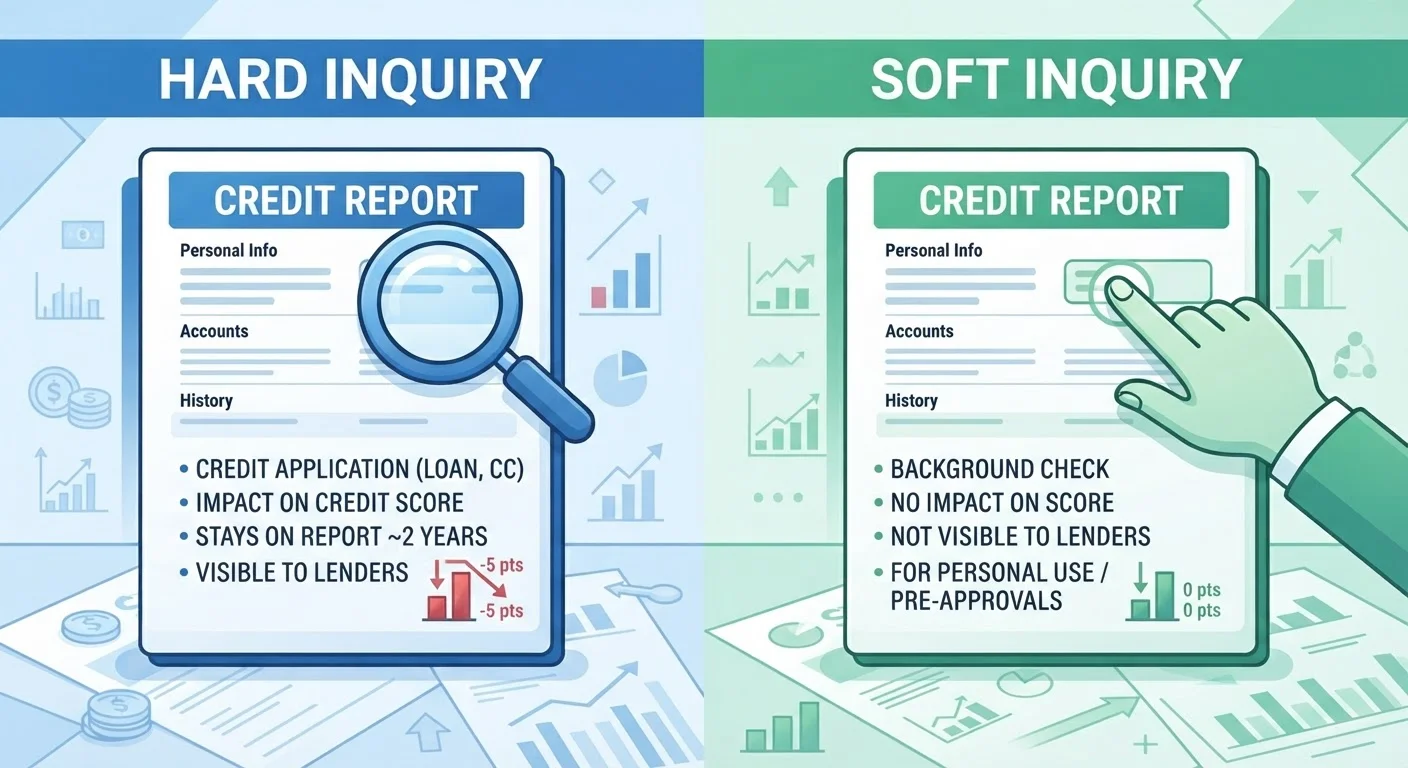
Every time your credit file is accessed, a record of that access - called an inquiry - is logged. But not all inquiries work the same way, and this distinction matters more than most families realize.
Understanding the difference starts with knowing why your credit is being checked. To understand the broader context of what lives in your credit file, it helps to first get clear on the difference between a credit score and a credit report.
<5 pts
Typical score drop from one hard inquiry
According to FICO, a single hard inquiry generally lowers a score by fewer than five points for most consumers.
2 years
How long hard inquiries stay on your report
Hard inquiries remain visible on your credit report for 24 months, though scoring impact typically fades after 12 months.
10%
Weight of new credit inquiries in FICO score
FICO's scoring model allocates roughly 10% of your score to the 'new credit' category, which includes recent hard inquiries.
Hard Inquiries: What They Are and When They Happen
A hard inquiry (sometimes called a hard pull) occurs when a lender or creditor reviews your credit file as part of a formal credit application. Common examples include:
- Applying for a mortgage or home equity loan
- Financing a vehicle
- Opening a new credit card
- Taking out a personal or student loan
Hard inquiries signal to lenders that you're actively seeking new credit. Because taking on new debt can increase financial risk, scoring models treat a cluster of hard inquiries as a mild warning sign. That said, the impact is typically small - usually fewer than five points per inquiry - and temporary.
The practical takeaway: a single hard inquiry is unlikely to derail your financial plans. Where it gets more complicated is if you're applying for several different types of credit in a short period. To understand how inquiries fit into the bigger picture of what scoring models measure, see what your credit score actually measures.
Time Your Applications Strategically
If you know you'll be applying for a major loan - like a mortgage - in the next few months, try to avoid opening new credit accounts in the meantime. Keeping hard inquiries low before a big application gives your score the best chance to reflect your true creditworthiness. Even a few extra points can make a difference in the interest rate you're offered.
Soft Inquiries: Checks That Leave No Mark
A soft inquiry (or soft pull) happens whenever your credit is checked without you actively applying for new credit. These include:
- Checking your own credit score or report
- Pre-approval checks from lenders sending you offers in the mail
- Employer background checks (with your permission)
- Account reviews by your existing creditors
The critical point: soft inquiries do not affect your credit score at all. They may appear in your credit file, but scoring models ignore them entirely. This means you can - and should - monitor your own credit regularly without worrying about any penalty.
If you've never closely reviewed your own credit report, reading your credit report without getting lost is a good place to start.
Rate Shopping: When Multiple Hard Inquiries Don't Hurt
One of the most misunderstood areas of credit inquiries is rate shopping. Many families avoid comparing lenders for a mortgage or auto loan because they fear multiple hard inquiries will tank their score. In most cases, that fear is unwarranted.
Both the FICO and VantageScore models recognize that consumers comparing loan offers are acting responsibly, not recklessly. These models apply a rate-shopping window - typically 14 to 45 days depending on the scoring version - during which multiple hard inquiries for the same loan type are grouped and counted as a single inquiry.
This protection applies specifically to mortgage, auto, and student loan shopping. It does not apply to credit card applications, so applying for several cards in a short period will generate separate hard inquiries.
The Rate-Shopping Window Varies by Scoring Model
Older FICO models use a 14-day rate-shopping window, while newer FICO versions and VantageScore extend that window to 45 days. Because you won't always know which version a lender uses, it's safest to aim to complete your loan comparison shopping within two weeks when possible.
Before you begin shopping for a loan, it's worth doing some groundwork. A credit health checklist before applying for a loan can help you spot any issues worth addressing first.
How to Manage Inquiries as Part of Your Credit Strategy
Hard inquiries are just one small piece of your overall credit profile. Payment history and credit utilization carry far more weight in your score. Even so, a few habits will help you keep inquiries from becoming an unnecessary drag:
- Apply for new credit intentionally. Only submit formal applications when you're genuinely ready to proceed.
- Cluster your loan shopping. When financing a home or car, get all your rate quotes within a short window to take advantage of the rate-shopping rule.
- Check your report for unauthorized inquiries. If you spot a hard inquiry you don't recognize, you have the right to dispute it with the credit bureau.
It's also worth remembering that paying on time alone isn't always enough to build strong credit - your score reflects several factors working together, and keeping inquiries in check is simply one part of a healthy overall picture.
This article is for general informational purposes only and does not constitute personalized financial or credit advice. For guidance specific to your situation, consider speaking with a qualified financial professional.
Frequently Asked Questions
For most people, a single hard inquiry lowers a credit score by fewer than five points. The exact impact depends on your overall credit profile - someone with a thin credit file may see a slightly larger dip than someone with a long, established history.
No. Checking your own credit score or report is always a soft inquiry and has zero effect on your score. You can check as often as you like without any penalty.
Hard inquiries remain visible on your credit report for two years. However, most scoring models only factor them into your score for roughly the first twelve months.
Generally, no. Most credit scoring models group multiple hard inquiries for the same loan type - such as a mortgage or auto loan - within a 14- to 45-day window and treat them as a single inquiry. Shopping around for the best rate during a concentrated period is considered responsible borrowing behavior.
Soft inquiries happen when you check your own credit, when a lender pre-screens you for a pre-approved offer, or when an employer runs a background check. These do not affect your score in any way.
You can dispute a hard inquiry you did not authorize through the credit bureau that reported it. However, legitimate hard inquiries resulting from applications you actually submitted cannot be removed early - they age off after two years.
The content provided on our blog site traverses numerous categories, offering readers valuable and practical information. Readers can use the editorial team’s research and data to gain more insights into their topics of interest. However, they are requested not to treat the articles as conclusive. The website team cannot be held responsible for differences in data or inaccuracies found across other platforms. Please also note that the site might also miss out on various schemes and offers available that the readers may find more beneficial than the ones we cover.