

The Five Factors Behind Your Number
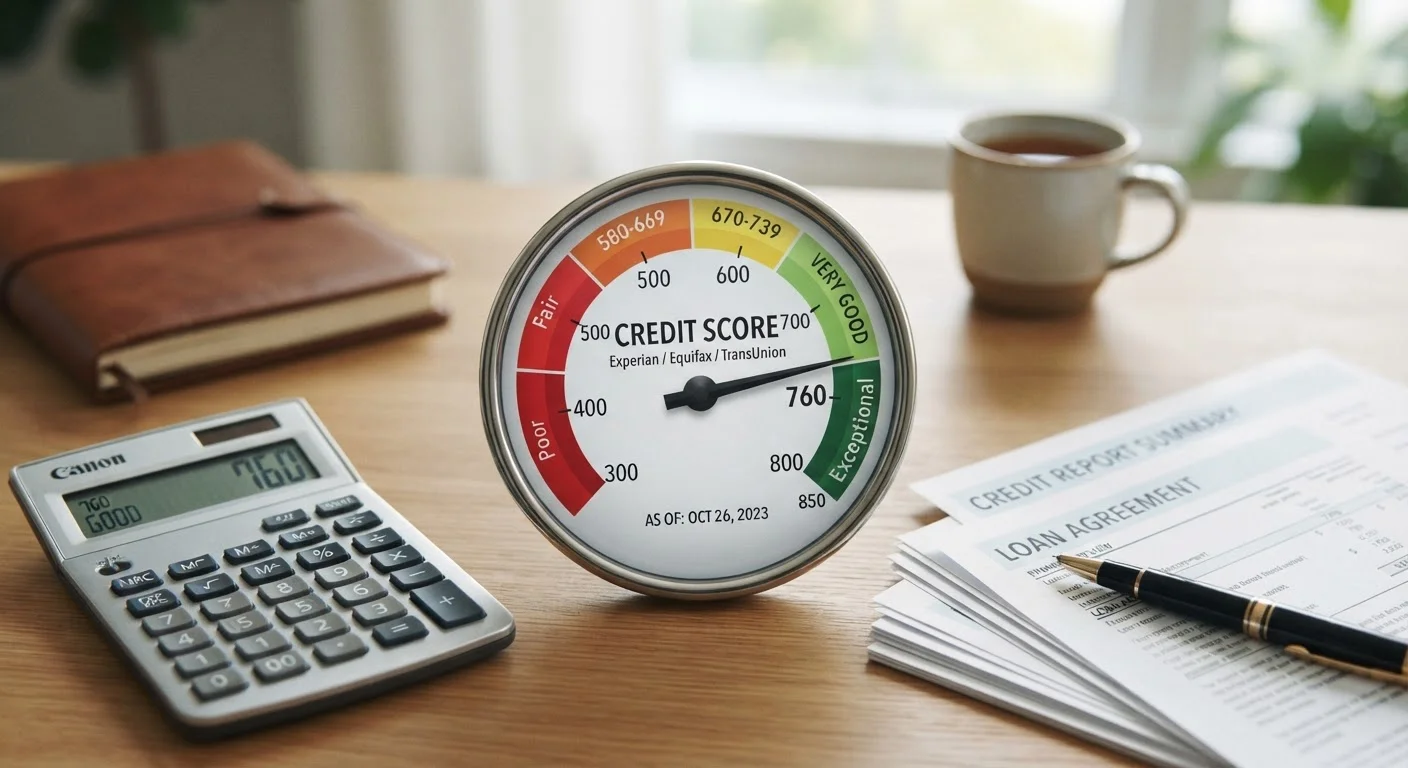
Your credit score isn't a gut feeling or a mystery algorithm - it's a formula built from five specific categories of information drawn from your credit report. Understanding these categories is the first step to knowing why your score looks the way it does and what you can actually change.
The FICO model, the most widely used in the U.S., breaks down like this:
- Payment history (35%): Whether you've paid your bills on time.
- Amounts owed / credit utilization (30%): How much of your available credit you're currently using.
- Length of credit history (15%): How long your accounts have been open.
- Credit mix (10%): The variety of account types you manage (credit cards, auto loans, mortgages, etc.).
- New credit (10%): How recently and how often you've applied for new credit.
Each factor carries a different weight, which means some decisions have a bigger impact than others. Missing a payment, for example, hurts far more than opening a new store card.
35%
Weight of payment history in FICO Score
According to FICO's published scoring model breakdown, payment history is the single largest factor in calculating your score.
30%
Weight of credit utilization in FICO Score
FICO's model weights amounts owed - primarily your utilization ratio - as the second most influential factor in your score.
200M+
Americans with a scoreable credit file
The Consumer Financial Protection Bureau (CFPB) has noted that the vast majority of American adults have enough credit history to generate a score.
Payment History and Utilization: The Heavy Hitters
Together, payment history and credit utilization make up roughly two-thirds of your FICO Score - so these two areas deserve the most attention.
Payment history tracks whether you've paid every bill on time, across every account on your report. One 30-day late payment can meaningfully drop your score, and the effect lingers for up to seven years, though it fades over time as newer on-time payments accumulate. As paying on time alone isn't always enough explains, consistent payments are necessary - but they don't automatically solve every scoring challenge.
Credit utilization is the ratio of your current balances to your total credit limits across revolving accounts like credit cards. If you have a $10,000 total limit and you're carrying $3,500 in balances, your utilization is 35%. Many financial educators suggest keeping this figure below 30%, and lower is generally better. This ratio can shift quickly because it reflects your balances at the time your lender reports to the bureaus - typically around your statement closing date.
Time Your Payments Strategically
Your credit utilization is typically captured around your card's statement closing date - before your payment is due. If you pay down your balance before that date rather than after, your reported utilization will be lower, which can positively affect your score. Check your statement cycle dates to see when your issuer reports to the bureaus.
The Smaller Factors That Still Add Up
Length of credit history rewards longevity. The model looks at the age of your oldest account, your newest account, and the average age of all your accounts. This is why financial educators often caution against closing old cards even if you no longer use them - doing so can shorten your average history and remove that account's positive aging effect.
Credit mix reflects whether you manage different types of credit responsibly. Having both revolving credit (like credit cards) and installment loans (like a car loan or mortgage) can signal to lenders that you're experienced with different borrowing structures. That said, this factor carries the least weight, and you shouldn't open accounts you don't need just to diversify your mix.
New credit tracks recent applications. Each time you apply for credit, a hard inquiry is placed on your report and can temporarily lower your score by a few points. Multiple inquiries in a short window can compound this effect. For more detail, see our article on hard and soft inquiries.
Your Score vs. Your Credit Report
It's worth being clear: your credit score and your credit report are two separate things, even though one feeds the other. Your credit report is the full document - a detailed history of your accounts, balances, payment records, and public information like bankruptcies. Your score is calculated from that report at a specific moment in time.
Understanding the difference between the two matters because errors on your report can drag down your score unfairly. If your score seems lower than you'd expect given your habits, pulling your full credit report and reading through each section carefully can reveal errors worth disputing.
This article is for general informational and educational purposes only and does not constitute personalized financial or credit advice. For guidance specific to your situation, consider consulting a qualified financial professional.
Your Score Can Vary by Lender
Different lenders may pull different versions of scoring models and from different bureaus, so the number a mortgage lender sees can differ from what your bank app shows. These variations are normal and generally reflect the same underlying credit health. Focus on the fundamentals - on-time payments and low utilization - rather than chasing a specific number on one platform.
Frequently Asked Questions
Generally, scores above 670 are considered good, and scores above 740 are considered very good by most lenders. <a href="/family-finance/debt-and-credit/credit-score-ranges-decoded-what-each-tier-means-for-your-family">Each score tier</a> comes with different lending terms and interest rates. The exact cutoffs can vary by lender and the type of loan.
Your credit score recalculates whenever your credit report data changes, which typically happens when lenders report new information - usually monthly. So your score can shift up or down from one month to the next based on balance changes, new accounts, or payment activity.
No. Checking your own score is a soft inquiry and does not affect your number. Only hard inquiries - triggered when a lender checks your credit for a loan or card application - can cause a small, temporary dip. Learn more about <a href="/family-finance/debt-and-credit/hard-inquiries-soft-inquiries-and-what-each-does-to-your-score">how inquiries work</a>.
Yes. Carrying a balance doesn't automatically hurt your score - what matters most is how that balance compares to your credit limits (utilization) and whether you're making payments on time. Keeping balances well below your limits generally helps.
Not every lender reports to all three major credit bureaus (Equifax, Experian, and TransUnion), so each bureau may have slightly different data on file. Because the data differs, the score calculated from each report can differ too. It's a good idea to check all three periodically.
It can. Closing an old account may shorten your average credit history length and reduce your total available credit, both of which could nudge your score downward. If the card has no annual fee, keeping it open and occasionally using it is often the lower-risk move.
The content provided on our blog site traverses numerous categories, offering readers valuable and practical information. Readers can use the editorial team’s research and data to gain more insights into their topics of interest. However, they are requested not to treat the articles as conclusive. The website team cannot be held responsible for differences in data or inaccuracies found across other platforms. Please also note that the site might also miss out on various schemes and offers available that the readers may find more beneficial than the ones we cover.