

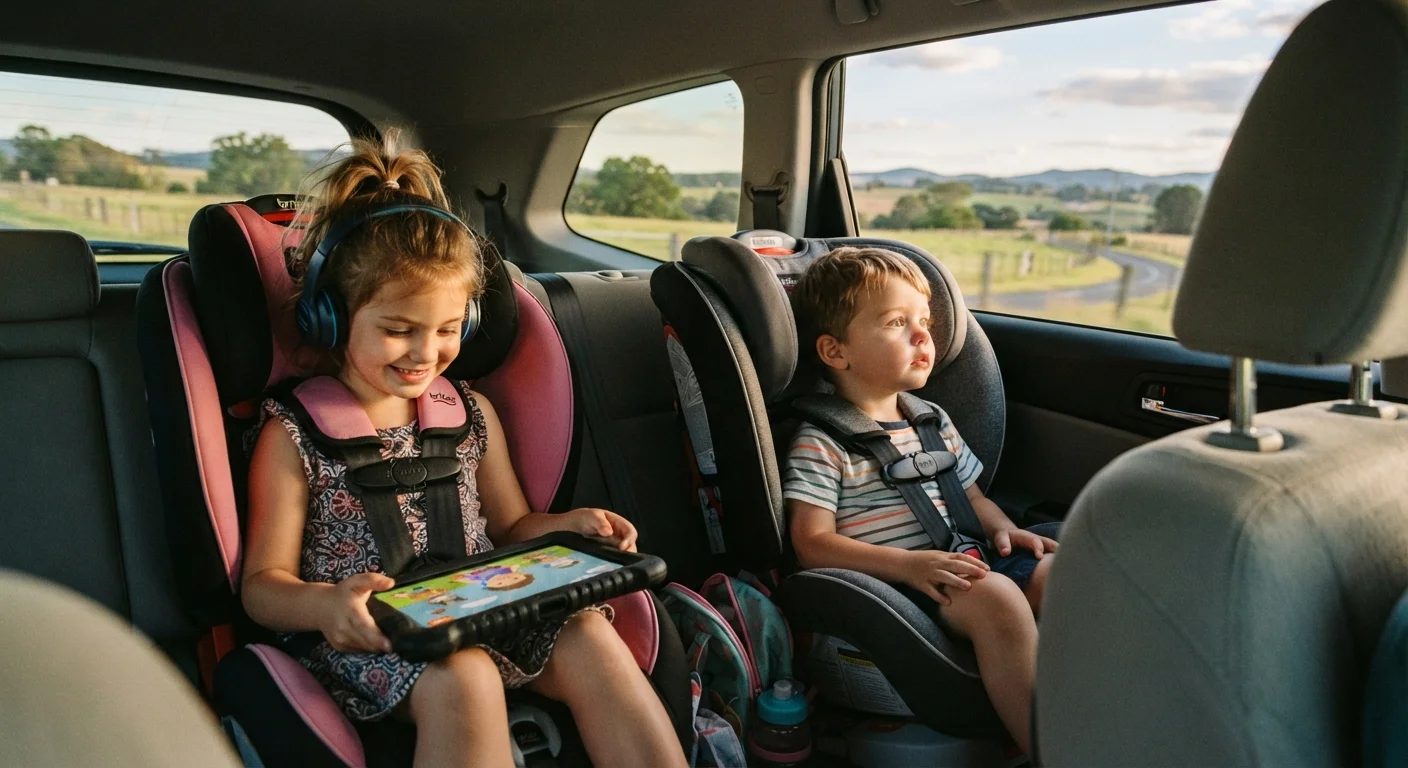
Option A
Screen Time Activities
The tried-and-true digital peacekeeper.
Best for: Families with younger children or long stretches of highway who need reliable, independent entertainment.
Option B
No-Screen Activities
The creative, connection-building alternative.
Best for: Families prioritizing conversation, imagination, and a break from device dependency during road trips.
Why This Question Matters More Than You Think
Every parent who has survived a five-hour drive with restless kids has faced the same moral calculus: hand over the tablet and drive in peace, or tough it out screen-free and hope for the best. Neither choice is wrong, but they carry meaningfully different trade-offs worth understanding before you load the car.
How you keep kids entertained in the backseat also affects safety up front. Frequent demands, arguments, and noise are all forms of distraction — and reducing that chaos matters. See our overview of in-car distraction risks for context on why a calmer backseat directly helps the driver focus.
The goal here isn't to declare a winner. It's to give you a clear picture of what each approach actually delivers — and where each falls short — so you can pack accordingly.
Screen Time on the Road: Honest Pros and Cons
Tablets, smartphones, and portable DVD players have become standard road trip gear for American families, and it's easy to see why. Pre-downloaded content works without cell service, headphones keep noise contained, and familiar shows provide genuine comfort to anxious or tired children.
Where screens shine: They offer sustained, independent entertainment — critical on multi-hour stretches where the scenery hasn't changed in two hours. Educational apps and audiobooks with visual companions can layer in some learning, too.
Where screens fall short: Battery life and charging logistics require planning. Children who get motion sick often report that screen use intensifies nausea. Screens can also trigger arguments over devices, volume, and content — creating exactly the distraction you were trying to avoid. For a broader look at what research says about kids and extended screen exposure, our screen time and sedentary habits article offers a measured, evidence-based overview.
| Criterion | Screen Time Activities | No-Screen Activities |
|---|---|---|
| Preparation needed | Download content in advance | Pack books, games, or art supplies |
| Works without cell service | Yes, if pre-downloaded | Yes, always |
| Motion sickness risk | Higher for susceptible kids | Lower; window-watching friendly |
| Parental involvement required | Low once set up | Moderate to high |
| Best age range | Toddlers through teens | School-age and up (varies by activity) |
| Battery / charging logistics | Must plan ahead | Not applicable |
| Family connection potential | Low (individual activity) | High (shared experience) |
| Driver distraction risk | Low if volume is managed | Moderate if games need facilitation |
No-Screen Activities: Creative, Connection-Driven — and Realistic
Screen-free car entertainment often gets romanticized, so let's be honest: it takes more effort from everyone, including parents who are already managing navigation, fuel stops, and snack logistics. That said, the payoff — genuine conversation, shared laughs, and kids who feel present on the journey — is real.
What works well: Classic car games like the license plate game, 20 Questions, or storytelling chains require zero supplies and scale to multiple ages. Activity books, travel journals, and small art kits give hands-on learners something tactile to do. Audiobooks and family podcasts offer a middle-ground: no screen, but still passive enough that kids can listen independently.
What doesn't work: Fine-detail crafts are frustrating in a moving car. Competitive games with younger kids can escalate quickly. And screen-free approaches tend to require parental participation, which works less well when one adult is driving solo.
For no-prep game ideas your whole family can use immediately, car games that hold up across ages and miles is a great starting point.
90–120 min
Recommended break interval for kids on road trips
Pediatric travel experts and family travel advisors generally suggest stopping every 90–120 minutes to allow children to move and reset.
~1 in 3
Children who experience motion sickness
According to general pediatric estimates, roughly one in three children is susceptible to motion sickness, with screen use in a moving vehicle often worsening symptoms.
5+ hours
Drive length where screen fallback is most valued
Family travel surveys consistently find that parents on drives exceeding five hours rate device-based entertainment as significantly more essential than on shorter trips.
Building a Blended Strategy That Actually Works
Most seasoned road-tripping families land in the same place: a rotation. Block the first hour as screen-free — kids are fresh, curious, and conversation flows naturally. Reserve screens for the dead zones of a drive: post-lunch slump, late afternoon fatigue, or the final hour before arrival when patience is thinnest.
A few practical tips for the rotation approach:
- Pre-download everything. Relying on streaming in rural stretches almost always ends in frustration.
- Set clear screen windows. "Screens go on after the state line" gives kids a concrete marker and avoids constant negotiation.
- Pack a no-screen bag per child. A small tote with a travel journal, a few activity cards, and a favorite toy gives kids agency over their own entertainment.
- Use audiobooks as transitions. They bridge the gap between screen-off and screen-on windows without requiring active participation from the driver.
And remember: actual family driving time is almost always longer than the GPS suggests. Build in buffer stops every 90–120 minutes — physical movement resets everyone's patience and reduces the pressure on any entertainment strategy to do all the heavy lifting.
For broader trip-planning ideas that keep costs manageable, our travel on a budget hub covers affordable strategies that complement smart on-the-road decisions.
The content provided on our blog site traverses numerous categories, offering readers valuable and practical information. Readers can use the editorial team’s research and data to gain more insights into their topics of interest. However, they are requested not to treat the articles as conclusive. The website team cannot be held responsible for differences in data or inaccuracies found across other platforms. Please also note that the site might also miss out on various schemes and offers available that the readers may find more beneficial than the ones we cover.