

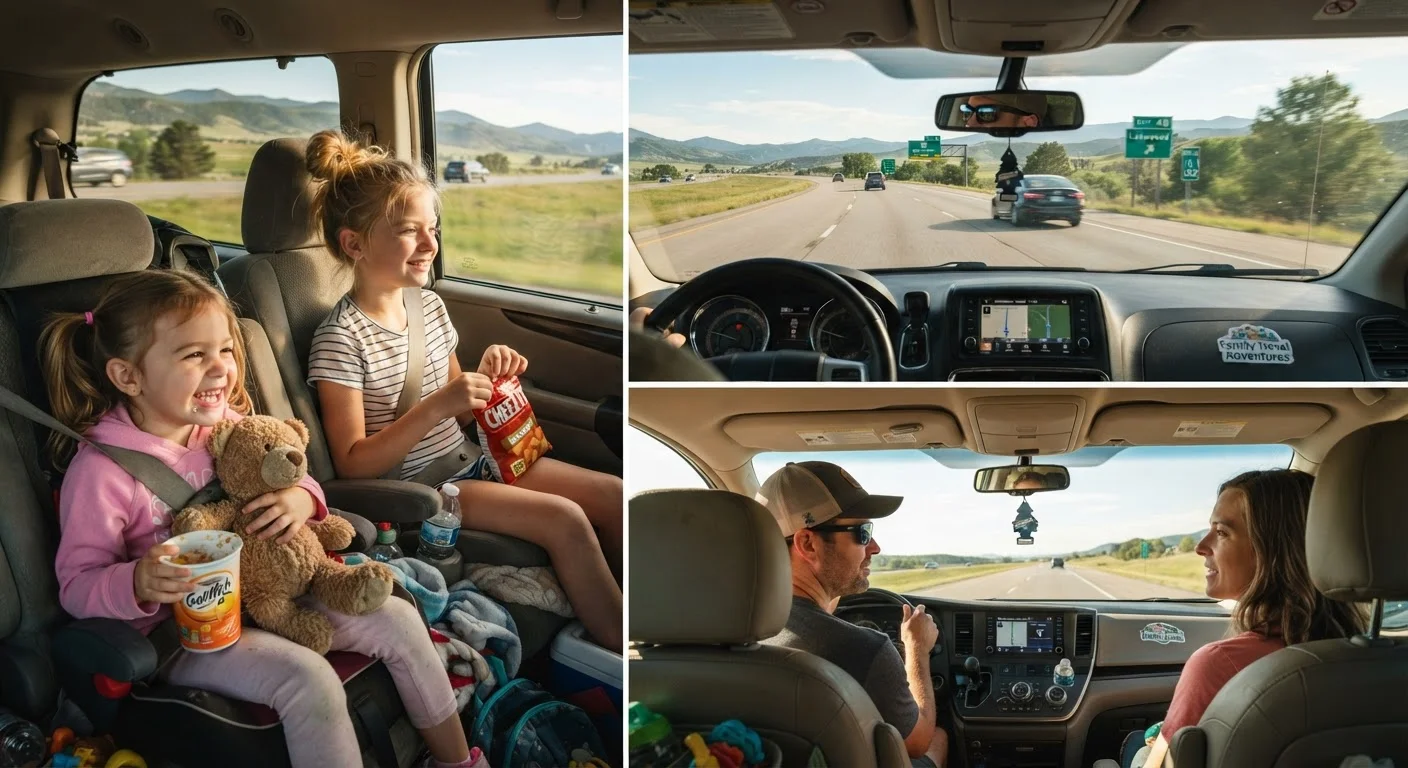
Why Your Navigation App Doesn't Know You Have Kids
Every parent has lived this moment: you punch a destination into your phone, see a six-hour estimate, and start mentally calculating arrival time — only to roll in nine hours later, completely wrung out. The app wasn't wrong about the road. It was wrong about your passengers.
Navigation tools calculate travel time based on posted speed limits, historical traffic flow, and average driving behavior. They assume a driver who stops once for gas, maybe grabs a coffee, and otherwise stays in the seat. That's a reasonable model for a solo commuter. It is a fantasy when your car holds a four-year-old who needs to use the bathroom immediately after every fast-food stop and a seven-year-old who gets carsick on curves.
Understanding what "drive time" actually means for your family — not the GPS version — is the foundation of planning any road trip that ends well. For a broader look at the planning missteps that make drives feel brutal, see why your road trip always feels longer than it should.
~2 hrs
Recommended max seated stretch for young children
Pediatric occupational therapists generally advise movement breaks every 1.5–2 hours for children under 8 during long car journeys.
30–50%
Extra time families should add to GPS estimates
Family travel researchers and road trip planners consistently recommend this buffer to account for stops, delays, and child-related pauses on long drives.
300–350 mi
Practical daily driving cap for families with young kids
This range is widely cited by family travel advisors as a sustainable daily mileage that balances progress with passenger wellbeing.
The Real Math: What to Add to Any Estimate
A practical starting point is to add 30–50% to whatever your navigation app tells you. If the map says five hours, budget seven to seven-and-a-half. This isn't pessimism — it's logistics. Here's where that extra time goes:
- Bathroom stops: With multiple children, expect at least one stop every 90 minutes, regardless of how recently everyone went before departure.
- Meltdown or motion-sickness pauses: A child who feels carsick needs the car stopped, not just slowed down. These moments are unpredictable but nearly inevitable on longer drives.
- Food and fuel overlap: Combining a gas stop with a meal sounds efficient, but with kids, it typically takes twice as long as either would alone.
- Re-boarding time: Getting everyone buckled, snacks distributed, and screens or activities restarted after each stop eats 10–15 minutes you never account for in advance.
A good rule for families with children under 10: plan no more than 300–350 miles of driving per day. That may feel modest, but it consistently results in arrivals where everyone is still speaking to each other.
Use Landmarks, Not Time, as Milestones
Instead of telling kids "two more hours," try "three more rest stops" or "after we cross the state line." Concrete, visible markers give children a sense of progress that clock time simply doesn't. It also reduces the dreaded "are we there yet?" loop significantly.
Building a Route Around Human Beings, Not Mileage
The most resilient family road trips treat the route as a series of manageable segments rather than a single long haul. Break each driving day into named "legs" with a clear stopping point kids can look forward to — a specific park, a fun diner, a state welcome sign to photograph. This reframes the drive as a series of small victories rather than an endless countdown.
When choosing where to stop overnight, prioritize locations with easy parking, nearby restaurants or grocery stores, and ideally some outdoor space for a quick run-around. Arriving at a trailhead or a town square gives kids an immediate win rather than another hotel lobby to wait in.
Route flexibility also matters. Locking yourself into a rigid hour-by-hour schedule is the fastest way to turn a delay into a crisis. Leave buffer time in the day — not just for problems, but for unexpected moments that become the trip's best memories. Building an itinerary kids won't dread covers exactly how to structure these days so pacing works for everyone.
Keeping the Miles from Feeling Like Miles
Drive time also has a psychological dimension. Two hours can feel like twenty minutes with the right activity, and twenty minutes can feel like two hours when a child is bored and uncomfortable. Managing that experience is as important as managing the clock.
A mix of screen and non-screen time tends to work better than either extreme. Audiobooks and podcasts designed for kids can hold attention across age groups without the eye strain of a tablet. Simple observation games tied to the landscape — license plates, highway exit numbers, cloud shapes — give kids a sense of participation in the journey. For a balanced breakdown, our guide on screen time vs. no-screen activities walks through what actually works at different ages.
If you're looking for zero-prep options, car games that hold up across ages and miles offers a solid collection that works for mixed-age families without any supplies.
Smart packing is part of this equation too. How you load the car affects how easily kids access their comfort items, snacks, and activities mid-drive. Packing the car without losing your mind has a practical approach to keeping things reachable and organized.
“The families who enjoy road trips the most are the ones who decide early that the drive is part of the destination — not just time to be survived until they arrive.”
— Family Travel Association, U.S.-based nonprofit supporting family travel research and education
Frequently Asked Questions
Most family travel experts suggest capping driving at 6–8 hours of actual road time per day, accounting for frequent stops. With toddlers or infants, 4–5 hours of total travel may be a more realistic ceiling. Pushing beyond a family's comfort threshold typically leads to miserable arrivals.
A general guideline is a movement break every 1.5 to 2 hours for younger children. Older kids and teens can stretch this to 2–3 hours with engaging in-car activities. Short, intentional stops tend to go better than long unplanned ones.
Driving during nap or sleep hours can reduce in-car friction for some families, especially with younger children. However, it also increases driver fatigue risk, which is a serious safety concern. If you try overnight driving, ensure a rested co-driver is available to take over.
Give children a concrete visual anchor — a simple paper map they can track, or countdown markers tied to landmarks rather than time. Breaking the trip into named "legs" rather than a single destination makes progress feel tangible and manageable for young travelers.
For families, a multi-day approach almost always results in a better experience. It allows for rest, reduces driver fatigue, and turns the drive itself into part of the adventure. Trying to push through an 800-mile day with children is rarely the smooth shortcut it seems on paper.
The content provided on our blog site traverses numerous categories, offering readers valuable and practical information. Readers can use the editorial team’s research and data to gain more insights into their topics of interest. However, they are requested not to treat the articles as conclusive. The website team cannot be held responsible for differences in data or inaccuracies found across other platforms. Please also note that the site might also miss out on various schemes and offers available that the readers may find more beneficial than the ones we cover.