

Why One Person Can't Carry the System Alone
Most home organization efforts stall at the same point: one person sets everything up, then watches it unravel within weeks. The problem usually isn't the system itself — it's that the rest of the household never had a say in creating it. When people don't understand why something is organized a certain way, they're unlikely to maintain it.
Research in behavioral science consistently shows that people are more committed to rules and habits they helped establish. The same principle applies to household organization. If your partner or children feel like they're complying with your system rather than participating in their own, motivation drops fast.
Before diving into the steps below, it helps to check your assumptions about what organized living even looks like for your family. Our article on home organization myths addresses several widely held beliefs that can quietly undermine your efforts before they start.
What you will need
How to Build a System Your Whole Family Will Actually Use
The steps below are designed to move your household from a one-person-carries-everything model to a shared, self-sustaining routine. Take them at whatever pace fits your family's schedule — the goal is lasting change, not speed.
Hold a family conversation — not a family meeting
Call it a "home reset chat" or fold it into dinner conversation, but the point is to invite input rather than announce decisions. Ask each family member what spaces frustrate them most and what would make their daily routine easier. You're gathering real feedback, not selling a plan.
Take notes. Even a young child's observation — "I can never find my shoes" — is actionable intelligence that should shape your system.
Assign zones, not just chores
Instead of assigning individual tasks, give each person ownership of a zone — a drawer, a shelf, a section of the mudroom. Zones create accountability without micromanagement. The person responsible for the zone decides how it's organized, within agreed household standards.
For shared spaces like the living room, rotate zone responsibility weekly so no one feels permanently burdened.
Use visual systems that work without memory
Labels, picture-based charts for young children, and color-coded bins reduce the cognitive load of remembering where things go. When the system is visible, family members don't need to ask — they can just look.
Keep labeling simple and honest: label things where they actually live now, not where you wish they lived. Aspirational organization systems rarely stick. You can also tackle specific problem spots like the junk drawer — our junk drawer guide walks through a practical approach.
Match responsibilities to age and ability
A 5-year-old can sort toys into bins by color or type. A 10-year-old can manage their own backpack station and laundry. A teenager can take on full ownership of their bedroom organization and one shared household task. Calibrating expectations to actual capability prevents frustration on both sides.
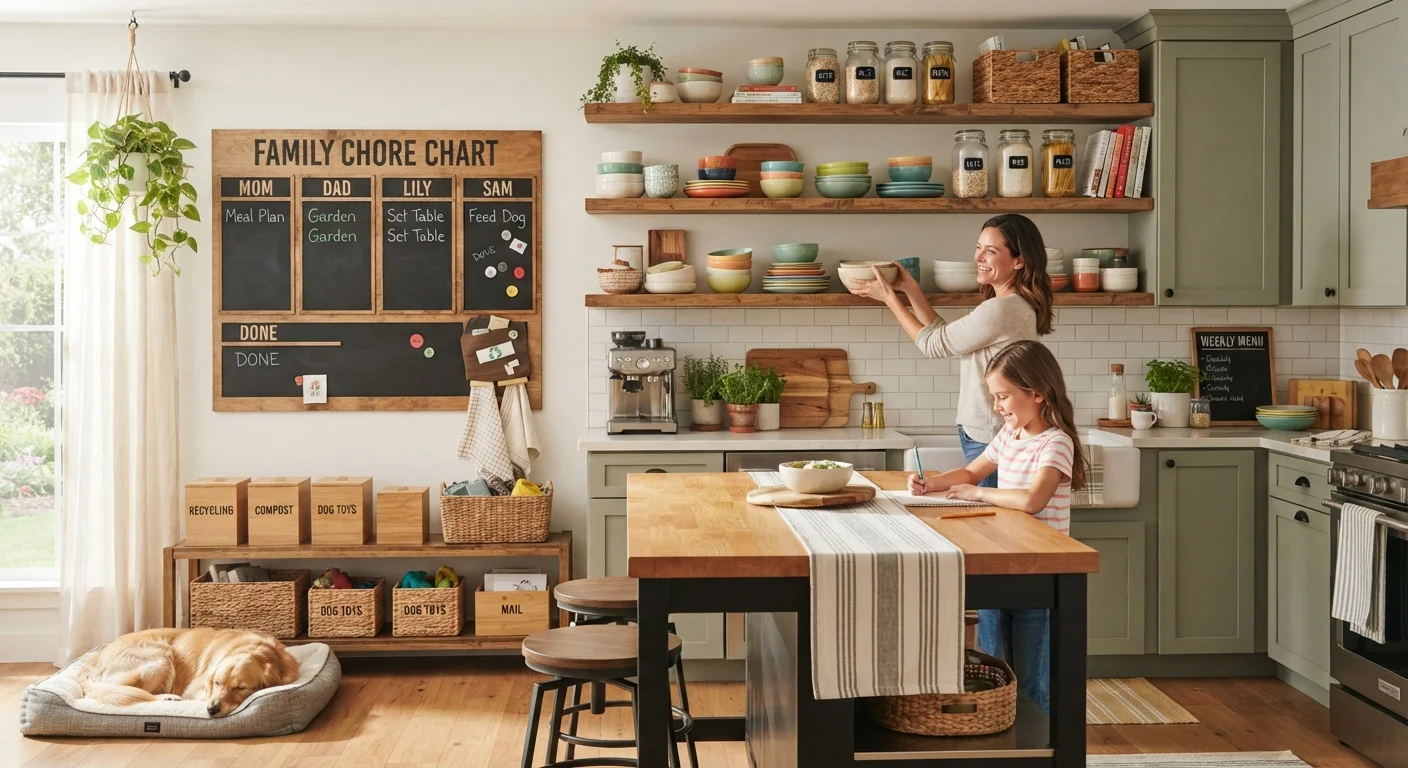
Write these responsibilities down in plain language and post them somewhere visible — a fridge chart works well for younger children.
Build a daily reset into existing routines
A 5-minute tidy before bedtime — or right after dinner — is far more effective than a Saturday morning overhaul. Attach the reset to something the family already does every day so it becomes automatic rather than optional.
Consistency, not completeness, is the standard. A mostly tidy home at the end of each day is a success. Think of organization as an ongoing habit similar to other shared household contributions — everyday household tasks can even double as light physical activity when approached with a bit of intention.
Make It Feel Collaborative, Not Corrective
Framing matters enormously when introducing new routines. Avoid language that implies the current situation is someone's fault. Instead, position the new system as a team upgrade that benefits everyone — less time searching for things, calmer mornings, fewer arguments. Families that approach organization as a shared project tend to sustain it far longer than those where one person imposes the rules.
Once the basics are in place, you can expand your approach room by room. Our room-by-room organization walkthrough covers practical strategies for every space your family uses daily.
Keeping Momentum After the Initial Setup
The most common setback families face isn't resistance — it's drift. Life gets busy, habits slip, and clutter quietly creeps back. The antidote is a light-touch weekly reset: a 10–15 minute sweep where everyone returns items to their designated spots. This is far easier to sustain than a full reorganization every few months.
It also helps to build in a low-stakes review every few weeks. Ask the family what's working and what isn't. If the shoe rack by the door is always overflowing, that's useful information — maybe it needs more hooks, or a different location. Systems should adapt to how your family actually lives, not the other way around.
Perfectionism Undermines Participation
If family members feel their efforts will be silently corrected or redone, they'll stop trying. Resist the urge to rearrange what a child just organized according to their own logic — unless it genuinely doesn't function. An imperfect system everyone uses beats a perfect one nobody maintains.
For inspiration on habits that prevent clutter from returning after your initial effort, see our guide to clutter-prevention habits. And if decluttering with kids in the mix feels daunting, decluttering with kids offers strategies tailored to family households specifically.
The content provided on our blog site traverses numerous categories, offering readers valuable and practical information. Readers can use the editorial team’s research and data to gain more insights into their topics of interest. However, they are requested not to treat the articles as conclusive. The website team cannot be held responsible for differences in data or inaccuracies found across other platforms. Please also note that the site might also miss out on various schemes and offers available that the readers may find more beneficial than the ones we cover.