

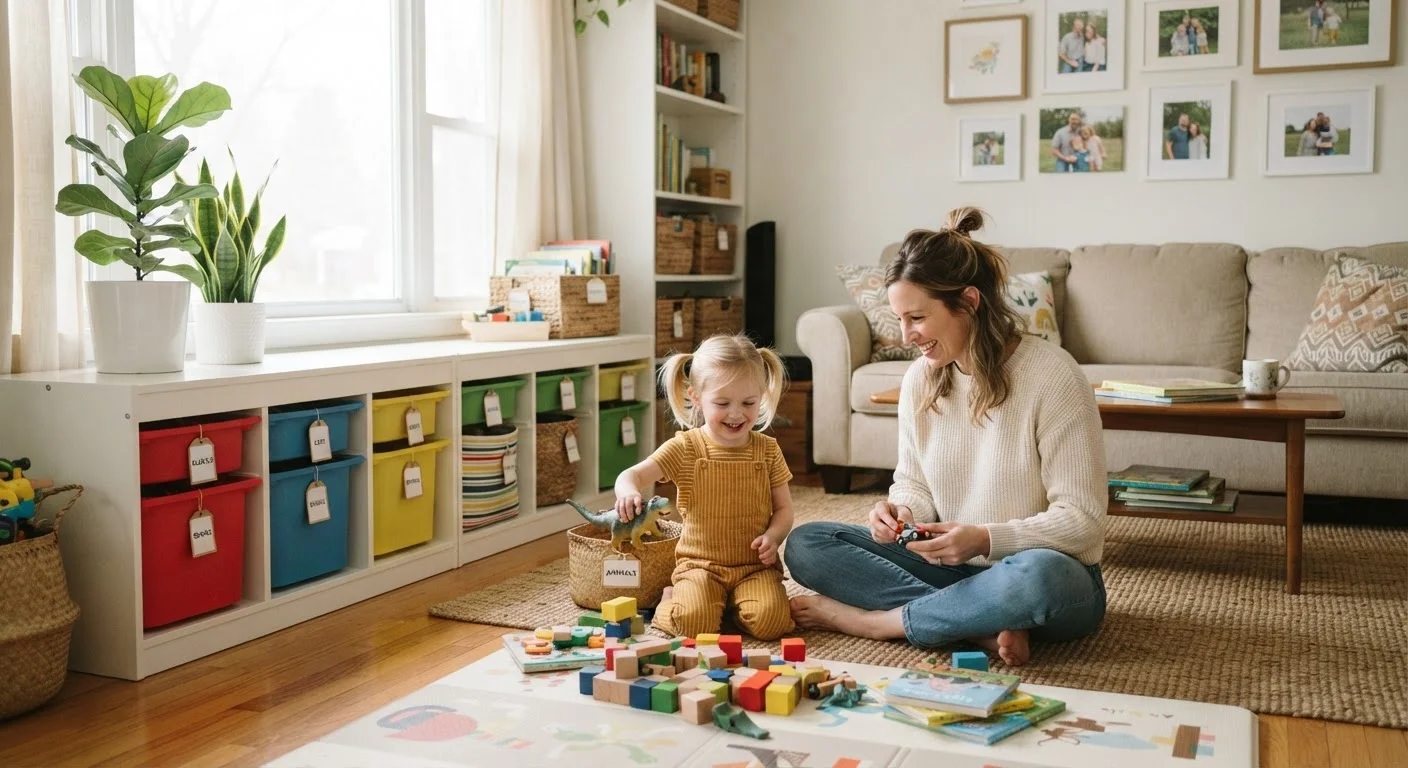
Why Standard Decluttering Advice Doesn't Translate to Family Life
Most organizing advice is written with one person — or a childless couple — in mind. The routines, timelines, and decision frameworks assume a level of control over your environment that families with young children simply don't have. Toys migrate. Art projects multiply. Outgrown gear piles up before anyone notices.
Decluttering a family home isn't harder because parents lack discipline. It's harder because the household has multiple stakeholders with different attachment levels to different items, and the volume of stuff regenerates quickly. Effective strategies have to account for that reality — not pretend it doesn't exist.
The good news: several approaches genuinely work in active family households. They just look different from the magazine-spread version of getting organized. For a broader look at how common misconceptions get in the way, see our piece on home organization myths that keep families stuck.
Practices That Actually Work
The following approaches are grounded in how children actually behave and how family schedules realistically function. They prioritize consistency over perfection and systems over willpower.
Work in short sessions of 20–30 minutes rather than full-day overhauls.
Children have limited attention spans, and exhaustion breeds frustration for everyone. Shorter sessions preserve energy and goodwill, making it easier to return the next day. Consistent small efforts compound over time without creating the dread that marathon sessions produce.
Assign each category of items a fixed home that children can reach and identify themselves.
When kids can't easily see or access where something belongs, they won't return it there. Low, open bins with visual labels (pictures for pre-readers, words for older children) dramatically reduce the friction of putting things away. The goal is an independent cleanup routine, not one that requires adult direction every time.
Let children make the keep-or-go decision for their own belongings.
Adults who quietly remove items often face strong emotional reactions when children notice. Involving kids in the choice — even if the process is slower — builds trust and teaches decision-making. It also makes children more invested in maintaining the result.
Separate the decluttering step from the organizing step.
Trying to sort and organize simultaneously overwhelms both children and adults. First, remove what no longer belongs; then, find homes for what stays. This two-phase approach makes each task simpler and prevents the common trap of organizing clutter rather than eliminating it.
Build a brief daily reset into the family routine.
A 10-minute end-of-day tidy prevents the gradual accumulation that turns a functional space into an overwhelming one. Consistent resets reduce the need for large-scale decluttering sessions. When the routine is predictable, children are more likely to participate without resistance.
Reduce the total volume of toys and supplies before adding any new storage.
More bins don't solve an excess-of-stuff problem — they just hide it temporarily. Editing down the quantity first means the storage you already have is often sufficient. This also models the principle that limits are useful, not punitive.
For ideas on keeping clutter from building back up after your initial effort, our guide on habits that prevent clutter from returning covers the everyday routines that make the biggest difference.
Setting Up Systems Children Can Actually Use
The most common reason family organization systems fail isn't lack of effort — it's that the systems were designed for adults. Storage placed too high, labels that require reading, or categories too broad for a child to navigate all create invisible friction that guarantees things won't get put away.
Every Child Responds Differently
Some children attach strongly to belongings and need extra time to make decisions — this is developmentally normal. Forcing rapid purges can create anxiety and backfire. Moving slowly and acknowledging feelings often produces better long-term results than speed. If a child is consistently overwhelmed, consider working on shared spaces before personal spaces.
When designing storage, think about the child who will use it most. Open bins beat lidded boxes for young children. Visual labels with simple pictures work better than handwritten words for pre-readers. Zones — defined areas where one type of item always lives — give children a reliable mental map of where things belong. For a plain-language breakdown of these concepts, zones, bins, and labels explained is a useful starting point.
Once you've decluttered, resist the urge to immediately purchase new storage. Walk through the space first and assess what you already have. Our pre-shopping checklist for storage bins can help you avoid the common mistake of organizing clutter rather than eliminating it.
What to Do With Items You're Removing
Once items leave the keep pile, the next question is where they go. Not everything should be donated, and not everything can be recycled. Broken items belong in disposal. Gently used children's items — clothing, books, toys — are often welcomed by local shelters, schools, or community exchanges.
For a practical decision framework covering common family items, see our guide on donation, disposal, or digitize. It's especially useful for the items families tend to hold onto longest — sentimental objects, paperwork, and outgrown but still-functional gear.
Involving children in this step — dropping off a donation bag together, for example — reinforces the idea that letting go of things can be a positive act, not just a loss. That framing pays dividends the next time a decluttering session comes around.
The content provided on our blog site traverses numerous categories, offering readers valuable and practical information. Readers can use the editorial team’s research and data to gain more insights into their topics of interest. However, they are requested not to treat the articles as conclusive. The website team cannot be held responsible for differences in data or inaccuracies found across other platforms. Please also note that the site might also miss out on various schemes and offers available that the readers may find more beneficial than the ones we cover.