

Why a Shared Vocabulary Makes Organization Easier
Home organization has its own language — and if you've ever felt confused by terms like "zones," "decanting," or "the KonMari method," you're not alone. Understanding these concepts isn't about following a trend. It's about giving your family a shared framework so that everyone knows where things belong and why.
This reference guide defines the core vocabulary you'll encounter when organizing your home. Use it as a starting point before tackling individual rooms, or return to it whenever a concept feels unclear. For a room-by-room application of these ideas, see our complete family walkthrough.
Zone
A designated area of a home assigned to a specific activity or category of belongings. Zones reduce decision fatigue by anchoring items to the places where they are actually used.
Decanting
Transferring items from their original packaging into consistent, often transparent containers. Common in pantries, it improves visibility and gives storage a uniform appearance.
Corralling
Grouping loose, related items together in a single tray, bin, or basket so they stay together and are easy to move or locate.
Flow
The natural path people take through a space. Effective organization respects existing movement patterns rather than fighting them.
KonMari Fold
A vertical folding technique associated with the KonMari method in which clothes are folded into compact rectangles and stored upright so all items remain visible in a drawer.
One-In, One-Out Rule
A maintenance habit in which one item must leave a category or container whenever a new item is added. It prevents gradual overflow without requiring periodic purges.
Four-Box Method
A decluttering technique in which every item in a space is sorted into one of four boxes: keep, donate, trash, or relocate. It makes decisions tangible and prevents sorting fatigue.
Döstädning (Swedish Death Cleaning)
A Scandinavian practice of gradually and intentionally reducing possessions throughout life so they don't become a burden to family members later.
The Building Blocks: Zones, Systems, and Flow
Most professional organizers build their approach around three foundational ideas: zones, systems, and flow. A zone is any area of your home designated for a specific activity or category of items — the homework zone, the charging zone, the sports gear zone. Zones eliminate the guesswork of "where does this go?" by anchoring items to the activities they support.
A system is the set of rules, containers, and habits that keep a zone functioning. It might be as simple as a hook by the door for backpacks, or as structured as color-coded bins for each family member. Flow refers to how naturally people move through and interact with a space. Good organization respects the way your family already moves — placing items close to where they're actually used, not where they theoretically belong.
| Most common zone types | Entry, kitchen, homework, laundry, charging, hobby |
| Typical container categories | Open bins, lidded boxes, drawer dividers, clear canisters |
| KonMari sorting order | Clothes → books → papers → miscellaneous → sentimental (Marie Kondo, The Life-Changing Magic of Tidying Up) |
| The 20/20 rule threshold | Under $20 to replace, within 20 minutes (Popularized by minimalism advocates Joshua Fields Millburn and Ryan Nicodemus) |
| Label formats for families with young children | Picture labels, color coding, or both |
These three concepts work together. A zone without a system tends to fill with clutter. A system without flow gets ignored. When all three align, spaces stay functional with far less daily effort. To understand how habits reinforce these systems over time, see our guide on habits that prevent clutter from returning.
Containers, Labels, and the Language of Storage
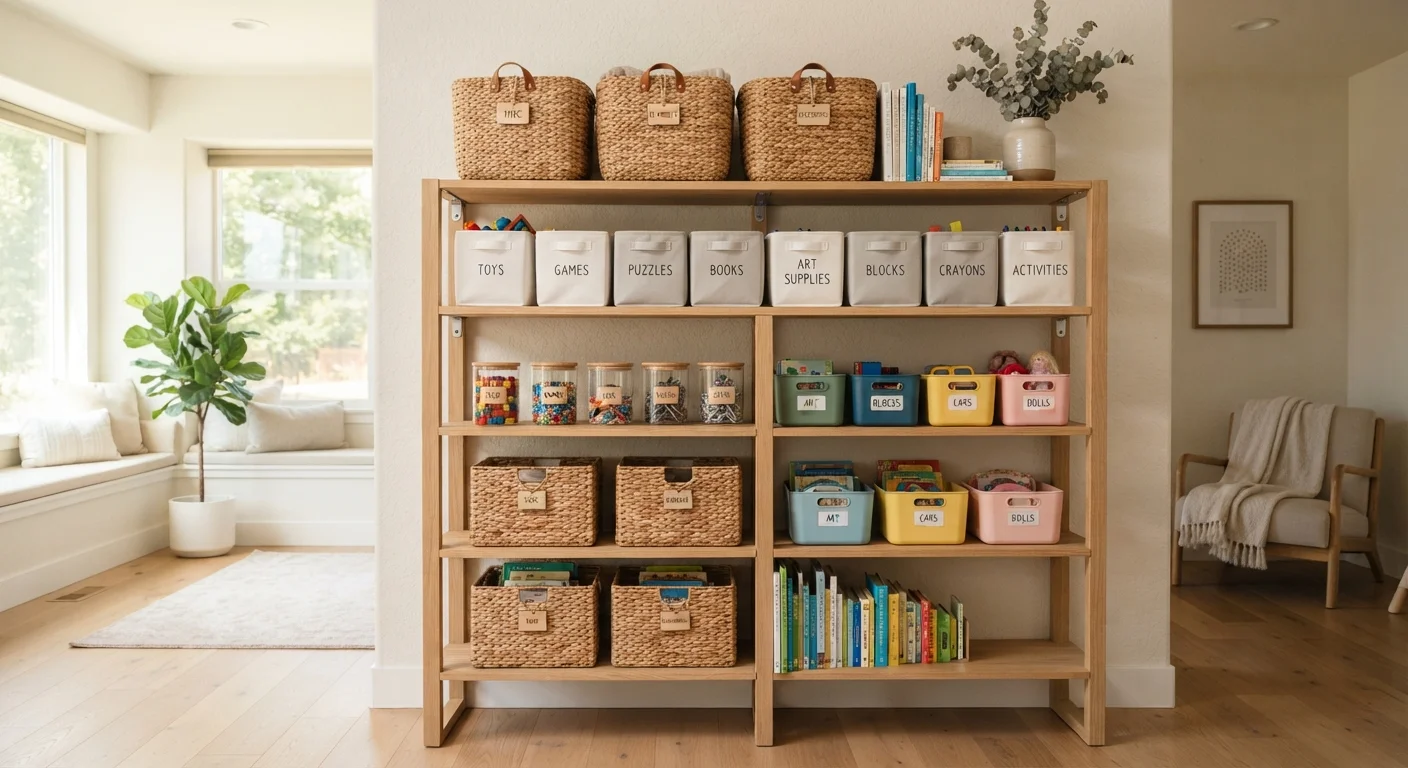
Bins, baskets, and boxes are the physical tools that give zones their structure. Decanting means transferring items from their original packaging into uniform containers — a common practice in pantry organization that makes quantities visible at a glance. Corralling means grouping loose, related items into a single container so they move and store together (think: all the remote controls in one tray).
Labels are the communication layer of any system. A well-labeled bin tells every family member — including young children — where to return an item without asking. Labels can be written, printed, color-coded, or image-based depending on the age of your household members. Organizing with kids often works best when picture labels replace text on lower shelves.
Container Limits Matter More Than Labels
A label tells people where something goes — but the container itself sets the limit. When a bin is full, that's the natural signal to reassess the category rather than find a bigger bin. Keeping containers appropriately sized for what a family actually needs is one of the most effective ways to prevent re-accumulation. If you find a container constantly overflowing, consider whether the zone needs reorganizing rather than simply more space.
The one-in, one-out rule is a maintenance habit closely tied to container limits: when a new item enters a category, one must leave. It prevents containers from overflowing and keeps systems honest over time.
Decluttering Frameworks Worth Knowing
Several structured approaches to decluttering have become widely used, each with its own logic:
- KonMari method: Developed by organizing consultant Marie Kondo, this approach involves sorting belongings by category (not room) and keeping only items that "spark joy." Clothes are folded vertically for visibility — a technique now commonly called the KonMari fold.
- The four-box method: Items are sorted into four boxes — keep, donate, trash, and relocate — making decisions concrete during a sort session.
- Swedish death cleaning (döstädning): A Scandinavian concept centered on gradually reducing possessions so they don't burden others. Useful for households managing inherited items or preparing for a move.
- The 20/20 rule: A guideline suggesting that if you could replace an item for under $20 and within 20 minutes, it may not be worth storing.
No single method works for every family. Most people draw from several approaches depending on the room or category. See our companion piece on home organization myths for a realistic look at what these frameworks can and can't do.
Getting everyone in your household to use these systems consistently is its own challenge — our guide on getting the whole family on board offers practical strategies for making that happen.
The content provided on our blog site traverses numerous categories, offering readers valuable and practical information. Readers can use the editorial team’s research and data to gain more insights into their topics of interest. However, they are requested not to treat the articles as conclusive. The website team cannot be held responsible for differences in data or inaccuracies found across other platforms. Please also note that the site might also miss out on various schemes and offers available that the readers may find more beneficial than the ones we cover.