

Why the Donation Bin Isn't Always the Answer
Most decluttering advice defaults to a single instruction: if you don't use it, donate it. That guidance is well-intentioned but incomplete. Donation organizations have limited capacity and specific needs. Many items that families instinctively drop off — worn clothing, partial toy sets, outdated electronics — cannot be redistributed and end up in landfill anyway, just via a longer route.
A more useful framework starts with three honest questions: Can someone else use this? Does it require special disposal? Does it hold value I want to preserve without keeping the object? These three questions map directly to the Donate, Dispose, and Digitize categories that make the entire process faster and less emotionally draining.
If you're decluttering with children in the house, a structured decision system also gives kids a clear role. See our guide to decluttering with kids for family-specific strategies that make the process stick.
What you will need
Three labeled bins or boxes
Used to physically separate items into Donate, Dispose, and Digitize categories as you sort.
Smartphone or flatbed scanner
Captures digital copies of photos, documents, children's artwork, and other paper keepsakes.
Permanent marker and labels
Marks boxes clearly so family members can contribute to sorting without confusion.
Local recycling and hazardous waste guide
Helps identify proper drop-off locations for electronics, batteries, and other regulated items.
Cloud storage or external hard drive
Stores digitized files securely so physical originals can be released with confidence.
How to Work Through Your Items Systematically
The steps below walk you through a complete sorting session from setup to removal. The process works room by room — don't try to tackle an entire home in one sitting. A bedroom closet, a garage corner, or a single kitchen cabinet is a realistic scope for one session.
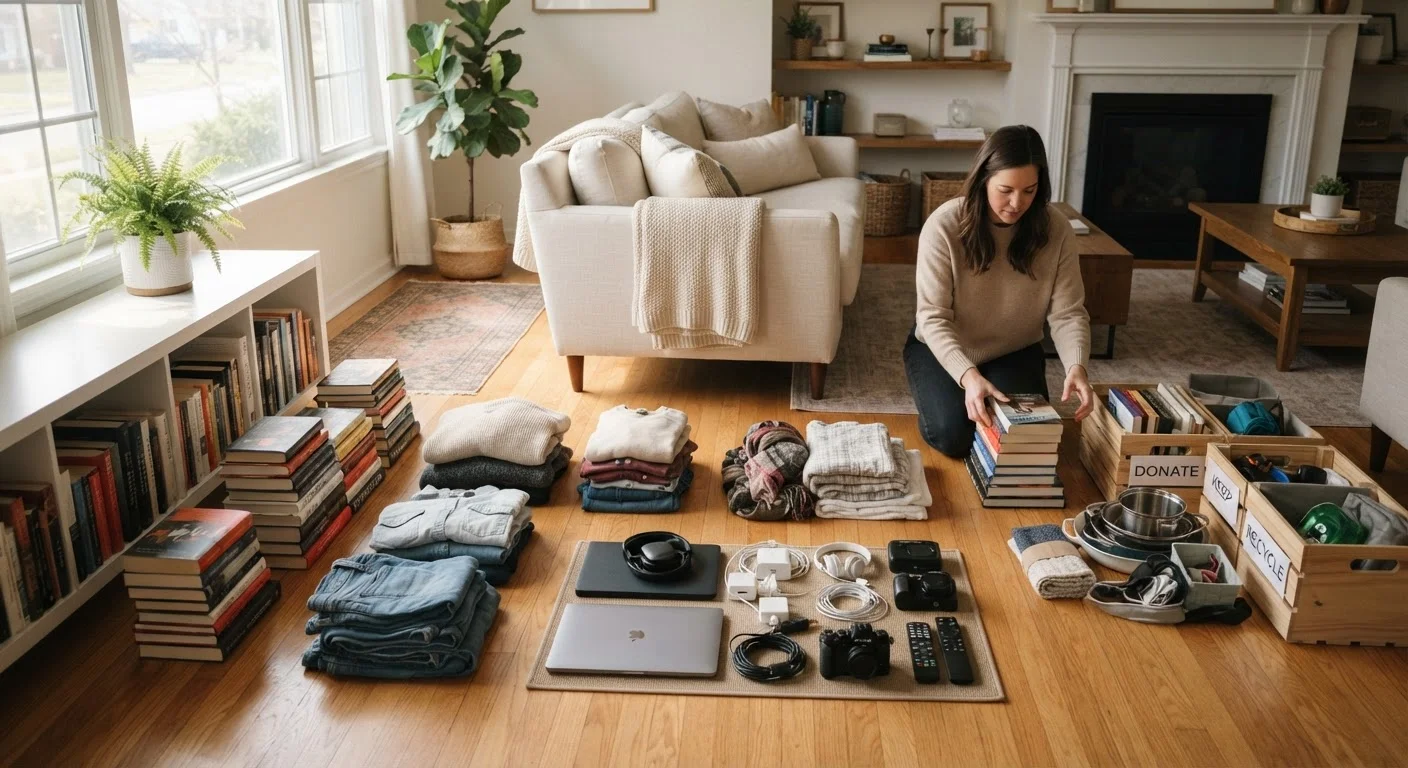
Set up your three-category sorting system
Before touching a single item, create three clearly labeled zones: Donate, Dispose, and Digitize. Use bins, boxes, or taped floor sections — whatever suits your space. Having a physical home for each category is what makes the sorting process fast and decisive. Avoid adding a "maybe" pile; it almost always expands to fill the room.
Assess condition before assigning a category
Pick up each item and ask one question first: Is this functional and in acceptable condition? If yes, it's a candidate for donation. If it's broken, stained, expired, or missing parts, donation is rarely appropriate. Items in poor condition should go directly to the Dispose category — where "dispose" may still mean recycling, not landfill.
Route usable items to the right donation channel
Not all donation organizations accept the same things. General thrift stores typically accept clothing, books, kitchenware, and small furniture in good condition. Specialized organizations — such as those supporting domestic violence survivors, shelters, or children's programs — may accept very specific items like new toiletries, gently used toys, or professional clothing. A quick call or website check before you load your car saves a wasted trip and ensures your items actually reach someone who needs them.
Identify what needs special disposal
Several common household categories cannot go into standard trash or single-stream recycling:
- Electronics (phones, computers, printers) — many retailers and municipalities offer e-waste collection
- Batteries — drop-off bins are available at many hardware and office supply stores
- Medications — many pharmacies and police stations host medication take-back programs
- Paint and solvents — check your municipality's hazardous waste schedule
- Fluorescent bulbs — treated as hazardous due to mercury content
Research your local options before disposal day so nothing sits in limbo.
Digitize sentimental items before letting go
Physical keepsakes — childhood photos, handwritten letters, children's artwork, paper recipes — often create the most decluttering paralysis. Digitizing lets you preserve the memory without preserving the object. Use your smartphone's camera or a dedicated scanning app for flat items; many libraries and copy shops also offer affordable scanning services for larger volumes. Store files in at least two locations (for example, cloud storage plus an external drive) so nothing is lost if one fails.
For items beyond photographs and paper, consider whether a well-framed digital photo of the object itself captures what matters to you.
Schedule removal within 48 hours
Sorted items that stay in your home have a way of migrating back to shelves and closets. As soon as your session ends, place donation boxes by the door or in your car, note the next hazardous waste drop-off date on your calendar, and move digitized originals to a single outgoing location. The decision is made — now make it stick by removing the items from your space quickly.
Hazardous Items Need Proper Disposal
Paints, batteries, fluorescent bulbs, old medications, and certain electronics should never go in your regular trash or recycling bin. Disposing of these incorrectly can harm the environment and may violate local regulations. Search your municipality's website for household hazardous waste drop-off events or permanent collection sites near you.
Paper-based clutter — mail, school records, receipts — often deserves its own session. Our article on paper clutter vs. digital clutter compares strategies for managing both physical and digital paper overflow in a family home.
Create a Holding Zone for Sentimental Items
If you're unsure whether to keep, digitize, or donate something with sentimental value, set it aside in a labeled box with a 30-day review date. This prevents rushed decisions you might regret. At the end of the period, revisit with fresh eyes — often the answer becomes much clearer.
Keeping the Cleared Space Clear
Decluttering creates immediate relief, but the real challenge is maintaining it. Once you've worked through a space, consider how items entered in the first place — impulse purchases, gifts without a home, items kept "just in case" — and whether small habit changes could reduce the inflow.
Don't Donate Items That Can't Be Used
Charities and thrift organizations depend on donations they can actually sell or redistribute. Stained clothing, broken appliances, and incomplete sets often cannot be accepted and create a burden for staff. When in doubt, call ahead to confirm what a specific organization accepts before dropping items off.
The junk drawer is one of the fastest places for clutter to re-accumulate after a session. Our junk drawer organizing guide walks through a practical method for editing and maintaining this common trouble spot.
Before adding any storage solutions to a newly cleared space, work through a quick planning checklist — buying bins before you've finished decluttering often just reorganizes the clutter rather than eliminating it. Our pre-shopping checklist helps you avoid that common mistake. And once your space is clear, everyday habits like the one-in, one-out rule can help prevent clutter from rebuilding over time.
The content provided on our blog site traverses numerous categories, offering readers valuable and practical information. Readers can use the editorial team’s research and data to gain more insights into their topics of interest. However, they are requested not to treat the articles as conclusive. The website team cannot be held responsible for differences in data or inaccuracies found across other platforms. Please also note that the site might also miss out on various schemes and offers available that the readers may find more beneficial than the ones we cover.