

Why the Junk Drawer Deserves Real Attention
The junk drawer is one of those household features that everybody has but nobody defends. It starts as a practical catch-all — a place for the spare key, the takeout menu, the batteries you're not sure still work — and gradually becomes a friction point that slows down daily life. Searching for scissors or a pen shouldn't take two minutes of rummaging.
The good news: reorganizing a junk drawer is one of the fastest, lowest-stakes organizing wins available to a busy family. It doesn't require a weekend, a big budget, or a design aesthetic. It just requires a method. This guide gives you one. If you're working through the rest of your home at the same time, our room-by-room organization walkthrough covers every space from the entryway to the garage.
What you will need
Step-by-Step: Sorting, Editing, and Setting Up
Follow these steps in order. The sequence matters — especially the decision to empty everything out before you evaluate a single item.
Empty the entire drawer at once
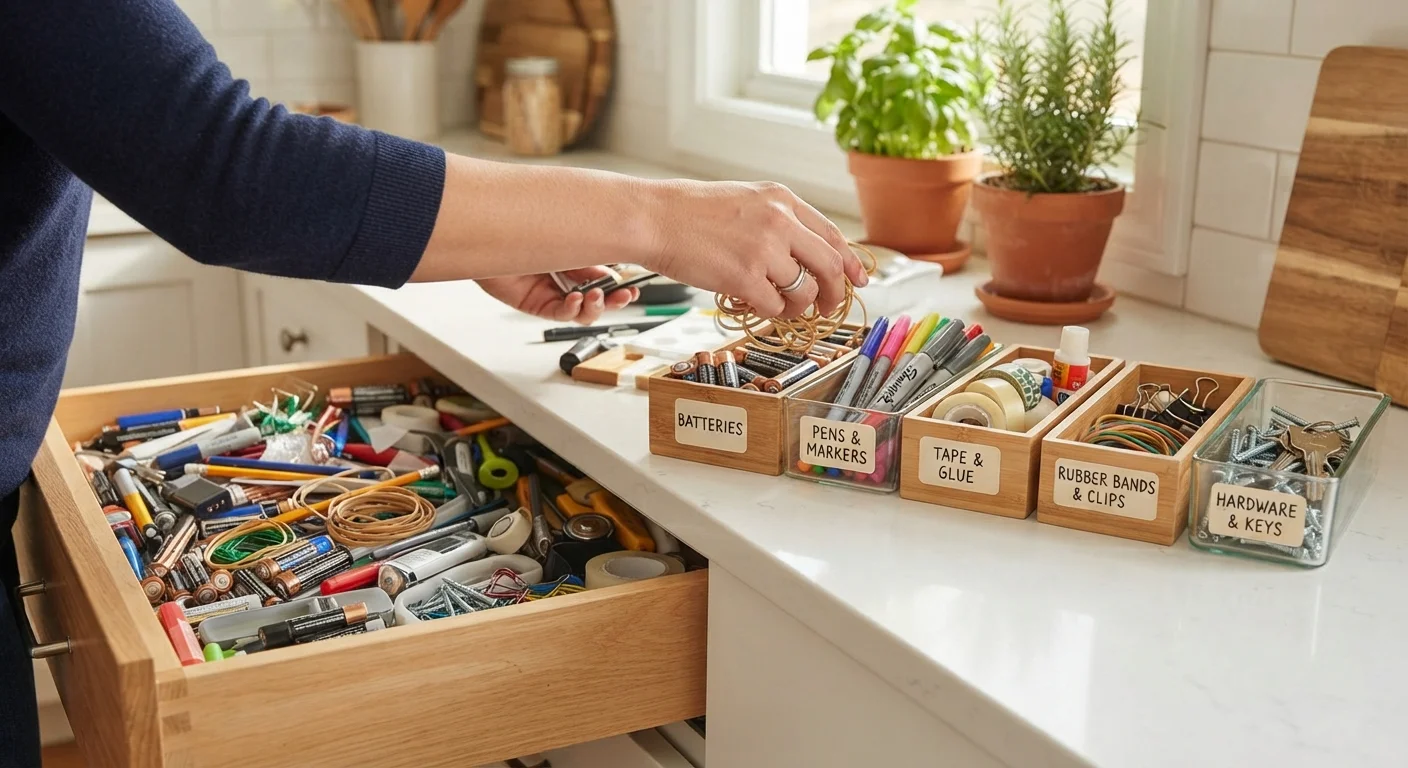
Pull everything out and place it on a flat surface. Don't sort as you go — just empty. This gives you a complete picture of what you're actually working with and prevents the common mistake of reorganizing clutter rather than eliminating it.
Discard the obvious waste first
Before categorizing anything, do a quick first pass for clear throwaways: dried-out pens, dead batteries, expired coupons, broken items, and mystery objects you cannot identify. Be honest. If you've lived without knowing what something is for over a year, you likely don't need it.
For dead batteries, check whether your municipality has a battery recycling drop-off rather than sending them to landfill. Many hardware and electronics retailers accept them.
Decide what the drawer is actually for
Before sorting the keepers, name the drawer's purpose. Most functional junk drawers serve one of two roles: a quick-access tool zone (tape, scissors, a screwdriver, batteries, pens) or a household essentials hub (keys, takeout menus, small first-aid items, pet accessories). Pick one focus and stick to it.
Items that don't fit that purpose belong somewhere else in the home — or nowhere at all. Our guide on deciding what to do with items you no longer need can help you work through the harder decisions.
Group remaining items into categories
Sort everything you're keeping into simple clusters: writing tools, batteries, adhesives (tape, glue), hardware (small screws, hooks), cords and chargers, and so on. Don't overthink the categories — broad groupings work better in a small space than overly granular ones.
Add simple dividers and return items to the drawer
You don't need a custom organizer. Small boxes, repurposed food-storage containers, or a basic drawer divider set are enough to define zones. Place your most frequently reached-for items — pens, tape, scissors — toward the front. Less-used items go toward the back.
If the drawer is in your kitchen and you're thinking about broader kitchen improvements, the small kitchen upgrades that make a real difference covers other low-effort improvements worth considering alongside this project.
One Drawer at a Time Is Enough
If tackling more of the house feels tempting after this, resist the urge to do everything in one sitting. Organizing fatigue is real, and a single completed project is more valuable than three half-finished ones. Consider pairing this with the home organization myths guide, which challenges the idea that you need a full weekend to make meaningful progress.
Keeping It Working After Day One
Organizing the drawer is only half the work. Maintenance is where most efforts fail — not because families are disorganized, but because no one establishes a reset habit. The drawer will drift back toward chaos within weeks if there's no simple routine to counter it.
Schedule a two-minute drawer reset at the start of each month. Remove anything that doesn't belong, toss obvious trash, and return wandering items to their zones. That's it. You don't need a full re-sort every time.
It also helps to communicate the system to everyone in the household. If kids and partners know which zone holds what, they're more likely to put things back correctly. Our article on getting the whole family on board with home organization has practical strategies for making shared systems stick without constant reminders.
Finally, if paper items keep migrating into the drawer — instruction manuals, expired coupons, old receipts — consider addressing that separately. Our guide to paper and digital clutter solutions covers exactly that problem.
Avoid Overfilling After You Reorganize
A freshly organized drawer invites optimism — and sometimes, overstuffing. The drawer's capacity didn't change; its clarity did. If items start getting crammed in to make them fit, that's a signal to re-evaluate what belongs there, not to squeeze harder.
The content provided on our blog site traverses numerous categories, offering readers valuable and practical information. Readers can use the editorial team’s research and data to gain more insights into their topics of interest. However, they are requested not to treat the articles as conclusive. The website team cannot be held responsible for differences in data or inaccuracies found across other platforms. Please also note that the site might also miss out on various schemes and offers available that the readers may find more beneficial than the ones we cover.