

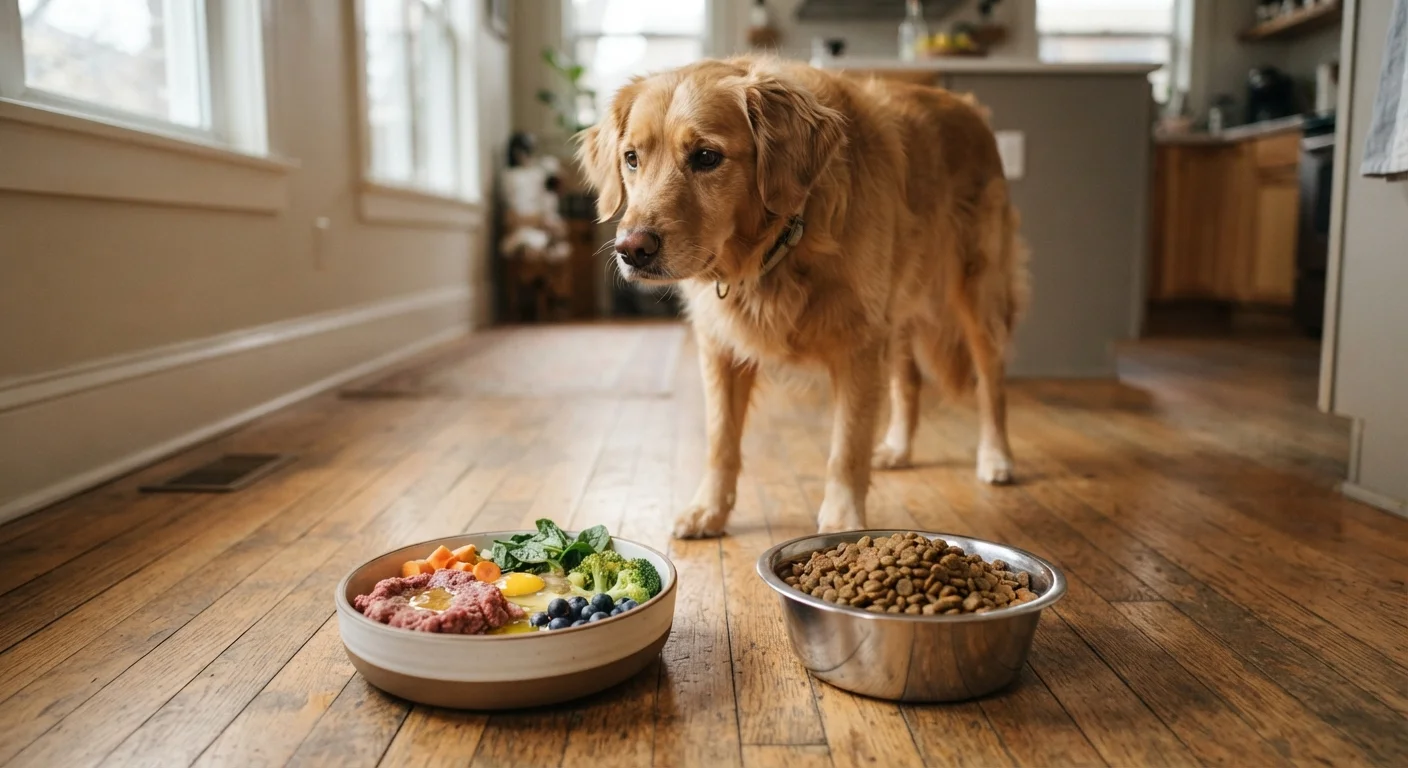
Our Verdict
Both raw feeding and commercial kibble can support a dog's health when implemented correctly, but they carry very different levels of complexity and risk. High-quality kibble meeting AAFCO nutritional standards offers a well-studied, convenient baseline for most families. Raw diets may appeal to owners seeking less-processed options, but require careful planning, handling discipline, and veterinary oversight to be nutritionally complete and safe.
| Best for | Recommended |
|---|---|
| Busy families with children, elderly relatives, or immunocompromised members | Commercial Kibble |
| Owners willing to invest significant time in meal planning and safe food handling | Raw Diet (with veterinary guidance) |
| Dogs with specific sensitivities or conditions requiring dietary customization | Discuss both options with a veterinary nutritionist |
Why the Debate Exists
Dog nutrition has become one of the most passionately debated topics among pet owners — and for understandable reasons. Families want what's genuinely best for their dogs, and the marketplace is filled with competing claims. Raw feeding advocates argue that a diet closer to what dogs' wild ancestors ate is more natural and less processed. Kibble proponents point to decades of feeding trials, consistent quality control, and convenience. Neither camp is simply wrong, which is why the conversation continues.
What's important to understand is that both approaches sit on a spectrum of quality. A poorly formulated raw diet can be just as harmful as a low-grade kibble, and vice versa. The right question for most families isn't "which is better in theory?" but rather "which can I implement safely, consistently, and within my household's real-world constraints?"
If your family also has cats and is navigating similar questions, our guide to wet vs. dry cat food covers parallel trade-offs for felines.
What the Research Currently Shows
Veterinary nutrition research on commercial kibble stretches back decades. Diets that meet standards set by the Association of American Feed Control Officials (AAFCO) — either through formulation or feeding trials — are designed to provide complete and balanced nutrition for a dog's life stage. This doesn't mean every kibble is equal, but it establishes a measurable nutritional floor that owners can verify on the label.
Research on raw diets is genuinely growing, but the evidence base is still much thinner. Some studies suggest potential benefits — including improved stool quality and palatability — though findings are often preliminary or drawn from small sample sizes. What is consistently documented in the scientific literature is the microbiological risk: studies, including FDA sampling programs, have found pathogenic bacteria in commercially prepared raw pet foods at rates that concern public health researchers.
1 in 3
Raw pet food samples testing positive for Salmonella
A U.S. FDA sampling study found Salmonella in roughly one-third of raw pet food products tested, highlighting cross-contamination risks in the home.
~74%
Homemade raw diets found nutritionally deficient in one review
A review published in the Journal of Nutritional Science found the majority of home-prepared dog diets — including raw — had at least one nutritional imbalance.
Nutritional imbalance is a separate concern with raw feeding. Unless a diet is formulated by a board-certified veterinary nutritionist, homemade raw meals frequently fall short on key minerals like calcium and phosphorus, or critical vitamins. For large-breed puppies in particular, skeletal development depends on precise calcium-to-phosphorus ratios — a point also worth considering if your family is raising a large breed dog.
Safety, Handling, and the Household Factor
Raw Diets and Household Safety
Raw meat — including pet-grade products — can harbor bacteria such as Salmonella, Listeria, and E. coli that pose risks to humans, not just dogs. The FDA and Centers for Disease Control and Prevention advise particular caution in households with young children, pregnant individuals, older adults, or anyone with a weakened immune system. If you feed raw, thorough handwashing, surface disinfection, and dedicated feeding bowls are essential — not optional.
Food safety isn't just about your dog's bowl — it extends to every surface, hand, and family member the food comes into contact with. Commercial kibble, when stored in a sealed container in a cool, dry space, carries minimal pathogen risk and has a long shelf life. Raw diets require freezer storage, careful thawing (refrigerator thawing is preferred over counter thawing), dedicated bowls, and consistent cleaning of preparation areas.
This is a practical calculus, not a judgment. A family with a toddler who frequently touches the floor and puts hands in their mouth faces genuinely different risk exposure than a single adult with a separate feeding station and no other vulnerable household members. Honest self-assessment matters here.
Cost, Convenience, and Daily Reality
Budget and time are legitimate factors in pet care decisions — and being realistic about them is responsible ownership, not a shortcut. Raw diets typically cost more per serving than mid-range kibble, especially for larger dogs. Sourcing quality protein, organ meat, and bone components (or purchasing commercially prepared raw) adds up quickly. Preparation time — defrosting, portioning, cleaning — adds a daily commitment that busy families should honestly factor in.
Kibble's convenience is real: measure, pour, done. That simplicity also supports feeding consistency, which matters for your dog's digestive system and daily routine. If you're building a structured daily schedule for your dog, the predictability of kibble portions fits neatly into that framework — something we explore further in our guide to building a daily routine your dog can depend on.
Transitioning Foods? Go Slowly
Whether you're moving toward raw or switching kibble formulas, abrupt dietary changes can cause digestive upset. Most veterinarians recommend a gradual transition over seven to ten days, mixing increasing amounts of the new food with the old. Monitor stool consistency and energy levels throughout, and pause the transition if you notice vomiting or significant diarrhea.
Making an Informed Choice for Your Dog
| Raw Diet | Commercial Kibble | |
|---|---|---|
| Nutritional completeness | Requires careful formulation; easy to get wrong | AAFCO-compliant options are reliably complete |
| Pathogen risk | Higher — Salmonella, E. coli, Listeria possible | Very low when stored and handled correctly |
| Cost | Generally higher; varies by protein source | Wide range; affordable options widely available |
| Preparation time | Significant — sourcing, portioning, thawing | Minimal — measure and serve |
| Storage requirements | Freezer space required; strict thawing protocols | Dry pantry storage; longer shelf life |
| Veterinary evidence base | Growing but limited; long-term data sparse | Decades of feeding trials and research |
| Palatability | Often high; many dogs are enthusiastic | Varies by recipe and dog preference |
The most important step before changing your dog's diet is a conversation with your veterinarian. They can assess your dog's current health, life stage, breed-specific needs, and any underlying conditions that might make one approach preferable. If you're seriously considering raw feeding, asking for a referral to a board-certified veterinary nutritionist is worthwhile — they can design a complete, balanced raw plan rather than leaving nutritional gaps.
There's no universal answer here, and that's okay. A family's feeding choice may evolve over time as circumstances change, the dog ages, or new research emerges. What matters most is that the diet is nutritionally complete, prepared safely, and reviewed periodically by a veterinary professional.
This article is for general informational purposes only and does not constitute veterinary or nutritional advice. Always consult a licensed veterinarian before making significant changes to your dog's diet.
The content provided on our blog site traverses numerous categories, offering readers valuable and practical information. Readers can use the editorial team’s research and data to gain more insights into their topics of interest. However, they are requested not to treat the articles as conclusive. The website team cannot be held responsible for differences in data or inaccuracies found across other platforms. Please also note that the site might also miss out on various schemes and offers available that the readers may find more beneficial than the ones we cover.