

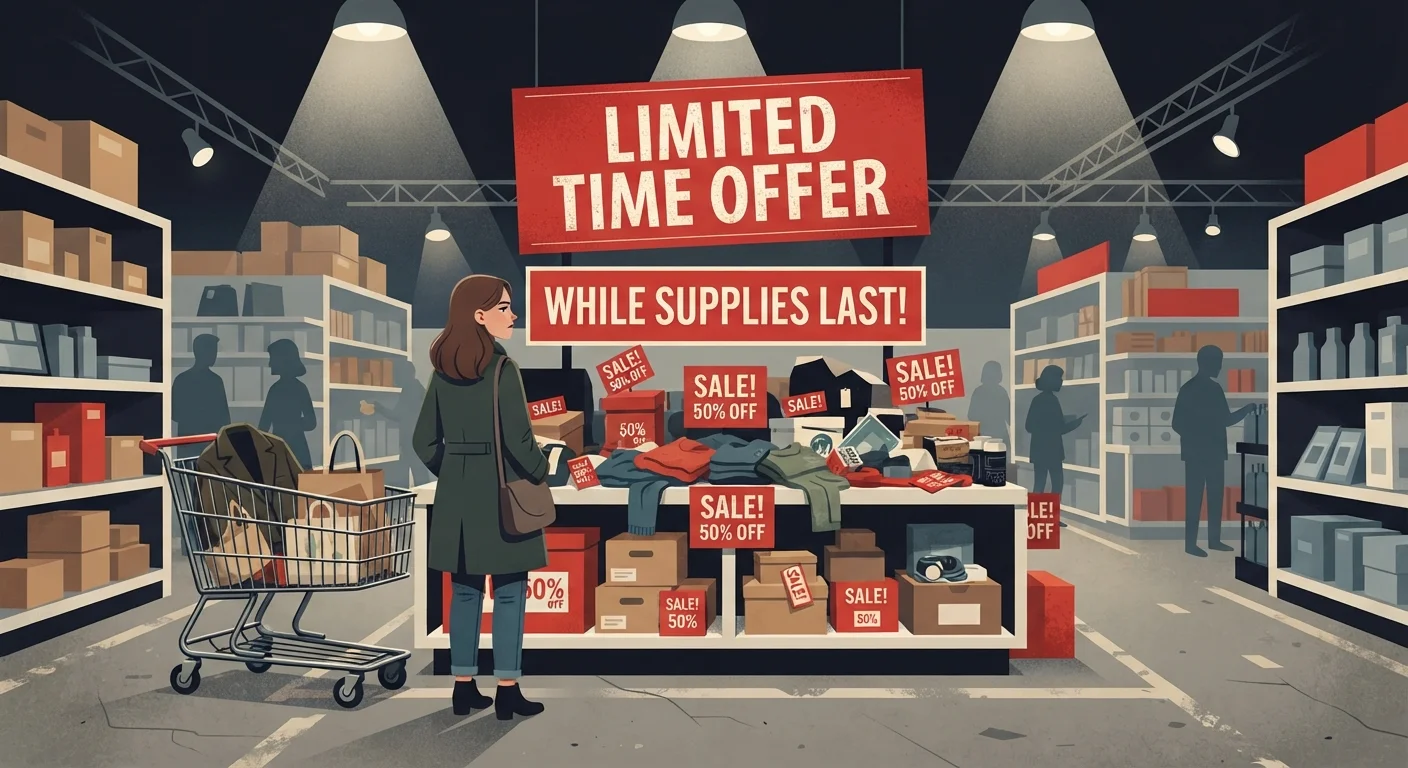
What These Phrases Actually Commit a Retailer To
Walk through any store or scroll any retailer's homepage and you'll encounter some version of the same message: act now, or miss out. "Limited time offer." "While supplies last." "Today only." The language feels urgent and specific. Legally, it commits retailers to almost nothing.
Unlike regulated terms — such as "sale" in states with price advertising laws — phrases like "while supplies last" carry no standardized definition. A retailer can use them on a product stocked in abundant quantities or on a promotion that quietly reappears next week. There is no universal authority requiring that a "limited time" offer expire at a specific hour or that "supplies" be genuinely scarce.
That doesn't mean every promotion using this language is deceptive. Some genuine clearance events do end. Some products do sell out. But the phrasing alone is not evidence of either. It's a prompt designed to shorten your decision window — and the less time you spend deciding, the less time you spend comparing.
For a broader look at how promotional language is constructed, see our piece on retail tricks families encounter most often.
Common Myths About Urgency Offers — Corrected
Most shoppers carry at least a few assumptions about time-pressure deals that simply don't hold up. Here's what consumer behavior research and retail practice actually show.
Myth
If an offer says 'today only,' it won't be available tomorrow.
Fact
Many 'today only' promotions repeat regularly or roll over without announcement.
Promotional calendars at major retailers are planned weeks or months in advance. A "today only" sale on a product category often recurs on the same day each week or resets at the start of a new promotion cycle. Consumer advocates have documented cases where the same "one-day" price appeared on the same product across multiple weeks. The label is a marketing frame, not a binding schedule.
Myth
A 'while supplies last' warning means stock is genuinely running low.
Fact
Retailers are not required to disclose actual inventory levels alongside this phrase.
"While supplies last" is one of the most broadly applied phrases in retail because it's accurate in the most literal sense — supplies of any product will eventually end. But the phrase carries no implication about how much stock exists. A warehouse with thousands of units can legally use this language. Unless a retailer shows you a verified inventory count, the phrase tells you nothing actionable about availability.
Myth
Urgency offers are always priced lower than usual.
Fact
Urgency language and genuine price reductions are separate things — one does not guarantee the other.
A product can be promoted with a countdown timer at its standard everyday price. Urgency language is a persuasion tool applied to the presentation of an offer, not a reliable indicator of its value. Cross-checking the promoted price against price history or other retailers is the only reliable way to determine whether a discount is real. Our companion piece on how sale prices are constructed explains reference pricing in more depth.
Myth
If I feel urgency, I should trust that the deal is genuinely time-sensitive.
Fact
The feeling of urgency is a designed response, not evidence that the underlying offer is exceptional.
Retail environments — physical and digital — are deliberately engineered to create emotional states that favor quick decisions. Countdown timers, scarcity indicators, and bold red pricing all trigger the same mental shortcuts. Consumer psychology researchers have repeatedly shown that perceived scarcity increases the perceived value of an item, independent of its actual market price. Recognizing that your sense of urgency was likely prompted by a design choice, not by objective circumstances, is itself a practical tool for slowing down.
Myth
Limited-edition or exclusive items are always produced in small quantities.
Fact
The word 'exclusive' has no regulated meaning in most retail contexts.
"Exclusive" can mean available only through one channel, produced in a specific colorway, or simply marketed under a distinct label. It does not legally require limited production volume. Retailers and manufacturers use exclusivity framing to create differentiation without committing to genuine scarcity. Before paying a premium for "exclusive" positioning, it's worth asking what specifically is exclusive — the design, the retailer, the bundle — and whether that distinction matters for your actual use of the product.
The Psychology Behind the Pressure
Urgency tactics work because of a well-documented cognitive pattern: potential losses feel more motivating than equivalent gains. Researchers call this loss aversion. When a retailer frames a promotion as something you could miss, it activates that same mental calculus — even if the "loss" is entirely constructed.
~65%
Shoppers who made an unplanned purchase due to a sale
A National Retail Federation survey found roughly two-thirds of shoppers reported buying something unplanned specifically because it was marked on sale.
3x
Weight of losses vs. equivalent gains in decision-making
Behavioral economics research consistently finds that the psychological impact of a potential loss is roughly two to three times stronger than an equivalent gain — the mechanism urgency tactics exploit.
Retailers layer multiple signals to reinforce the effect: countdown timers, low-stock indicators, and social proof messages like "47 people viewing this item" compound the feeling that action is required immediately. Online platforms have refined these tools significantly, but the underlying technique predates e-commerce by decades.
Understanding the mechanism doesn't make you immune, but it does create a useful moment of pause. When you notice yourself feeling rushed, that feeling itself is worth examining. It's a signal that urgency cues are present — not necessarily that the urgency is real.
Practical Steps Before You React to Urgency Language
You don't need to become a cynical shopper to protect yourself from pressure tactics. A short, consistent checklist does most of the work.
- Check the price history. Free browser extensions and dedicated tools track historical pricing on major retail platforms. If the current price has been the same or lower in recent months, the "deal" framing deserves skepticism.
- Wait at least 24 hours on non-essential purchases. Most "today only" promotions either extend, repeat, or are quietly replaced by something comparable. If the need is real and the price is still good tomorrow, it was a real deal. If the offer disappears and you don't miss the item, that's useful information too.
- Search the same product elsewhere. Urgency language is retailer-specific. The identical item may be available at a similar or lower price with no countdown attached.
- Read the fine print. Our guide on decoding the fine print on rebates and limited-time offers covers what conditions frequently appear in promotional terms.
Countdown Timers Online May Not Reflect Real Deadlines
On many e-commerce platforms, countdown timers reset when the page is refreshed or when a session ends — they are a display feature, not a live reflection of an offer's actual end time. If you see a timer running, treat it as a visual prompt designed to increase pace, and apply the same 24-hour pause you would to any urgency offer. Check whether the promotion terms are disclosed elsewhere on the page before treating the timer as definitive.
It also helps to know when price drops in certain categories are actually predictable — and have nothing to do with manufactured scarcity. Seasonal buying windows explains which product categories follow real price cycles tied to inventory and season.
Finally, the same pressure tactics that appear mid-browse also appear at checkout. Checkout line upsells exploit decision fatigue in the same way — worth understanding as a pair.
The content provided on our blog site traverses numerous categories, offering readers valuable and practical information. Readers can use the editorial team’s research and data to gain more insights into their topics of interest. However, they are requested not to treat the articles as conclusive. The website team cannot be held responsible for differences in data or inaccuracies found across other platforms. Please also note that the site might also miss out on various schemes and offers available that the readers may find more beneficial than the ones we cover.