

Two Distances, One Dangerous Gap
Most drivers think of stopping as a single action - press the brake, car stops. In reality, stopping involves two separate phases that stack on top of each other, and the combined total is almost always longer than people expect.
Reaction distance is the ground your car covers from the instant you see a hazard until your foot moves to the brake pedal. Research on driver response suggests average reaction time runs between 1.5 and 2.5 seconds, depending on alertness, distraction level, and age. At 30 mph, that translates to roughly 44-110 feet of travel before the brakes engage at all.
Braking distance is what the vehicle needs after the brakes engage to reach a full stop. This figure is governed by speed, vehicle weight, tire condition, and road surface. Add reaction distance to braking distance and you have your total stopping distance - which is the number that actually determines whether you hit something.
Reaction Time Varies More Than You May Realize
Average reaction time figures used in traffic safety research (typically 1.5 seconds) represent an alert, undistracted driver. Fatigue, phone use, unfamiliar roads, or being in conversation can push that number significantly higher. Even a half-second increase in reaction time adds 44 feet of travel at 60 mph before braking begins.
Understanding both components is especially useful when thinking about why tailgating is so dangerous - even a short gap disappears quickly when both distances are in play.
Why Speed Has a Disproportionate Effect
Here is where physics becomes critically important for everyday drivers. Kinetic energy - the energy a moving vehicle carries - increases with the square of speed. That means if you double your speed, you do not double the energy the brakes must absorb: you quadruple it.
In practical terms, a car traveling at 60 mph does not need twice the stopping distance of one going 30 mph. It needs roughly four times as much. This non-linear relationship is why highway crashes at high speed are so catastrophically destructive, and why even modest speed reductions in hazardous conditions produce meaningful safety gains.
4×
Braking distance increase when speed doubles
Because kinetic energy scales with the square of speed, doubling velocity quadruples the energy brakes must absorb to stop a vehicle.
88 ft/sec
Distance traveled per second at 60 mph
At highway speeds, even a 1.5-second reaction delay means over 130 feet of road covered before brakes engage.
50-100%
Braking distance increase on wet pavement
Reduced tire-road friction on wet surfaces significantly extends the distance needed to bring a vehicle to a stop.
This physics is also the core reason speed limits are reduced in school zones and construction areas. A child stepping off a curb at 40 mph gives a driver far less usable response window than the same scenario at 20 mph - the difference in stopping distance is not marginal; it is transformative.
Road Conditions, Tires, and the Variables You Can Control
Dry pavement at the speed limit is the baseline most drivers intuitively calibrate to. But real-world driving rarely offers ideal conditions, and each variable compounds the others.
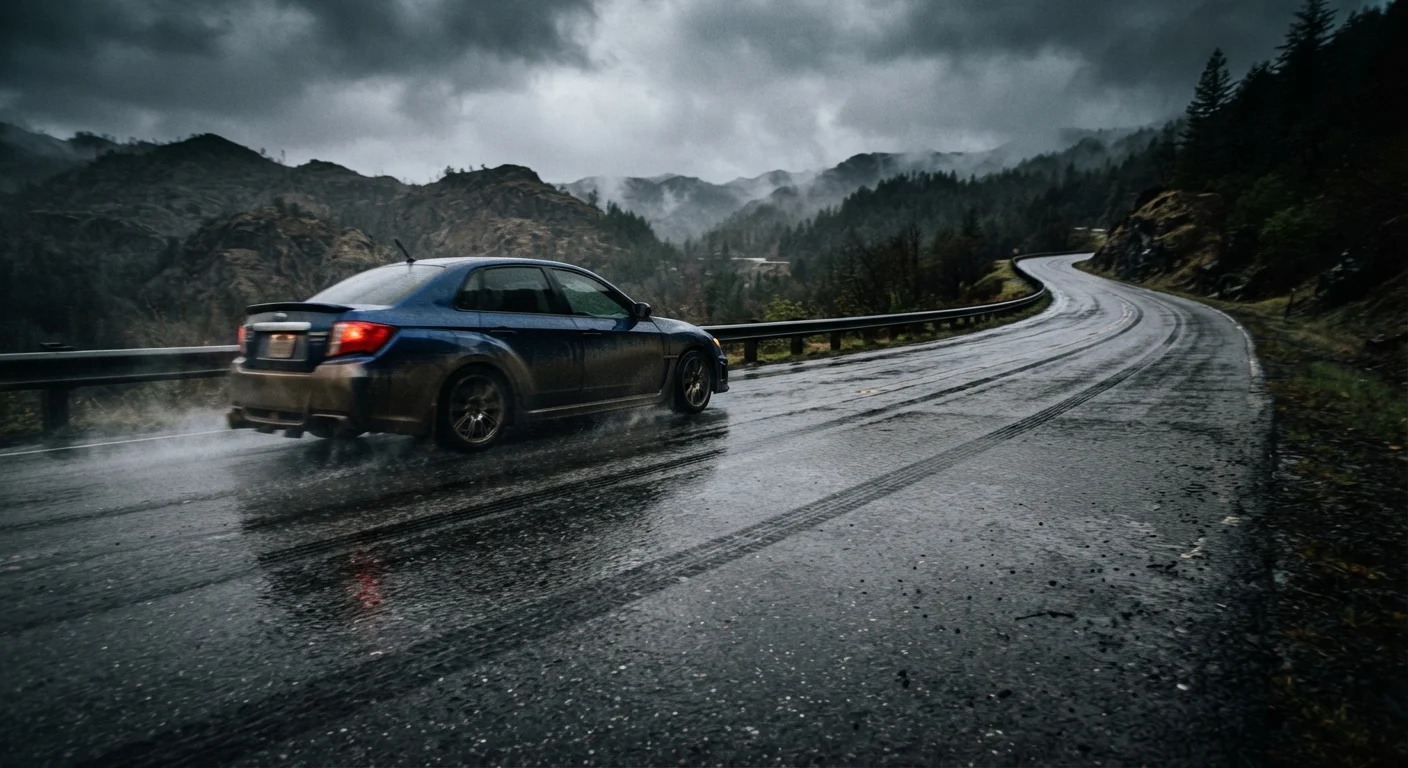
- Wet roads: Water reduces friction between tire and road. Braking distance can increase by 50% or more on wet pavement. At highway speeds in rain, stopping from 60 mph may require an additional 100+ feet compared to dry conditions.
- Ice and snow: Packed ice can increase braking distance by 300-400% over dry asphalt. This is why speed must drop dramatically in winter conditions - it is not about comfort; it is about physics.
- Tire condition: Worn tread reduces the tire's ability to channel water and grip the road. Tires at or near the wear indicator (typically 2/32 of an inch of tread remaining) perform significantly worse in wet braking tests than tires with full tread.
- Vehicle load: A fully loaded minivan or SUV carries more mass, which requires more braking force to decelerate. Families carrying luggage, kids, and gear should account for this when setting following distances.
Extend Your Following Distance in Adverse Conditions
The standard three-second following gap is a starting point, not a ceiling. In rain, at highway speeds, after dark, or when carrying a full vehicle load, increase your gap to four seconds or more. Stopping distance physics does not care about your schedule - give yourself the room to respond.
These factors interact with night driving conditions as well - see what changes when you drive after dark for more on managing reduced visibility alongside longer stopping needs.
Translating Physics Into Everyday Driving Habits
Understanding stopping distance is only useful if it changes how you drive. A few evidence-backed habits make the biggest difference:
- Follow the three-second rule - or longer. Pick a fixed point ahead. When the car in front passes it, count three seconds before you reach it. In rain, fog, or at highway speeds, extend to four seconds. This cushion accounts for both reaction time and braking distance.
- Slow down incrementally in adverse conditions. Rather than waiting until roads feel dangerous, reduce speed proactively when it begins to rain or when temperatures approach freezing. You cannot recover stopping distance once a hazard appears.
- Check tires regularly. A simple penny test - insert a penny into the tread groove with Lincoln's head pointing down; if you see the top of his head, tread is critically low - can indicate whether your tires are still performing safely. Consult a qualified tire professional if you are uncertain.
- Minimize distractions. Reaction time is not fixed. Fatigue, phone use, or even a conversation can add fractions of a second - and at speed, fractions of a second translate to dozens of feet. Some persistent driving myths suggest experienced drivers can multitask safely; the evidence does not support this.
This article provides general educational information about vehicle physics and safe driving habits. It is not a substitute for professional driving instruction or advice specific to your vehicle or conditions.
Frequently Asked Questions
On a dry road, most passenger vehicles need roughly 240-300 feet to stop from 60 mph when you factor in an average reaction time. Wet or degraded road surfaces can extend that significantly. Tire condition and vehicle weight also play a role.
Yes - at 60 mph, a car travels about 88 feet per second. An average reaction time of 1.5 seconds means you cover more than 130 feet before your foot even touches the brake. In stop-and-go traffic, that gap can be the difference between a close call and a collision.
Wet pavement can increase braking distance by 50-100% compared to dry conditions. Ice or snow can extend it even further. Reduced traction means the tires take longer to convert braking force into deceleration.
ABS helps you maintain steering control during hard braking and prevents wheel lockup, but it does not necessarily shorten stopping distances on all surfaces. On loose gravel or deep snow, ABS may actually result in slightly longer stops. Its primary benefit is control, not pure distance reduction.
The two-second rule gives you a following gap that roughly accounts for reaction time and initial braking at moderate speeds. However, in adverse conditions - rain, fog, night driving, or higher speeds - safety experts generally recommend extending it to three or four seconds.
Lower speed limits in school zones directly reduce stopping distances, giving drivers more time to respond to children who may enter the road unexpectedly. At 20 mph instead of 40 mph, stopping distance drops dramatically, which significantly reduces the severity of any potential impact.
The content provided on our blog site traverses numerous categories, offering readers valuable and practical information. Readers can use the editorial team’s research and data to gain more insights into their topics of interest. However, they are requested not to treat the articles as conclusive. The website team cannot be held responsible for differences in data or inaccuracies found across other platforms. Please also note that the site might also miss out on various schemes and offers available that the readers may find more beneficial than the ones we cover.