

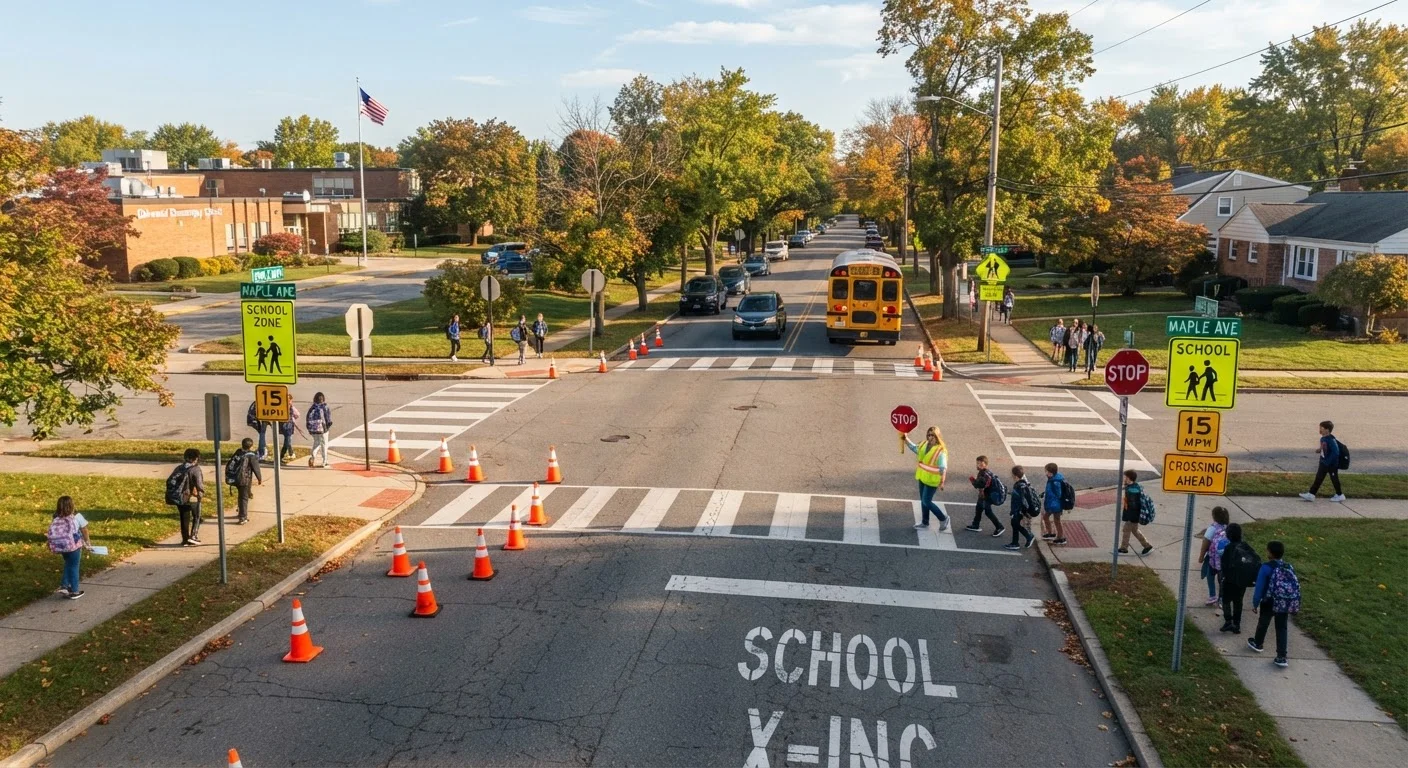
Why These Zones Demand Extra Attention
Most collisions don't happen on open highways at high speed - they happen in familiar, slower-speed environments where drivers feel comfortable enough to let their guard down. School zones and construction areas are two of the most consistently dangerous road environments in the U.S., precisely because they mix moving vehicles with unpredictable pedestrians, workers, and equipment.
| Typical school zone speed limit | 15-25 mph (varies by state) (State traffic codes; confirm locally) |
| Fine multiplier in school zones | 2× to 3× standard fine in most states (State motor vehicle statutes) |
| Work zone fine enhancement | Doubled in most U.S. states when workers are present (Federal Highway Administration) |
| School bus stop-arm law | Stop required in all 50 states on undivided roads (National Conference of State Legislatures) |
| Recommended following distance in work zones | 3-4 seconds minimum (General traffic safety guidance) |
| School zone enforcement hours | Typically active 30 min before and after school (Varies by jurisdiction; check posted signs) |
Understanding exactly what makes each zone hazardous - and what the law requires of you in each - is the foundation of safe driving through them. This is especially true for families: if children ride with you regularly, the habits you model in these zones become the habits they absorb.
For guidance on how other challenging conditions affect your driving, see how weather changes what you should do behind the wheel.
School Zones: Rules, Risks, and What to Watch For
School zones are typically marked by fluorescent yellow-green signs and flashing amber beacons that activate during arrival and dismissal windows. Speed limits in these zones generally drop to 15-25 mph, though the exact limit varies by state and municipality. In most jurisdictions, fines for speeding in a school zone are doubled or tripled compared to standard violations.
Key hazards in school zones
- Children darting between parked cars. Children's smaller stature makes them harder to spot, and they're less predictable about when and where they'll cross.
- School bus stop-arm violations. Every state requires drivers to stop when a school bus extends its stop arm and red lights flash, in both directions on undivided roads. Passing a stopped school bus is one of the most common and dangerous school-zone violations.
- Drop-off and pick-up congestion. The curb lane fills quickly; drivers may pull out unexpectedly, and pedestrian crossings are frequent.
- Distracted or fatigued parents. High-traffic moments - 7:30-8:30 a.m. and 2:30-4:00 p.m. - can bring stressed, hurried drivers who aren't paying full attention.
Practical habits for school zones
- Slow to the posted limit before you enter the zone, not once you're already in it.
- Put your phone down completely - no glancing, no voice commands while navigating the curb lane.
- Make eye contact with crossing guards and crossing children before moving through an intersection.
- If you're dropping off, follow the school's designated traffic pattern rather than improvising a closer spot.
Stop arm
The retractable red sign that extends from the driver's side of a school bus when it is stopped to load or unload children. Drivers in both directions on undivided roads are legally required to stop when it is deployed.
Flagger
A trained worker stationed in a construction zone to direct traffic using hand signals, paddles, or flags. Obeying a flagger's directions carries the same legal weight as obeying a traffic signal in all U.S. states.
Zipper merge
A lane-merging technique in which drivers in both lanes continue at speed until the merge point and then alternate turns, like the teeth of a zipper. Traffic engineers generally recommend it over early merging because it reduces overall queue length.
Work zone speed limit
A temporary, posted speed reduction that applies in and around active construction areas. Fines for exceeding this limit are doubled in most U.S. states, and violations may carry additional penalties when workers are present.
School zone beacon
A flashing amber light mounted above a school zone speed-limit sign that activates during designated school hours. When illuminated, the lower posted speed limit is legally in effect regardless of traffic conditions.
Construction and Work Zones: A Different Set of Risks
Work zones present hazards that shift daily - lane closures move, temporary speed limits change, and the workers themselves may be just feet from live traffic. According to the Federal Highway Administration, thousands of crashes occur in work zones each year, injuring both drivers and road workers.
What changes in a work zone
- Lane widths narrow. Temporary barriers and cones compress travel lanes, reducing your margin for error and making large vehicles harder to pass.
- Surface conditions vary. Grooved pavement, loose gravel, rumble strips, and uneven joints between old and new asphalt all affect traction. See how different road surfaces demand different techniques for more detail.
- Merge points appear suddenly. Lane drops are among the most misjudged situations for everyday drivers - understanding how merging works can help you handle them smoothly.
- Workers are present. Flaggers direct traffic and must be obeyed like traffic signals under law in all 50 states.
Work zone driving habits
- Increase your following distance to at least three or four seconds - braking distances in narrowed lanes leave less room for error. Following too closely is a leading cause of rear-end collisions in these environments.
- Merge early and smoothly when lanes close - zipper merging at the marked merge point is both legal and more efficient than cutting in late.
- Watch for flagger signals from a distance so you're not braking hard when you reach them.
- If construction runs at night, reduce speed further - night driving reduces your perception and reaction time significantly.
Other High-Risk Environments Worth Knowing
School zones and construction areas get the most attention, but several other road environments carry elevated risk that everyday drivers often underestimate.
Hospital and emergency zones
Driveways near hospitals see frequent ambulance movement and distracted pedestrians - patients, visitors, and staff - often crossing without checking traffic. Slow down and yield generously near emergency entrances.
Railroad crossings
Never race a train - trains cannot stop quickly, and their speed is almost always underestimated. Always stop at crossings with flashing lights or lowered gates, look both ways even at gated crossings (a second track may carry another train), and never stop on the tracks themselves.
Parking lots
Parking lots have no federally mandated speed limits in most states, but they produce a disproportionate share of low-speed collisions and pedestrian contacts. Treat them like a 5-10 mph environment, watch for reversing vehicles, and never let a child walk ahead unsupervised through a parking lot.
Managing these habits consistently is also part of responsible vehicle ownership overall. For a broader look at keeping your car safe without overspending, see practical ways to reduce car costs without sacrificing safety.
The content provided on our blog site traverses numerous categories, offering readers valuable and practical information. Readers can use the editorial team’s research and data to gain more insights into their topics of interest. However, they are requested not to treat the articles as conclusive. The website team cannot be held responsible for differences in data or inaccuracies found across other platforms. Please also note that the site might also miss out on various schemes and offers available that the readers may find more beneficial than the ones we cover.