

Why Soil Type Matters for Your Garden
Before you plant a single seed, the ground beneath your feet is already making decisions for you. Soil type determines how quickly water drains, how well roots can spread, and how many nutrients your plants can actually access. Choosing the wrong plants for your native soil — or ignoring its characteristics entirely — is one of the most common reasons home gardens struggle.
The good news: you don't need a science degree to work with your soil. This quick-reference guide breaks down the four most common garden soil types so you can identify what you have and know exactly what to do with it. If you're also weighing whether to garden in the ground or in a raised bed, our guide to raised beds vs. in-ground plots covers how soil control factors into that decision.
| Number of primary soil texture types | 4 (clay, loam, sandy, silty) (USDA Natural Resources Conservation Service) |
| Ideal pH range for most vegetables | 6.0–7.0 (University cooperative extension general guidance) |
| Clay particle size | Less than 0.002 mm (USDA soil classification system) |
| Best all-purpose soil amendment | Compost (decomposed organic matter) |
| Low-cost soil testing resource | Local cooperative extension service (Available in most U.S. counties) |
The Four Common Soil Types at a Glance
Clay Soil
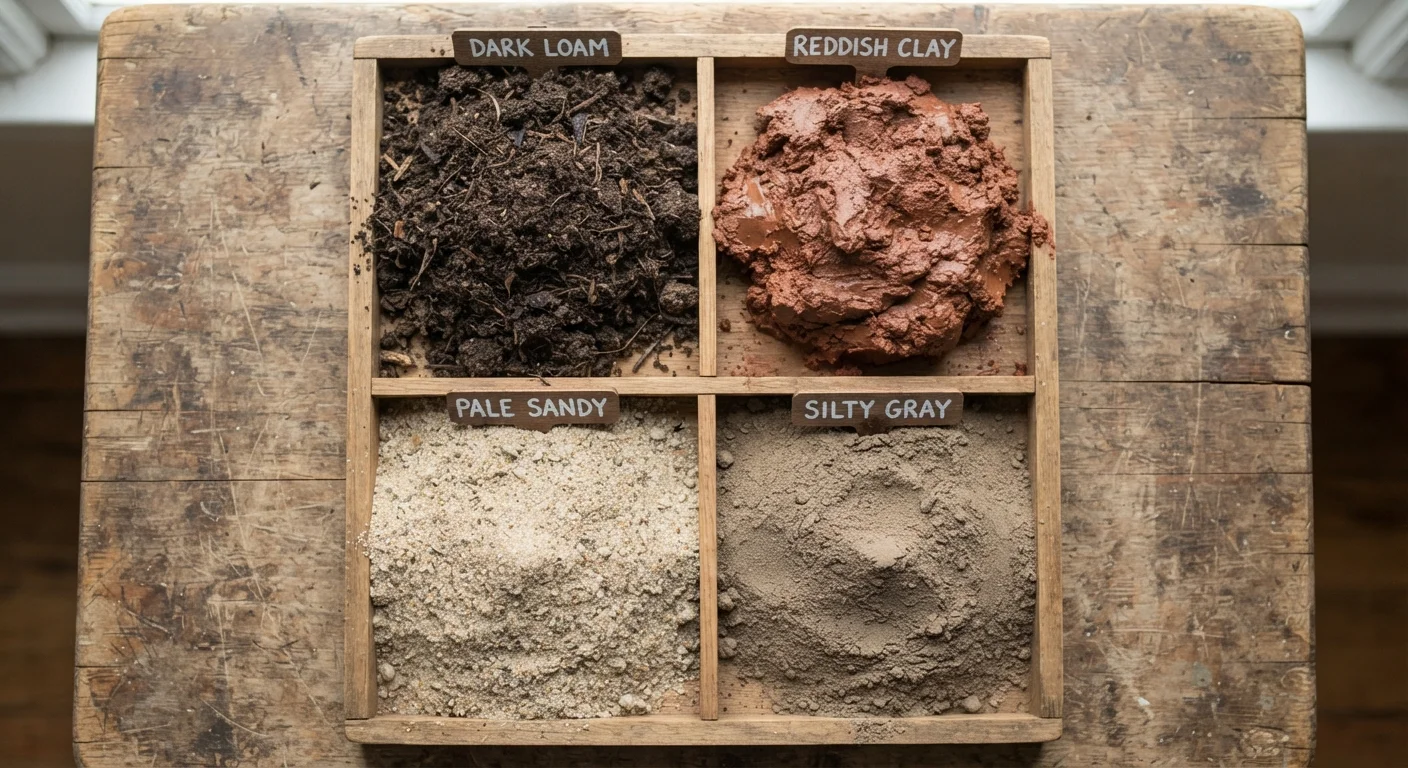
Clay soil is made up of very fine, tightly packed particles that hold moisture and nutrients well — but drain poorly. It becomes sticky and heavy when wet and cracks when dry. Root penetration can be difficult without amendment.
- Drainage: Poor — water pools and sits
- Nutrient retention: High
- Best suited for: Asters, black-eyed Susans, ornamental grasses, and some fruit trees that tolerate wet feet
- Improvement tip: Work in compost or aged organic matter each season to improve aeration and drainage over time
Loam Soil
Often called the "ideal" garden soil, loam is a balanced mix of sand, silt, and clay. It drains well, holds moisture adequately, and supports strong root development. Most vegetables and ornamentals thrive in loam.
- Drainage: Good — water moves through without pooling
- Nutrient retention: Moderate to high
- Best suited for: Tomatoes, peppers, roses, and most edible crops
- Improvement tip: Maintain loam's structure by adding compost annually and avoiding compaction from foot traffic
Sandy Soil
Sandy soil has large particles with lots of air space between them. Water and nutrients drain through it quickly, which means plants can dry out fast and may struggle to get enough nutrition.
- Drainage: Excellent — sometimes too fast
- Nutrient retention: Low
- Best suited for: Lavender, rosemary, carrots, cacti, and drought-tolerant native plants
- Improvement tip: Incorporate organic matter regularly and consider mulching to slow moisture loss
Silty Soil
Silty soil sits between sand and clay in particle size. It holds moisture longer than sandy soil and is generally fertile, but it can become compacted easily and may have drainage issues in low-lying areas.
- Drainage: Moderate — can be slow if compacted
- Nutrient retention: Moderate to high
- Best suited for: Shrubs, willows, moisture-loving perennials, and many grasses
- Improvement tip: Avoid working silty soil when it's very wet; add organic matter to improve structure
Soil texture
The proportion of sand, silt, and clay particles in a soil sample. Texture determines drainage rate, nutrient retention, and how easy the soil is to work with.
Loam
A balanced soil type containing roughly equal parts sand, silt, and clay. It is widely considered ideal for most garden plants because it drains well while retaining adequate moisture and nutrients.
Soil amendment
Any material — such as compost, peat, or perlite — mixed into existing soil to improve its structure, drainage, or nutrient content.
Drainage
How quickly water moves through and out of the soil. Poor drainage leads to waterlogged roots; excessive drainage causes plants to dry out quickly.
Organic matter
Decomposed plant or animal material added to soil to improve its structure and feed beneficial microorganisms. Common examples include compost and aged manure.
Soil pH
A measure of how acidic or alkaline a soil is, rated on a scale from 0 to 14. Most garden plants prefer a slightly acidic to neutral pH, roughly between 6.0 and 7.0.
Simple Ways to Identify and Improve Your Soil
A basic home test can point you in the right direction. Take a handful of moist soil and squeeze it into a ball, then open your hand. If it holds its shape and feels sticky, you likely have clay. If it crumbles immediately and feels gritty, it's probably sandy. If it holds loosely but breaks apart with a poke, you're closer to loam or silt.
For a more precise reading, inexpensive soil test kits are widely available at garden centers and provide pH and nutrient data — useful information before you start amending. Your local cooperative extension service may also offer low-cost or free soil testing.
When to Consider a Professional Soil Test
If your plants consistently underperform despite good watering and fertilizing habits, a professional soil test through your county's cooperative extension office can reveal hidden issues like pH imbalance, nutrient deficiencies, or compaction. These tests typically cost very little and provide specific amendment recommendations tailored to your results. It's a worthwhile step before investing in new plants or major garden projects.
Regardless of soil type, adding organic matter — compost, leaf mold, or aged manure — improves almost every garden soil over time. It adds nutrients, supports beneficial microbes, and helps clay drain better while helping sandy soils retain more moisture. If you're planning your planting season, pairing soil prep with our spring yard prep checklist can help you get everything in order before the growing season begins. And if you're choosing plants suited to your native conditions, native plants are often naturally adapted to local soil types — making them a lower-effort choice for busy families.
The content provided on our blog site traverses numerous categories, offering readers valuable and practical information. Readers can use the editorial team’s research and data to gain more insights into their topics of interest. However, they are requested not to treat the articles as conclusive. The website team cannot be held responsible for differences in data or inaccuracies found across other platforms. Please also note that the site might also miss out on various schemes and offers available that the readers may find more beneficial than the ones we cover.