

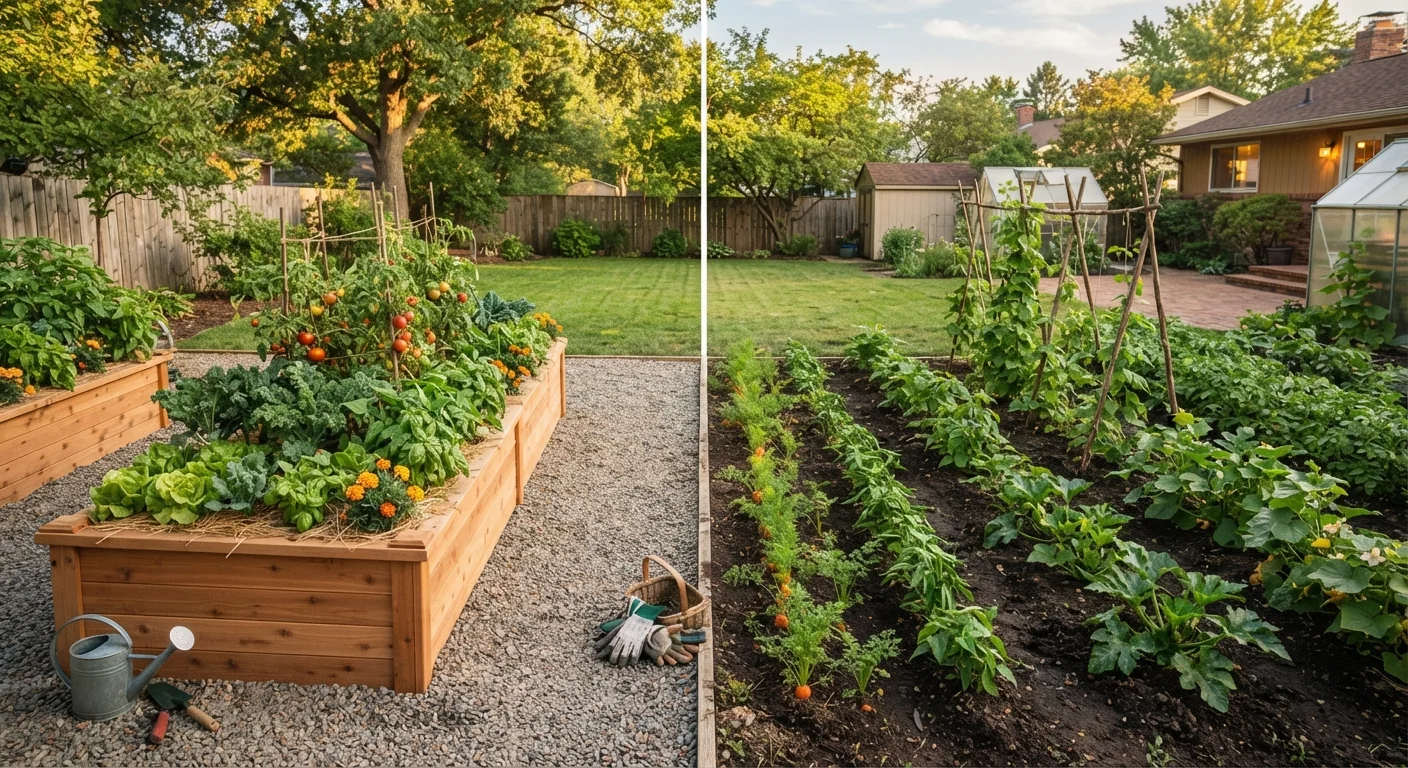
Option A
Raised Beds
The controlled, accessible, beginner-friendly setup.
Best for: Families with poor native soil, limited mobility, or a preference for tidy, defined growing spaces.
Option B
In-Ground Plots
The traditional, expansive, low-cost classic.
Best for: Families with healthy existing soil, larger planting ambitions, and a modest setup budget.
What You're Actually Choosing Between
At their core, raised beds and in-ground plots are simply two ways to organize growing space. A raised bed is a contained structure — typically framed with wood, metal, or composite material — filled with imported growing mix and positioned above your existing yard surface. An in-ground plot is a section of your actual yard soil that you prepare, amend, and plant directly into.
Neither is universally superior. The right choice depends almost entirely on what you're starting with: your native soil quality, your available space, your physical comfort, and how much you want to invest upfront. Before committing to either, it's worth understanding what each demands of you over time.
If you're completely new to home gardening, our first-season garden roadmap walks through the broader decisions you'll face before picking up a shovel.
| Criterion | Raised Beds | In-Ground Plots |
|---|---|---|
| Upfront cost | Moderate to high (materials + fill soil) | Low (tools and amendments only) |
| Soil control | Full — you choose the growing mix | Partial — depends on native soil quality |
| Drainage | Excellent by design | Varies with native soil type |
| Spring warm-up speed | Faster — soil heats earlier | Slower — ground takes longer to warm |
| Weed pressure | Generally lower | Higher, especially after tilling |
| Scalability | Limited by material cost | Easily expanded across yard space |
| Accessibility | High — reduced bending required | Lower — requires kneeling or bending |
| Long-term maintenance | Frame upkeep; soil replenishment | Annual compost addition; periodic tilling |
Soil Control, Drainage, and Growing Conditions
Soil quality is where the two setups diverge most sharply. With an in-ground plot, you inherit whatever your yard already contains. That could be productive loam or it could be dense clay that pools water after every rain. Understanding what you're working with matters — our guide to common garden soil types can help you identify what your yard holds and what it needs.
Raised beds sidestep native soil limitations entirely. You fill them with a custom blend — typically a mix of topsoil, compost, and a draining material like coarse sand or aged wood chips — designed to support plant roots from the start. This also means raised beds warm up faster in spring, which can give you a two- to four-week head start on planting in cooler climates.
In-ground plots can absolutely produce excellent growing conditions, but they often require upfront soil amendment: adding compost, adjusting pH, or breaking up compaction. That work is a one-time investment for most yards, but it's real labor worth planning for.
~6 inches
Minimum raised bed depth for most vegetables
University extension guidelines generally recommend at least 6 inches of growing medium for shallow-rooted crops, and 12 or more for deep-rooted vegetables like carrots or tomatoes.
2–4 weeks
Earlier planting potential in raised beds
Raised bed soil can warm several degrees faster than in-ground soil in early spring, potentially allowing earlier planting in colder U.S. climate zones.
4×8 ft
Most common starter raised bed footprint
This size is widely recommended by garden educators because it allows a gardener to reach the center from either side without stepping into the bed, protecting soil structure.
Cost, Setup, and Long-Term Maintenance
Setup cost is one of the clearest practical differences. An in-ground plot's main expenses are tools and amendments — a spade, compost, and perhaps a soil test. Raised beds add material and labor costs: framing boards or panels, fasteners, landscape fabric if you want a weed barrier underneath, and enough bulk growing mix to fill the structure. A single 4×8-foot bed can require several hundred pounds of fill material.
Over time, maintenance patterns shift. Raised beds tend to accumulate fewer weeds because you're not disturbing dormant weed seeds the way tilling does with in-ground soil. However, the contained volume of soil in a raised bed can dry out more quickly, meaning more frequent watering — something worth pairing with the right irrigation approach. Our comparison of drip irrigation versus sprinkler systems is a useful next step if you're planning your watering setup.
In-ground plots require periodic soil rejuvenation — adding compost each season — but they don't have the finite soil volume problem. They also don't carry structural maintenance: wooden raised bed frames can eventually rot, and even rot-resistant cedar typically needs replacement after several years.
Families thinking about long-term planting strategies should also factor in whether they plan to grow perennials alongside annuals. Understanding the difference between perennials and annuals affects how you plan and rotate space in either setup.
What About a Smaller Yard or Patio?
If your outdoor space is very limited, neither a full raised bed nor an in-ground plot may be your best starting point. Container gardening offers a flexible alternative that works on patios, balconies, and narrow side yards. Our container gardening guide covers how to select the right pots, soil, and plants for small-space growing.
The content provided on our blog site traverses numerous categories, offering readers valuable and practical information. Readers can use the editorial team’s research and data to gain more insights into their topics of interest. However, they are requested not to treat the articles as conclusive. The website team cannot be held responsible for differences in data or inaccuracies found across other platforms. Please also note that the site might also miss out on various schemes and offers available that the readers may find more beneficial than the ones we cover.