

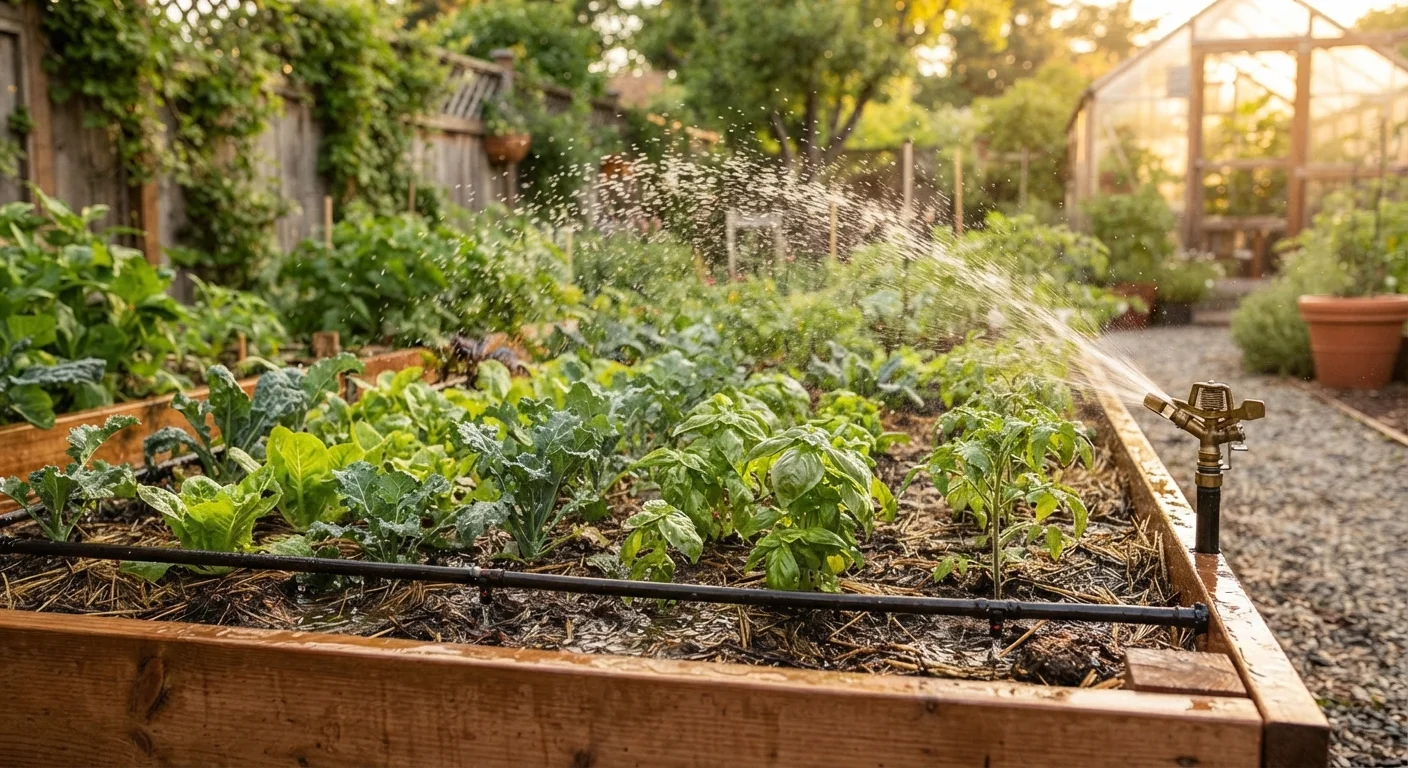
Option A
Drip Irrigation
The precise, water-efficient choice for targeted plant care.
Best for: Vegetable gardens, raised beds, and drought-sensitive landscapes where root-zone watering matters most.
Option B
Sprinkler Systems
The broad-coverage solution for lawns and open garden spaces.
Best for: Lawns, ground covers, and wide flower beds that need even surface watering across a large area.
How Each System Works
Understanding the mechanics of each system helps you match it to your garden's actual needs rather than guessing.
Drip irrigation uses a network of flexible tubing, emitters, and sometimes soaker hoses to deliver water slowly and directly to the base of each plant. Water seeps into the soil at a controlled rate, reaching root zones with minimal waste. Because water is never sprayed into the air, very little is lost to evaporation.
Sprinkler systems spray water over a wide area from fixed or rotating heads, mimicking rainfall. They can be in-ground (with pop-up heads connected to buried pipes) or above-ground (portable oscillating or rotating sprinklers). Coverage is broad and relatively uniform, which suits open spaces but is less targeted for individual plants.
If you're deciding between raised beds and in-ground plots, keep in mind that your bed type often influences which irrigation approach will be easiest to set up and maintain.
| Criterion | Drip Irrigation | Sprinkler Systems |
|---|---|---|
| Water delivery method | Slow, targeted at root zone | Broad spray over surface area |
| Water efficiency | High — minimal evaporation | Moderate — evaporation loss possible |
| Best use case | Vegetables, shrubs, raised beds | Lawns, open beds, ground covers |
| Installation complexity | Moderate — planning required | Low to high (portable vs. in-ground) |
| Foliage wetness | Stays dry — lower disease risk | Gets wet — can promote fungal issues |
| Weed suppression | Better — dry surface discourages weeds | Less effective — wet soil encourages weeds |
| Automation compatibility | Yes — works with timers | Yes — works with timers |
| Upfront cost range | Typically low to moderate | Low (portable) to high (in-ground) |
Water Efficiency and Plant Health
Water efficiency is often the deciding factor for families concerned about utility costs or living in regions with seasonal restrictions.
Drip systems direct water where it's needed, keeping the surface soil drier. That drier surface discourages weed germination and keeps foliage dry, which reduces the likelihood of common fungal problems like powdery mildew. For vegetable rows, herb gardens, and shrub beds, these are meaningful benefits. Our guide on growing herbs indoors and outdoors notes that consistent, targeted moisture is especially important for herbs that are sensitive to wet leaves.
Sprinklers, while less precise, are effective for turf grass and densely planted flower beds where surface moisture is acceptable. Their primary limitation is evaporation — water sprayed into warm air or bright sunlight can be lost before it reaches the ground. Watering in the early morning helps reduce this loss with either system.
Up to 50%
Water savings with drip vs. sprinklers
The U.S. Environmental Protection Agency (EPA) notes that drip irrigation can use up to 50% less water than conventional sprinkler systems in comparable garden settings.
30–50%
Outdoor water use lost to evaporation
According to the EPA's WaterSense program, as much as 30–50% of water applied by traditional sprinklers never reaches plant roots due to evaporation, wind, and runoff.
~9 billion gallons
Water used daily by U.S. households for landscaping
The EPA estimates that U.S. households collectively use roughly 9 billion gallons of water per day outdoors, with a significant portion applied inefficiently.
Setup, Cost, and Ongoing Maintenance
Neither system is inherently difficult to install, but the effort involved differs considerably.
Drip irrigation requires planning: you'll map out emitter placements for each plant, cut tubing to length, and connect a filter and pressure regulator at the water source. Starter kits are widely available and can be expanded over time. Once in place, the system needs periodic checks to clear clogged emitters and inspect for tubing damage from foot traffic or digging.
Sprinkler systems range from simple hose-end attachments to in-ground networks installed by a landscaping professional. In-ground systems involve trenching and generally require a permit in many municipalities — always check local codes before digging. Above-ground versions are much simpler and can be moved as your garden layout changes.
Both systems work well with automatic timers, which remove the daily task of remembering to water. This is a practical upgrade for busy households, and it also prevents the common mistake of overwatering — something garden myths often downplay.
Which Plants Benefit Most from Each System
Plant type, spacing, and growth habit all influence which irrigation approach fits best.
Drip irrigation works well for:
- Vegetable gardens (tomatoes, peppers, squash, cucumbers)
- Herb beds and raised planting boxes
- Shrubs, fruit trees, and perennial borders
- Container plantings connected to a drip line
Sprinklers work well for:
- Lawns and turf grass areas
- Densely seeded wildflower or annual beds
- Ground covers that spread across large spaces
- New seedings that need consistent surface moisture to germinate
If your garden includes a mix of perennials and seasonal plantings, consider which plants will stay in place long enough to justify a permanent drip layout. Our overview on perennials vs. annuals can help you think through planting permanence before committing to a fixed irrigation setup.
Check Local Water Restrictions First
Many U.S. municipalities have seasonal watering schedules or restrictions on the days and times you can irrigate. Some areas also offer rebates for homeowners who install drip systems as part of water-conservation programs. Contact your local water utility before investing in a new irrigation setup to understand any rules that apply to your property and whether financial incentives are available.
The content provided on our blog site traverses numerous categories, offering readers valuable and practical information. Readers can use the editorial team’s research and data to gain more insights into their topics of interest. However, they are requested not to treat the articles as conclusive. The website team cannot be held responsible for differences in data or inaccuracies found across other platforms. Please also note that the site might also miss out on various schemes and offers available that the readers may find more beneficial than the ones we cover.