

Our Verdict
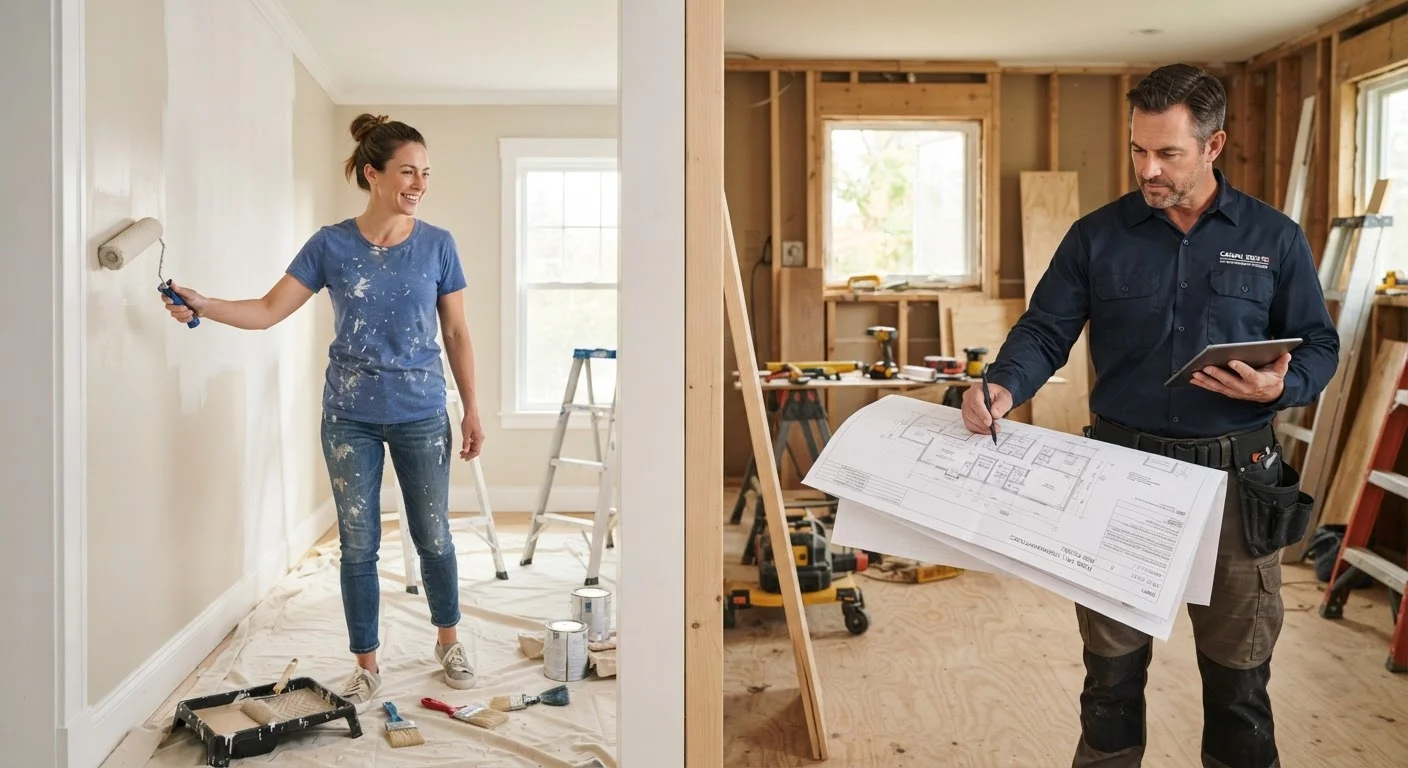
Neither DIY nor hiring a contractor is universally better. The right choice depends on the specific project's safety demands, permit requirements, your honest skill level, and the realistic time you can commit. Use each approach where it genuinely fits rather than defaulting to one out of habit or cost alone.
| Best for | Recommended |
|---|---|
| Cosmetic updates and low-complexity repairs | DIY |
| Electrical, structural, gas, or plumbing-into-mains work | Licensed contractor |
| Projects requiring permits and inspections | Licensed contractor |
| Prep work on larger professional jobs | Hybrid approach |
Why This Decision Matters More Than Cost Alone
Most homeowners frame the DIY-vs.-contractor question as a budget calculation. Labor costs money; doing it yourself saves money. That logic isn't wrong, but it's incomplete. A poorly executed repair can cost more to fix than hiring a professional from the start. And in categories like electrical, structural, or gas work, errors carry genuine safety consequences.
A more useful framework weighs four factors together: safety risk, permit and code requirements, your actual skill level, and project scope. Think of these as filters. A project that fails even one of the first two filters should generally go to a licensed professional. Projects that clear all four comfortably are strong DIY candidates.
For context on how this plays out in a different setting, the same structured thinking applies to vehicle care — see which car maintenance tasks are safe to handle at home for a parallel breakdown.
Filter 1 & 2: Safety Risk and Permit Requirements
These two filters are non-negotiable. Work involving electrical panels, load-bearing walls, gas lines, or connections to the main plumbing stack carries physical risk if performed incorrectly — and in most jurisdictions, such work requires a licensed trade professional by law.
Permits exist to protect you, not just to generate municipal revenue. When you skip a required permit, you may face fines, be required to tear out completed work for inspection, and — critically — create complications with homeowner's insurance or future home sales. Understanding what a building permit actually covers is essential before starting any project that touches structure, systems, or significant square footage.
Unpermitted Work Creates Real Liability
Completing work that legally requires a permit — without obtaining one — can void relevant portions of your homeowner's insurance, create disclosure obligations when selling the property, and potentially require the work to be demolished and redone to pass inspection. When in doubt about permit requirements, contact your local building department before starting, not after.
Renovation projects that involve removing walls add another layer of complexity. Load-bearing concerns alone can make what looks like a simple demo job into a structural engineering question. Our overview of open-plan home renovation tradeoffs covers why professional assessment matters here.
Filter 3 & 4: Skill Level and Project Scope
Once you've confirmed a project is legally and safely appropriate for a homeowner to attempt, evaluate your actual experience honestly — not your enthusiasm. Painting a room, replacing a faucet, installing trim, or laying a peel-and-stick tile floor are genuinely accessible tasks with forgiving learning curves. Hanging drywall, installing a pre-hung door, or tiling a shower surround sit in an intermediate range where technique matters and mistakes are harder to reverse.
Project scope also shapes the calculus. A single-day task you can abandon and restart with minimal consequence is very different from a multi-week project on which your household depends — a bathroom gut renovation, for example. Ask: What is the realistic cost if I make an error midway through? If the answer involves major rework, structural exposure to weather, or a non-functional bathroom for weeks, the risk profile shifts toward professional help.
Honest Self-Assessment Pays Off
Before starting any project, look up video walkthroughs for the specific task and ask yourself whether the steps shown are genuinely within your comfort zone — not just theoretically possible. If a step gives you pause, that's useful information. A realistic assessment upfront prevents costly mid-project decisions made under pressure.
Be wary of advice that implies skill or cost savings that don't account for reality. Common home improvement myths — like assuming primer is optional or that any adhesive will bond any surface — regularly lead DIYers into expensive corrections.
The Hybrid Approach: Splitting the Work Strategically
A frequently overlooked option is dividing a project between DIY and professional labor. This approach works especially well for larger jobs where a significant portion of the cost is prep work, demolition, painting, or clean-up — tasks that don't require a license but consume contractor time.
For example: you might handle demolition, debris removal, and finish painting yourself while a licensed electrician handles panel work and a plumber manages supply and drain connections. The contractor focuses on the hours that actually require their license; you contribute where your skills are adequate and the risk is manageable.
| DIY | Licensed Contractor | Hybrid Approach | |
|---|---|---|---|
| Typical cost | Materials only | Materials + labor | Reduced labor cost |
| Safety risk management | Homeowner's responsibility | Professional accountability | Shared by task type |
| Permit handling | Homeowner must research and file | Contractor typically manages | Varies by task split |
| Skill requirement | Beginner to intermediate | Professional licensed trade | Task-dependent |
| Time investment | High — owner does all work | Low — owner coordinates only | Moderate |
| Best project fit | Cosmetic, low-risk tasks | Structural, electrical, gas, plumbing | Large projects with separable tasks |
Before committing to any approach, get a clear picture of what the project actually involves. Scope creep — where a simple repair reveals a larger underlying problem — is common in home improvement. Build in a margin for the unexpected, whether that's time, budget, or the realistic option to call a professional if the job grows beyond your initial assessment.
The content provided on our blog site traverses numerous categories, offering readers valuable and practical information. Readers can use the editorial team’s research and data to gain more insights into their topics of interest. However, they are requested not to treat the articles as conclusive. The website team cannot be held responsible for differences in data or inaccuracies found across other platforms. Please also note that the site might also miss out on various schemes and offers available that the readers may find more beneficial than the ones we cover.