

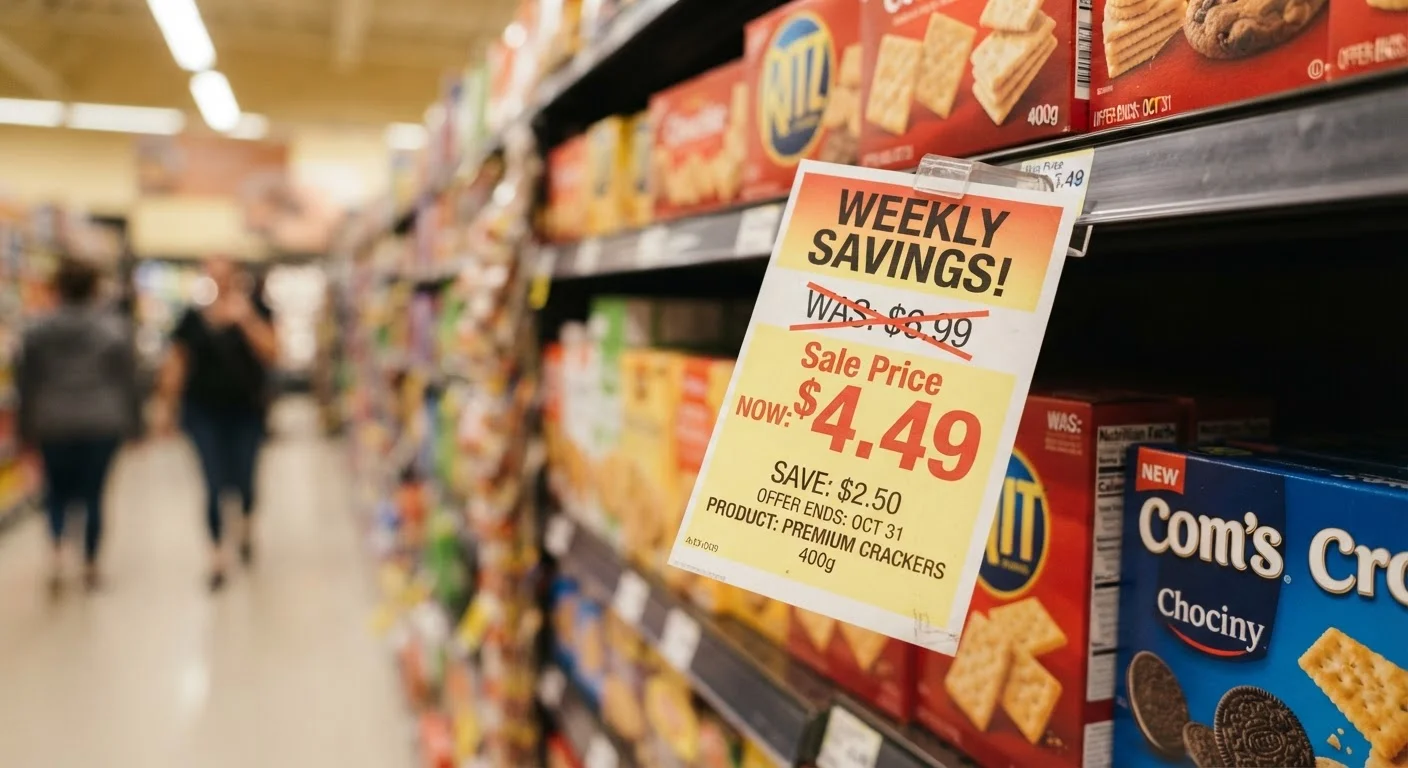
The Number You See First Changes Everything
Walk through any retail store or browse almost any e-commerce page, and you will spot the same pattern: a price shown in gray or with a strikethrough, followed by a bolder, lower number. This presentation is deliberate. Retailers know that the first price you register becomes a reference point — an anchor — that your brain uses to evaluate everything that comes after.
Behavioral economists call this the anchoring effect. When you see Was $120 / Now $79, you do not just evaluate whether $79 is a reasonable price for the item. You evaluate $79 relative to $120. That $41 gap feels like a win, even if $79 has been the item's price for months and the $120 figure was only briefly listed, if ever genuinely charged.
The anchor does not have to be realistic to work. Studies in consumer psychology show that people's price judgments shift significantly based on whatever number they encounter first — even when they are aware of the tactic.
“The mind does not evaluate price in a vacuum. It compares. And whatever number it has available becomes the yardstick — whether or not that number is meaningful.”
— Dan Ariely, Behavioral economist and author of 'Predictably Irrational'
How Retailers Set the Anchor
Anchor prices are not always drawn from actual transaction history. Common methods retailers use include:
- Manufacturer's Suggested Retail Price (MSRP): A figure that may never reflect what any shopper paid, used as a ceiling to make the shelf price look favorable.
- Brief high-price windows: Listing an item at a high price for a short period, then marking it down to a "sale" price that is actually the intended selling price. This practice sits in a legal gray zone and is subject to state-level consumer protection regulation.
- Comparison to higher-tier items: Showing the price of a premium model next to a standard model, implying the standard is a bargain by proximity.
Understanding these mechanics is not about distrust of every retailer — it is about recognizing that the framing of a price is a marketing decision, not a neutral fact. Our related piece on how reference pricing works covers the mechanics of inflated original prices in more detail.
Anchoring Is Legal — Up to a Point
Using a reference price in advertising is generally permitted under U.S. law, but the FTC's Guides Against Deceptive Pricing state that a "former price" must be one at which the product was actually offered to the public for a reasonably substantial period. Prices that were never genuinely charged, or were only offered briefly, can cross into deceptive territory. State attorneys general have pursued cases involving inflated reference prices, though enforcement and standards vary by state.
Breaking the Anchor's Hold Before You Buy
The most practical defense against anchoring is to redirect your attention from the comparison to the item itself. A few habits that help:
- Evaluate the sale price in isolation. Cover or ignore the "was" price and ask: Is this amount what I would willingly pay for this product if I had no reference point? If yes, it may genuinely suit your budget. If the answer is uncertain, the anchor may be doing the heavy lifting.
- Check price history before large purchases. Browser extensions and third-party tracking tools record historical prices for many products, especially in electronics, appliances, and home goods. Price history tools can reveal whether a "sale" is a genuine drop or just routine pricing with new packaging.
- Compare across contexts. A price that looks like a deal at one retailer may be the standard price everywhere else. Cross-checking takes two minutes and removes the anchor entirely.
Try the Blank-Anchor Test Before Buying
Before completing a purchase, mentally remove the "was" price from the equation and ask yourself: if I saw only the current price on a plain tag, with no comparison, would I still feel good about this purchase? If the answer is yes, the price likely holds up on its own merits. If the answer is uncertain, that is a signal to research further before committing.
For grocery and everyday essentials, unit pricing labels offer a reliable alternative benchmark — one that is standardized by regulation rather than set by marketing teams.
Why This Matters for Your Family's Budget
Anchoring is not a rare edge case. It is the dominant pricing presentation across retail — in-store, online, and in promotional emails. For families making dozens of purchasing decisions each month, the cumulative effect of responding to perceived discounts rather than actual value can be significant.
The goal is not to become a skeptic who never buys anything on sale. Genuine discounts exist, and timing purchases around them is a sound strategy. The goal is to make sure the "deal" feeling comes from the item's real value to your household, not from a number printed next to it that may have little grounding in reality.
Checking the patterns behind common retail tactics is a straightforward way to build that judgment over time, purchase by purchase.
This article is for general informational and educational purposes only. It does not constitute financial, legal, or consumer protection advice. Readers should verify applicable consumer protection laws in their state and consult relevant authorities with specific concerns.
Frequently Asked Questions
Anchor pricing itself is a legal and widely used retail practice. However, using a fabricated or misleading "original" price — one that was never genuinely offered for a meaningful period — can violate consumer protection laws in many U.S. states. The FTC has issued guidance on deceptive pricing, and enforcement varies by state.
Check the item's price history using a browser tool or third-party tracker before purchasing. If the "sale" price has been the normal price for months, the anchor is likely inflated. Also compare the price across different retailers rather than relying on a single store's reference point.
No — it is just as common online, and arguably more sophisticated there. E-commerce platforms can show personalized anchor prices, display limited-time "original" prices, and use countdown timers to amplify the urgency of the perceived deal.
Awareness of a cognitive bias does not fully eliminate its effect. Research in behavioral economics shows that even informed consumers are influenced by anchor numbers. Knowing about anchoring helps you slow down and apply deliberate checks, but the automatic mental comparison still happens.
Ask yourself: Would I consider this price fair if no original price were shown? Do I actually need this item, or am I responding to the perceived discount? Has the price been lower recently? These three questions redirect attention from the anchor to the item's actual value to you.
The content provided on our blog site traverses numerous categories, offering readers valuable and practical information. Readers can use the editorial team’s research and data to gain more insights into their topics of interest. However, they are requested not to treat the articles as conclusive. The website team cannot be held responsible for differences in data or inaccuracies found across other platforms. Please also note that the site might also miss out on various schemes and offers available that the readers may find more beneficial than the ones we cover.