

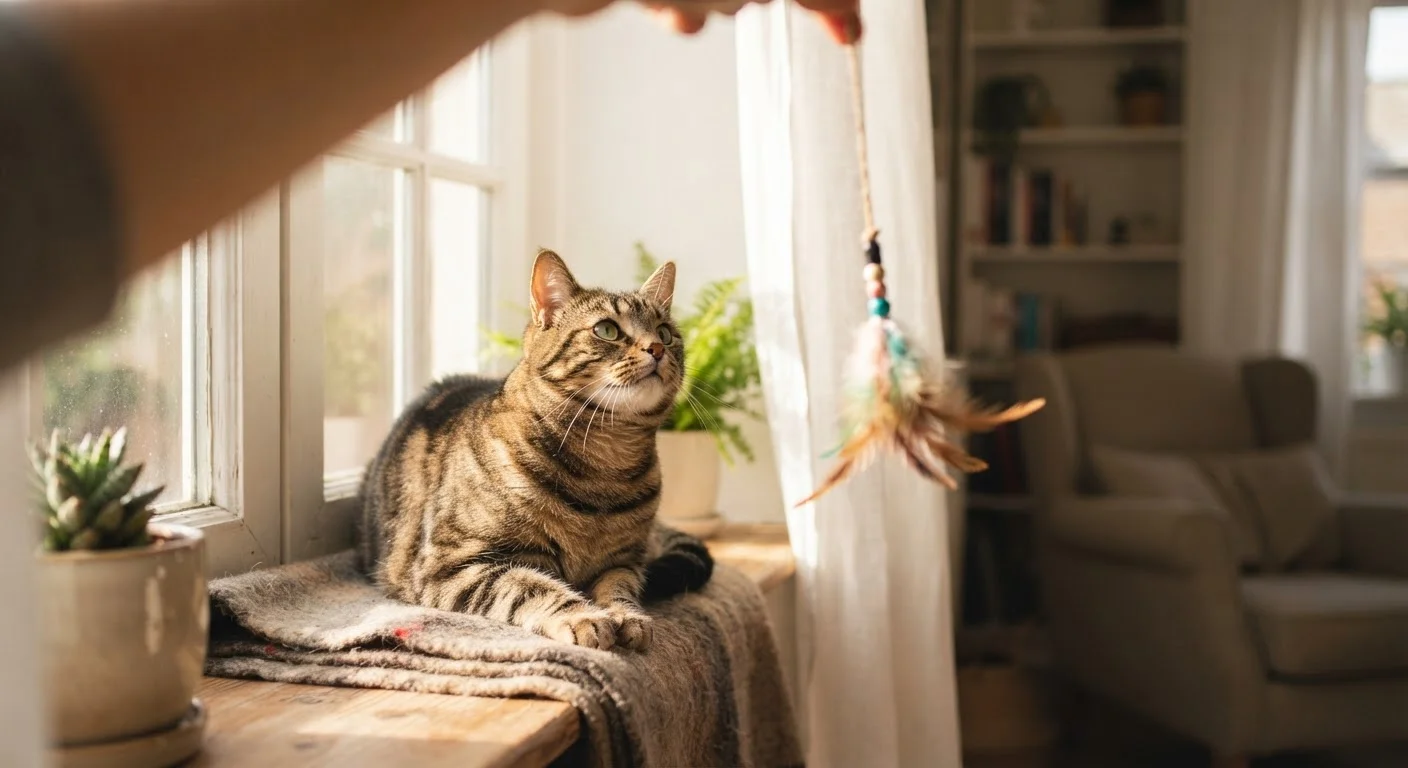
Why Mental Stimulation Matters for Indoor Cats
Indoor cats live longer, safer lives on average — but a life spent entirely indoors can also become repetitive without intentional enrichment. Cats are natural hunters wired for problem-solving, stalking, and exploring, and when those drives go unmet, the results often show up as scratching furniture, nighttime yowling, overeating, or anxious behavior.
If you've ever wondered why your cat knocks things off counters or ambushes your ankles, those behaviors usually signal a need for more engagement. Our article Why Cats Do That: Strange Behaviors Finally Explained takes a deeper look at the instincts behind these moments. The good news: enrichment doesn't have to be elaborate or time-consuming. Small, consistent efforts make a meaningful difference.
~40%
Indoor cats showing signs of boredom or stress
Veterinary behaviorists broadly estimate that a significant proportion of indoor cats exhibit at least one stress-related or boredom-linked behavior, such as over-grooming or destructive scratching.
5–10 min
Ideal length per play session
Feline behavior researchers generally recommend multiple short interactive play sessions daily to match a cat's natural hunt-rest cycle rather than one extended session.
Best Practices for Keeping Your Cat Mentally Engaged
The following practices are grounded in feline behavioral science and are practical enough for busy households. Mix and match based on your cat's personality — some cats are bold explorers while others prefer calm sensory variety.
Schedule two or three short play sessions each day rather than one long one.
Cats hunt in multiple short bursts naturally, so brief sessions of five to ten minutes better mirror their instinctive rhythm. Regular sessions also reinforce your bond and give you predictable windows to engage without needing large blocks of free time.
Rotate toys every few days to restore novelty.
Cats habituate quickly to stimuli that don't change — the toy that thrilled them on Monday may be ignored by Thursday. Storing toys out of sight and cycling them back in makes them feel new again, sustaining interest without additional expense.
Use food puzzles or foraging feeders at mealtimes.
Hunting for food is one of the most cognitively demanding things a wild cat does. Puzzle feeders replicate this by requiring problem-solving before the reward arrives, which channels mental energy productively and can slow fast eaters to a healthier pace.
Create vertical space and dedicated lookout points.
Cats feel safer and more confident when they can survey their environment from height. Vertical space — cat trees, wall-mounted shelves, or cleared window ledges — expands a cat's perceived territory significantly without increasing your home's footprint.
Introduce safe sensory enrichment through scent and sound.
A cat's sense of smell is estimated to be far more sensitive than a human's, making scent a powerful enrichment channel that owners often overlook. New, safe scents and ambient nature sounds can engage a resting cat without requiring active interaction.
Teach simple training exercises using positive reinforcement.
Most people assume training is only for dogs, but cats learn readily through reward-based methods. Teaching a cat to touch a target stick, sit on cue, or come when called builds cognitive engagement and strengthens the human-animal bond while giving the cat a sense of accomplishment.
Quick Enrichment Wins You Can Start Today
You don't need a major home overhaul to improve your cat's daily life. These simple actions deliver immediate enrichment benefits and fit naturally into a family routine.
For households that share their home with dogs as well, check out our guide on keeping a dog mentally stimulated on a busy schedule — many of the underlying principles overlap.
Make Enrichment a Family Habit
Assign different family members — including children old enough to handle toys safely — a daily play shift. Even a five-minute wand session from a ten-year-old counts as meaningful enrichment. Rotating responsibility also ensures your cat gets interaction throughout the day, not just in the evening. You can also check out our guide on cat-proofing your home to make sure the spaces your cat explores during enrichment time are safe.
Adjusting Enrichment as Your Cat Ages
Kittens and young adult cats typically have high play drive and tolerate more active stimulation. As cats move into their senior years — generally considered to begin around age ten — their energy levels, joint comfort, and sensory abilities change. Lower perches, gentler toys, and shorter play sessions become more appropriate. Puzzle feeders remain excellent for seniors because they engage the mind without demanding physical exertion.
Our article on caring for a senior cat covers how to adapt your routine as your cat ages. If you're weighing whether your cat's current lifestyle — fully indoor, outdoor access, or a mix — is meeting their needs, Indoor vs. Outdoor Cats offers a balanced look at the tradeoffs. Before making any major changes to your cat's environment or routine, especially for cats with known health conditions, it's worth a conversation with your veterinarian.
This article is for general informational purposes only and is not a substitute for professional veterinary advice. If your cat shows sudden behavioral changes, consult a licensed veterinarian.
The content provided on our blog site traverses numerous categories, offering readers valuable and practical information. Readers can use the editorial team’s research and data to gain more insights into their topics of interest. However, they are requested not to treat the articles as conclusive. The website team cannot be held responsible for differences in data or inaccuracies found across other platforms. Please also note that the site might also miss out on various schemes and offers available that the readers may find more beneficial than the ones we cover.